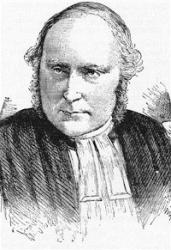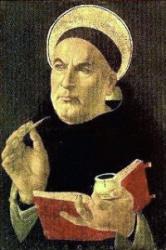
1225 - 1274 Person Name: Thomas Aquinas, 1225?-1274 Author (attributed to) of "Humbly I adore thee, Verity unseen" in The Hymnal 1982 Thomas of Aquino, confessor and doctor, commonly called The Angelical Doctor, “on account of," says Dom Gueranger, "the extraordinary gift of understanding wherewith God had blessed him," was born of noble parents, his father being Landulph, Count of Aquino, and his mother a rich Neapolitan lady, named Theodora. The exact date of his birth is not known, but most trustworthy authorities give it as 1227. At the age of five he was sent to the Benedictine monastery at Monte Cassino to receive his first training, which in the hands of a large-hearted and God-fearing man, resulted in so filling his mind with knowledge and his soul with God, that it is said the monks themselves would often approach by stealth to hear the words of piety and wisdom that fell from the lips of the precocious child when conversing with his companions. After remaining at Monte Cassino for seven years, engaged in study, St. Thomas, "the most saintly of the learned, and the most learned of the saints," returned to his family, in consequence of the sack of the abbey by the Imperial soldiers. From thence he was sent by his parents to the University of Naples then at the height of its prosperity, where, becoming intimate with the Fathers of the Dominican Order, and being struck, probably, by the devotedness and ability of the Dominican Professors in the University, he was induced to petition for admission into that order, though he was at that time not more than seventeen years of age. This step gave such umbrage to his mother that she caused him to be waylaid on the road to Paris (whither he was being hurried to escape from her), and to be kept for more than two years in prison, during which time his brothers, prompted by their mother, used all means, even the most infamous, to seduce him from religion.
At last the Dominicans' influence with the Pope induced the latter to move the Emperor Frederick to order his release, when St. Thomas was at once hurried back to Naples by the delighted members of his order. He was afterwards sent to Rome, then to Paris, and thence to Cologne. At Cologne his studies were continued under the celebrated Albertus Magnus, with whom, in 1245, he was sent by the Dominican Chapter once more to Paris for study, under his direction, at the University. In 1248, when he had completed his three years' curriculum at Paris, St. Thomas was appointed, before he was twenty-three years of age, second professor and “magister studentium,” under Albertus, as regent, at the new Dominican school (on the model of that at Paris), which was established by the Dominicans in that year at Cologne. There he achieved in the schools a great reputation as a teacher, though he by no means confined himself to such work. He preached and wrote; his writings, even at that early age, were remarkable productions and gave promise of the depth and ability which mark his later productions. His sermons also at that time enabled him to attract large congregations into the Dominican church. In 1248 he was directed to take his degree at Paris; and though his modesty and dislike of honour and distinction made the proposal distasteful to him, he set out and begged his way thither; but it was not until October 23rd, 1257, that he took his degree. The interval was filled by such labours in writing, lecturing, and preaching, as to enable him by the time he became a doctor to exercise an influence over the men and ideas of his time which we at this time can scarcely realise. So much was this the case that Louis IX. insisted upon St. Thomas becoming a member of his Council of State, and referred every question that came up for deliberation to him the night before, that he might reflect on it in solitude. At this time he was only thirty-two years of age.
In 1259 he was appointed, by the Dominican Chapter at Valenciennes, a member of a Commission, in company with Albertus Magnus and Pierre de Tarentaise, to establish order and uniformity in all schools of the Dominicans. In 1261 the Pope, Urban IV., immediately upon his election to the Pontifical throne, sent for St. Thomas to aid him in his project for uniting into one the Eastern and Western Churches. St. Thomas in that same year came to Rome, and was at once appointed by the General of his Order to a chair of theology in the Dominican College in that city, where he obtained a like reputation to that which he had secured already at Paris and Cologne. Pope Urban being anxious to reward his services offered him, first the Patriarchate of Jerusalem, and then a Cardinal's hat, but he refused both. After lecturing, at the request of the Pope, with great success at Vitervo, Orvieto, Perugia, and Fondi, he was sent, in 1263, as "Definitor," in the name of the Roman Province, to the Dominican Chapter held in London. Two years later Clement IV., who succeeded Urban as Pope, appointed him, by bull, to the archbishopric of Naples, conferring on him at the same time the revenues of the convent of St. Peter ad Aram. But this appointment he also declined. In 1269 he was summoned to Paris—his last visit— to act as "Definitor" of the Roman Province at the General Chapter of his Order, and he remained there until 1271, when his superiors recalled him to Bologna. In 1272, after visit¬ing Rome on the way, he went to Naples to lecture at the University. His reception in that city was an ovation. All classes came out to welcome him, while the King, Charles I., as a mark of royal favour bestowed on him a pension. He remained at Naples until he was summoned, in 1274, by Pope Gregory X., by special bull, to attend the Second Council of Lyons, but whilst on the journey thither he was called to his rest. His death took place in the Benedictine Abbey of Fossa Nuova in the diocese of Terracina, on the 7th of March 1274, being barely forty-eight years of age.
St. Thomas was a most voluminous writer, his principal work being the celebrated Summa Theologiae, which, although never completed, was accepted as such an authority as to be placed on a table in the council-chamber at the Council of Trent alongside of the Holy Scriptures and the Decrees of the Popes. But it is outside the province of this work to enlarge on his prose works. Though not a prolific writer of hymns, St. Thomas has contributed to the long list of Latin hymns some which have been in use in the services of the Church of Rome from his day to this. They are upon the subject of the Lord's Supper. The best known are:—
Pange lingua gloriosi Corporis Mysterium; Adoro te devote latens Deitas; Sacris sollemniis juncta sint gaudia; Lauda Sion Salvatorem; and Verbum supernum prodiens. The 1st, 3rd, and 5th of these are found in the Roman Breviary, the 2nd, 4th, and 5th in Newman's Hymni Ecclesiae; the 4th in the Roman Missal; all of them appear in Daniel; the 2nd and 4th in Mone; and the 2nd, 4th, and 5th in Königsfeld.
Of these hymns numerous translations have been made from time to time, and amongst the translators are found Caswall, Neale, Woodford, Morgan, and others. [Rev. Digby S. Wrangham, M.A.]
-- Excerpts from John Julian, Dictionary of Hymnology (1907)
Thomas Aquinas

 My Starred Hymns
 My FlexScores
 My Hymnals
 My Purchased Files