You help make Hymnary.org possible. More than 10 million people from 200+ countries found hymns, liturgical resources and encouragement on Hymnary.org in 2025, including you. Every visit affirms the global impact of this ministry.

If Hymnary has been meaningful to you this year, would you take a moment today to help sustain it? A gift of any size—paired with a note of encouragement if you wish—directly supports the server costs, research work and curation that keep this resource freely available to the world.

Give securely online today, or mail a check to:
Hymnary.org
Calvin University
3201 Burton Street SE
Grand Rapids, MI 49546

Thank you for your partnership, and may the hope of Advent fill your heart.

Search Results

Text Identifier:"^one_holy_church_of_god_appears$"

Planning worship? Check out our sister site, ZeteoSearch.org, for 20+ additional resources related to your search.

Texts

text icon
Text authorities

One holy Church of God appears

Author: Samuel Longfellow Meter: 8.6.8.6 Appears in 82 hymnals Topics: The Church Used With Tune: ST. STEPHEN Text Sources: Abridged

Tunes

tune icon
Tune authorities
Page scansAudio

NOX PRAECESSIT

Appears in 122 hymnals Composer and/or Arranger: J. B. Calkin Incipit: 33312 33421 35431 Used With Text: One holy church of God appears
Page scansAudio

HUMMEL

Appears in 128 hymnals Composer and/or Arranger: Charles Zeuner (1795-1857) Incipit: 51112 34354 3217 Used With Text: One holy Church of God appears
Audio

[One holy Church of God appears]

Appears in 901 hymnals Composer and/or Arranger: W. Croft Incipit: 53651 17151 5645 Used With Text: One holy Church of God appears

Instances

instance icon
Published text-tune combinations (hymns) from specific hymnals

One Holy Church of God Appears

Author: Samuel Longfellow; Tillit S. Teddlie Hymnal: Psalms, Hymns, and Spiritual Songs #371 (2012) Refrain First Line: There shall be one fold, one shepherd Languages: English Tune Title: [One holy church of God appears]
TextAudio

One Holy Church of God Appears

Author: Samuel Longfellow Hymnal: The Cyber Hymnal #5232 Meter: 8.6.8.6 Lyrics: 1. One holy Church of God appears Through every age and race, Unwasted by the lapse of years, Unchanged by changing place. 2. From oldest time, on farthest shores, Beneath the pine or palm, One unseen presence she adores, With silence, or with psalm. 3. The truth is her prophetic gift, The soul her sacred page; And feet on mercy’s errands swift Do make her pilgrimage. 4. O living Church, thine errand speed, Fulfill thy task sublime; With bread of life earth’s hungers feed; Redeem the evil time! Languages: English Tune Title: ST. JAMES

One holy Church of God appears

Author: Samuel Longfellow Hymnal: The Beacon Song and Service book #84 (1935) Meter: 8.6.8.6 Topics: The Church Languages: English Tune Title: ST. STEPHEN

People

person icon
Authors, composers, editors, etc.

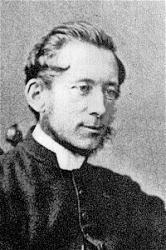
John Bacchus Dykes

1823 - 1876 Person Name: John B. Dykes Composer of "BEATITUDO" in Songs of the Christian Life As a young child John Bacchus Dykes (b. Kingston-upon-Hull' England, 1823; d. Ticehurst, Sussex, England, 1876) took violin and piano lessons. At the age of ten he became the organist of St. John's in Hull, where his grandfather was vicar. After receiving a classics degree from St. Catherine College, Cambridge, England, he was ordained in the Church of England in 1847. In 1849 he became the precentor and choir director at Durham Cathedral, where he introduced reforms in the choir by insisting on consistent attendance, increasing rehearsals, and initiating music festivals. He served the parish of St. Oswald in Durham from 1862 until the year of his death. To the chagrin of his bishop, Dykes favored the high church practices associated with the Oxford Movement (choir robes, incense, and the like). A number of his three hundred hymn tunes are still respected as durable examples of Victorian hymnody. Most of his tunes were first published in Chope's Congregational Hymn and Tune Book (1857) and in early editions of the famous British hymnal, Hymns Ancient and Modern. Bert Polman

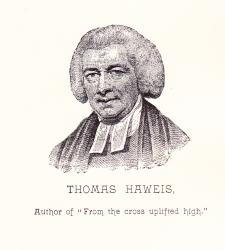
Thomas Haweis

1734 - 1820 Person Name: T. Haweis Composer of "CHESTERFIELD" in Common Praise Thomas Haweis (b. Redruth, Cornwall, England, 1734; d. Bath, England, 1820) Initially apprenticed to a surgeon and pharmacist, Haweis decided to study for the ministry at Oxford and was ordained in the Church of England in 1757. He served as curate of St. Mary Magdalen Church, Oxford, but was removed by the bishop from that position because of his Methodist leanings. He also was an assistant to Martin Madan at Locke Hospital, London. In 1764 he became rector of All Saints Church in Aldwinkle, Northamptonshire, and later served as administrator at Trevecca College, Wales, a school founded by the Countess of Huntingdon, whom Haweis served as chaplain. After completing advanced studies at Cambridge, he published a Bible commentary and a volume on church history. Haweis was strongly interested in missions and helped to found the London Mission Society. His hymn texts and tunes were published in Carmino Christo, or Hymns to the Savior (1792, expanded 1808). Bert Polman ============================ Haweis, Thomas, LL.B., M.D., born at Truro, Cornwall, 1732. After practising for a time as a Physician, he entered Christ's College, Cambridge, where he graduated. Taking Holy Orders, he became Assistant Preacher to M. Madan at the Lock Hospital, London, and subsequently Rector of All Saints, Aldwincle, Northamptonshire. He was also Chaplain to Lady Huntingdon, and for several years officiated at her Chapel in Bath. He died at Bath, Feb. 11, 1820. He published several prose works, including A History of the Church, A Translation of the New Testament, and A Commentary on the Holy Bible. His hymns, a few of which are of more than ordinary merit, were published in his Carmina Christo; or, Hymns to the Saviour. Designed for the Use and Comfort of Those who worship the Lamb that was slain. Bath, S. Hayward, 1792 (139 hymns), enlarged. London, 1808 (256 hymns). In 1794, or sometime after, but before the enlarged edition was published, two hymns "For the Fast-day, Feb. 28, 1794," were added to the first edition. These were, "Big with events, another year," and "Still o'er the deep the cannon's roar." The most popular and widely used of his hymns are, "Behold the Lamb of God, Who bore," &c.; "Enthroned on high, Almighty Lord"; and “O Thou from Whom all goodness flows." The rest, all being from Carmina Christo, first edition 1792, are:— 1. Dark was the night and cold the ground. Gethsemane. 2. From the cross uplifted high. Christ in Glory. 3. Great Spirit, by Whose mighty power. Whitsuntide. 4. Submissive to Thy will, my God. Resignation. 5. The happy morn is come. Easter. 6. Thou Lamb of God, that on the tree. Good Friday. The hymn, "Thy Head, the crown of thorns that wears," in Stryker & Main's Church Praise Book, N. Y., 1882, begins with st. ii. of this hymn. 7. To Thee, my God and Saviour, My heart, &c. Praise for Redemption. --John Julian, Dictionary of Hymnology (1907)

William Gardiner

1770 - 1853 Person Name: W. Gardiner Composer of "DEDHAM" in Jubilate Deo William Gardiner (b. Leicester, England, 1770; d. Leicester, 1853) The son of an English hosiery manufacturer, Gardiner took up his father's trade in addition to writing about music, composing, and editing. Having met Joseph Haydn and Ludwig van Beethoven on his business travels, Gardiner then proceeded to help popularize their compositions, especially Beethoven's, in England. He recorded his memories of various musicians in Music and Friends (3 volumes, 1838-1853). In the first two volumes of Sacred Melodies (1812, 1815), Gardiner turned melodies from composers such as Haydn, Mozart, and Beethoven into hymn tunes in an attempt to rejuvenate the singing of psalms. His work became an important model for American editors like Lowell Mason (see Mason's Boston Handel and Haydn Collection, 1822), and later hymnbook editors often turned to Gardiner as a source of tunes derived from classical music. Bert Polman
It looks like you are using an ad-blocker. Ad revenue helps keep us running. Please consider white-listing Hymnary.org or getting Hymnary Pro to eliminate ads entirely and help support Hymnary.org.