You help make Hymnary.org possible. More than 10 million people from 200+ countries found hymns, liturgical resources and encouragement on Hymnary.org in 2025, including you. Every visit affirms the global impact of this ministry.

If Hymnary has been meaningful to you this year, would you take a moment today to help sustain it? A gift of any size—paired with a note of encouragement if you wish—directly supports the server costs, research work and curation that keep this resource freely available to the world.

Give securely online today, or mail a check to:
Hymnary.org
Calvin University
3201 Burton Street SE
Grand Rapids, MI 49546

Thank you for your partnership, and may the hope of Advent fill your heart.

Search Results

Text Identifier:"^seems_it_in_my_anguish_lone$"

Planning worship? Check out our sister site, ZeteoSearch.org, for 20+ additional resources related to your search.

Texts

text icon
Text authorities

Seems it in my anguish lone

Author: Catherine Winkworth, 1827-1878; Christoph Titius Appears in 9 hymnals

Tunes

tune icon
Tune authorities
Page scansAudio

WEBER (Seymour)

Appears in 672 hymnals Composer and/or Arranger: Carl Maria von Weber; Henry Wellington Greatorex Tune Key: F Major Incipit: 32436 53233 33471 Used With Text: Seems it in my anguish lone

Instances

instance icon
Published text-tune combinations (hymns) from specific hymnals
TextPage scan

Seems it in my anguish lone

Author: Titius, d. 1703 Hymnal: Chorale Book for England, The #146 (1863) Lyrics: Seems it in my anguish lone, As though God forsook His own, Yet I hold this knowledge fast, God will surely help at last. Though awhile it be delay'd, He denieth not His aid; Though it come not oft with speed, It will surely come at need. As a father not too soon Grants his child the long'd-for boon, So our God gives when He will; Wait His leisure and be still. I can rest in thoughts of Him, When all courage else grows dim, For I know my soul shall prove His is more than father's love. Would the powers of ill affright, I can smile at all their might; Or the cross be pressing sore, God, my God, lives evermore! Man may hate me causelessly, Man may plot to ruin me, Foes my heart may pierce and rend; God in heaven is still my Friend. Earth may all her gifts deny, Safe my treasure still on high, And if heaven at last be mine, All things else I can resign. I renounce thee willingly, World, I hate what pleases thee, Baneful every gift of thine, Only be my God still mine. Ah Lord, if but Thee I have, Nought of other good I crave, Bright is even death's dark road, If but Thou art there, my God. Languages: English
TextPage scan

Seems it in my anguish lone

Hymnal: Evangelical Lutheran Hymnal. 9th ed. #a412 (1895) Lyrics: 1 Seems it in my anguish lone, As though God forsook His own, Yet I hold this knowledge fast, God will surely help at last. 2 Though awhile it be delayed, He denieth not His aid; Though it come not oft with speed, It will surely come in need. 3 As a father not too soon Grants his child the longed-for boon, So our God gives when He will; Wait His pleasure and be still. 4 I can rest in thoughts of Him, When all courage else grows dim, For I know my soul shall prove His is more than father's love. 5 Would the powers of ill affright, I can smile at all their might; Or the cross be pressing sore, God, my God, lives evermore! 6 Man may hate me causelessly, Man may plot to ruin me, Foes my heart may piecer and rend: God in heaven is still my Friend. 7 Earth may all her gifts deny, Safe my treasure is on high; And if heaven at last be mine, All things else I can resign. 8 I renounce thee willingly, World, I hate what pleases thee, Baneful every gift of thine, Only be my God still mine. 9 Ah Lord, if but Thee I have, Nought of other good I crave, Bright is even death's dark road, If but Thou art there, my God. Topics: Christian Life and Hope ; The Walk of Godliness Cross and Consolation Languages: English
TextPage scan

Seems it in my anguish lone

Hymnal: Evangelical Lutheran Hymn-book #360 (1893) Lyrics: 1 SEEMS it in my anguish lone, As though God forsook His own, Yet I hold the knowledge fast, God will surely help at last. 2 Though awhile it be delayed, He denieth not His aid; Though it come not oft with speed, It will surely come at need. 3 As a father not too soon Grants his child the longed-for boon, So our God gives when He will; Wait His pleasure and be still. 4 I can rest in thoughts of Him, When all courage else grows dim, For I know my soul shall prove His is more than father's love. 5 Would the powers of ill affright. I can smile at all their might; Or the cross be pressing sore, God, my God, lives evermore! 6 Man may hate me causelessly, Man my plot to ruin me, Foes my heart may pierce and rend; God in heaven is still my Friend. 7 Earth against me may declare, For her love I do not care; Though the world bear me a grudge, God my Father is my Judge. 8 Earth may all her gifts deny, Safe my treasure is on high; And if heaven at last be mine, All things else I can resign. 9 I renounce thee willingly, World, I hate what pleases thee; Baneful every gift of thine, Only be my God still mine. 10 Ah! Lord, if but Thee I have, Naught of other good I crave, Bright is even death's dark road, If but Thou art there, my God! Topics: The Cross and Comfort Languages: English

People

person icon
Authors, composers, editors, etc.

Catherine Winkworth

1827 - 1878 Translator of "Seems it in my anguish lone" in Evangelical Lutheran hymnal Catherine Winkworth (b. Holborn, London, England, 1827; d. Monnetier, Savoy, France, 1878) is well known for her English translations of German hymns; her translations were polished and yet remained close to the original. Educated initially by her mother, she lived with relatives in Dresden, Germany, in 1845, where she acquired her knowledge of German and interest in German hymnody. After residing near Manchester until 1862, she moved to Clifton, near Bristol. A pioneer in promoting women's rights, Winkworth put much of her energy into the encouragement of higher education for women. She translated a large number of German hymn texts from hymnals owned by a friend, Baron Bunsen. Though often altered, these translations continue to be used in many modern hymnals. Her work was published in two series of Lyra Germanica (1855, 1858) and in The Chorale Book for England (1863), which included the appropriate German tune with each text as provided by Sterndale Bennett and Otto Goldschmidt. Winkworth also translated biographies of German Christians who promoted ministries to the poor and sick and compiled a handbook of biographies of German hymn authors, Christian Singers of Germany (1869). Bert Polman ======================== Winkworth, Catherine, daughter of Henry Winkworth, of Alderley Edge, Cheshire, was born in London, Sep. 13, 1829. Most of her early life was spent in the neighbourhood of Manchester. Subsequently she removed with the family to Clifton, near Bristol. She died suddenly of heart disease, at Monnetier, in Savoy, in July, 1878. Miss Winkworth published:— Translations from the German of the Life of Pastor Fliedner, the Founder of the Sisterhood of Protestant Deaconesses at Kaiserworth, 1861; and of the Life of Amelia Sieveking, 1863. Her sympathy with practical efforts for the benefit of women, and with a pure devotional life, as seen in these translations, received from her the most practical illustration possible in the deep and active interest which she took in educational work in connection with the Clifton Association for the Higher Education of Women, and kindred societies there and elsewhere. Our interest, however, is mainly centred in her hymnological work as embodied in her:— (1) Lyra Germanica, 1st Ser., 1855. (2) Lyra Germanica, 2nd Ser., 1858. (3) The Chorale Book for England (containing translations from the German, together with music), 1863; and (4) her charming biographical work, the Christian Singers of Germany, 1869. In a sympathetic article on Miss Winkworth in the Inquirer of July 20, 1878, Dr. Martineau says:— "The translations contained in these volumes are invariably faithful, and for the most part both terse and delicate; and an admirable art is applied to the management of complex and difficult versification. They have not quite the fire of John Wesley's versions of Moravian hymns, or the wonderful fusion and reproduction of thought which may be found in Coleridge. But if less flowing they are more conscientious than either, and attain a result as poetical as severe exactitude admits, being only a little short of ‘native music'" Dr. Percival, then Principal of Clifton College, also wrote concerning her (in the Bristol Times and Mirror), in July, 1878:— "She was a person of remarkable intellectual and social gifts, and very unusual attainments; but what specially distinguished her was her combination of rare ability and great knowledge with a certain tender and sympathetic refinement which constitutes the special charm of the true womanly character." Dr. Martineau (as above) says her religious life afforded "a happy example of the piety which the Church of England discipline may implant.....The fast hold she retained of her discipleship of Christ was no example of ‘feminine simplicity,' carrying on the childish mind into maturer years, but the clear allegiance of a firm mind, familiar with the pretensions of non-Christian schools, well able to test them, and undiverted by them from her first love." Miss Winkworth, although not the earliest of modern translators from the German into English, is certainly the foremost in rank and popularity. Her translations are the most widely used of any from that language, and have had more to do with the modern revival of the English use of German hymns than the versions of any other writer. -- John Julian, Dictionary of Hymnology (1907) ============================ See also in: Hymn Writers of the Church

H. W. Greatorex

1813 - 1858 Person Name: Henry Wellington Greatorex Arranger of "WEBER (Seymour)" in Evangelical Lutheran hymnal Henry Wellington Greatorex United Kingdom 1813-1858. Born at Burton upon Trent, England, he received a thorough musical education from his father, Thomas Greatorex, who was for many years organist of Westminster Abbey, and conductor of the London concerts of ancient music. Henry became a composer, author, compiler, editor, and arranger of music. He emigrated to the U.S. In 1839. In 1849 he married artist Eliza Pratt, and they had four children: Elizabeth, Kathleen, Thomas, and Francis Henry. Prior to settling in New York City as a music teacher and organist at Calvary Church, he played at churches in Hartford, CT, including Center Church and St Johns Episcopal Church in West Hartford, CT. He frequently sang in oratorios and concerts. For some years he was also organist and conductor of the choir at St. Paul's Chapel. In 1853 he was an organist at St. Philip's Episcopal Church in Charleston, SC. He did much to advance the standard of sacred music in the U.S. In days when country singing school teachers imposed more rudimentary melodies on hymn books. He published a collection of “Psalm & hymn tunes, chants, anthems & sentences” (Boston 1851). He died of yellow fever in Charleston, SC. John Perry

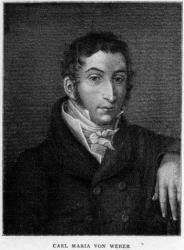
Carl Maria von Weber

1786 - 1826 Composer of "WEBER (Seymour)" in Evangelical Lutheran hymnal Carl Maria von Weber; b. 1786, Oldenburg; d. 1826, London Evangelical Lutheran Hymnal, 1908
It looks like you are using an ad-blocker. Ad revenue helps keep us running. Please consider white-listing Hymnary.org or getting Hymnary Pro to eliminate ads entirely and help support Hymnary.org.