

 My Starred Hymns
 My FlexScores
 My Hymnals
 My Purchased Files
Planning worship?
Check out our sister site, ZeteoSearch.org,
for 20+ additional resources related to your search.
- |
User Links
Search Results


When I behold my bleeding God
Appears in 4 hymnals Lyrics: 1 When I behold my bleeding God,
Each Mountain seems a Plain;
But if I e'er forget his Blood,
The Mountains rise again.
2 What means my inbred Sense, so rude,
To war against my Peace?
Or why should Reason bold intrude
Upon a Saviour's Grace?
3 What tho' my Senses loudly say,
I have nor Faith, nor Love;
Nor am I in the living Way
That leads to Realms above?
4 What if to increase still my Grief,
It summons Lust and Pride,
Hardness of Heart, and Unbelief,
And all my Ills beside:
5 And, from the Whole, would witness this,
Thou art devoid of Grace;
How canst thou hope, in Worlds of Bliss,
To see the Saviour's Face?
6 To this, the Witness of my Lord,
(Greater than all in me),
Replies, in his unerring Word,
The Saviour's Grace is free.
7 The Man who works not, but believes
On him who justifies
Ungodly Souls, in Christ receives
The Life that never dies.
8 Our Saviour full Atonement made,
When for our sins he dy'd;
And, when he left Death's gloomy Shade,
Our Persons justify'd.
9 Who shall condemn? 'twas Jesus dy'd,
'Twas Jesus rose again;
He with himself hat justify'd
The sinful Sons of Men.
10 In Hope of what in Christ I am,
Rejoicing, I believe,
Against my hopeless Guilt and Shame,
And thus, by Faith, I live.
Scripture: Romans 4:18
When I behold my bleeding God

When I behold my bleeding God
Hymnal: Christian Hymns, Poems, and Spiritual Songs #I.LVI (1776) Lyrics: 1 When I behold my bleeding God,
Each Mountain seems a Plain;
But if I e'er forget his Blood,
The Mountains rise again.
2 What means my inbred Sense, so rude,
To war against my Peace?
Or why should Reason bold intrude
Upon a Saviour's Grace?
3 What tho' my Senses loudly say,
I have nor Faith, nor Love;
Nor am I in the living Way
That leads to Realms above?
4 What if to increase still my Grief,
It summons Lust and Pride,
Hardness of Heart, and Unbelief,
And all my Ills beside:
5 And, from the Whole, would witness this,
Thou art devoid of Grace;
How canst thou hope, in Worlds of Bliss,
To see the Saviour's Face?
6 To this, the Witness of my Lord,
(Greater than all in me),
Replies, in his unerring Word,
The Saviour's Grace is free.
7 The Man who works not, but believes
On him who justifies
Ungodly Souls, in Christ receives
The Life that never dies.
8 Our Saviour full Atonement made,
When for our sins he dy'd;
And, when he left Death's gloomy Shade,
Our Persons justify'd.
9 Who shall condemn? 'twas Jesus dy'd,
'Twas Jesus rose again;
He with himself hat justify'd
The sinful Sons of Men.
10 In Hope of what in Christ I am,
Rejoicing, I believe,
Against my hopeless Guilt and Shame,
And thus, by Faith, I live.
Scripture: Romans 4:18 Languages: English
When I behold my bleeding God
When I behold my bleeding God
Hymnal: Evangelical Psalms, Hymns, and Spiritual Songs #16 (1792) Languages: English
When I behold my bleeding God
When I behold my bleeding God
Author: James Relly Hymnal: Psalms, Hymns and Spiritual Songs #194 (1808)
When I behold my bleeding God


James Relly
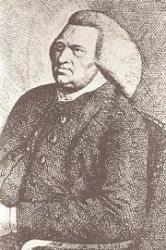
1722 - 1778 Author of "The Lord Jesus Christ, who is our Hope" James Relly was born about 1722 at Jeffreston, Pembrokeshire, Wales, and died in 1778. He was converted to Christianity during the Great Awakening ushered in by George Whitefield. He worked under George Whitefield as a Calvinistic Methodist preacher and missionary. However, Whitefield and Relly separated ways over Relly's seemingly universalist teaching that all humanity was elect (i.e. saved) when Christ took the punishment for all sin when he died. He also departed from both the Calvinists and Methodists by taking the doctrine of Justification further, in teaching that believers no longer sin and the Law's sole purpose is to condemn humanity and point them to Christ.
He was the mentor of John Murray, the founder of the Universalist Church of America. Relly along with his brother John wrote Christian Hymns, Poems and Spiritual Songs in 1758, which John Murray had republished in America in 1776.
Dianne Shapiro; from an article by Alexander Gordon in Dictionary of National Biography, 1885-1900, vol. 48; Dictionary of Unitarian and Universalist Biography; and Disoriented. Reoriented. blog (https://disorientedtheology.wordpress.com/2013/08/29/all-shall-be-well-chapter-6-james-relly/)
James Relly




