You help make Hymnary.org possible. More than 10 million people from 200+ countries found hymns, liturgical resources and encouragement on Hymnary.org in 2025, including you. Every visit affirms the global impact of this ministry.

If Hymnary has been meaningful to you this year, would you take a moment today to help sustain it? A gift of any size—paired with a note of encouragement if you wish—directly supports the server costs, research work and curation that keep this resource freely available to the world.

Give securely online today, or mail a check to:
Hymnary.org
Calvin University
3201 Burton Street SE
Grand Rapids, MI 49546

Thank you for your partnership, and may the hope of Advent fill your heart.

Search Results

Text Identifier:"^whoeer_would_win_the_battle$"

Planning worship? Check out our sister site, ZeteoSearch.org, for 20+ additional resources related to your search.

Texts

text icon
Text authorities
Page scans

Whoe'er Would Win the Battle

Appears in 9 hymnals First Line: Whoe'er would win the battle Must never mind the blows Refrain First Line: Then take up all the armor, The helmet and the sword Used With Tune: [Whoe'er would win the battle]

Tunes

tune icon
Tune authorities
Page scansAudio

[Whoe'er would win the battle] (Converse)

Appears in 3 hymnals Composer and/or Arranger: Karl Reden Incipit: 11234 55343 46511 Used With Text: Battle for the Lord
Page scans

[Whoe'er would win the battle]

Appears in 3 hymnals Composer and/or Arranger: W. H. Whitehead Incipit: 11234 51651 43211 Used With Text: Whoe'er Would Win the Battle

Instances

instance icon
Published text-tune combinations (hymns) from specific hymnals
Page scan

Whoe'er Would Win the Battle

Hymnal: The New Canadian Hymnal #142 (1916) First Line: Whoe'er would win the battle Must never mind the blows Refrain First Line: Then take up all the armor, The helmet and the sword Topics: Brotherhood; Work and Service Tune Title: [Whoe'er would win the battle]
Page scan

Whoe'er Would Win the Battle

Hymnal: The New Canadian Hymnal #142 (1921) First Line: Whoe'er would win the battle Must never mind the blows Refrain First Line: Then take up all the armor, The helmet and the sword Languages: English Tune Title: [Whoe'er would win the battle]
TextPage scanAudio

Battle for the Lord

Author: Rev. M. S. Savage Hymnal: Calvary Songs #120 (1875) First Line: Whoe'er would win the battle Refrain First Line: I'll battle for the Lord Lyrics: 1 Whoe'er would win the battle, Must never mind the blows; Whoe'er would enter heaven, Must not turn back for foes; But, taking all the armor, The helmet and the sword, I'll shout for Truth and Victory, And battle for the Lord. Refrain: I'll battle for the Lord, Yes, battle for the Lord; I'll shout for Truth and Victory And battle for the Lord. 2 God's little bands are mighty, When girded with his might; And greatest wrongs are helpless Before the smallest right. Then, taking all the armor, The helmet and the sword, I'll shout for Truth and Victory, And battle for the Lord. [Refrain] 3 Your enemies may gather, Like clouds in days of storms; But Truth's bright blade, like lightning, Shall scatter their proud forms, Then, taking all the armor, The helmet and the sword, I'll shout for Truth and Victory, And battle for the Lord. [Refrain] 4 The wrongs shall all be conquered, And every foe submit; All, in that day that's coming, Shall fall at Jesus' feet. But now, take all the armor, The helmet and the sword, And shout for Truth and Victory, And battle for the Lord. [Refrain] Languages: English Tune Title: [Whoe'er would win the battle] (Converse)

People

person icon
Authors, composers, editors, etc.

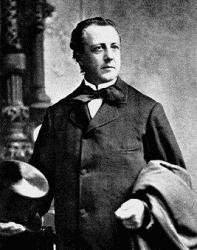
Charles C. Converse

1832 - 1918 Person Name: C. C. Converse Composer of "[Whoe'er would win the battle]" in Gathered Jewels Pseudonyms: Clare, Lester Vesé, Nevers, Karl Re­den, Revons ================================= Charles Crozat Converse LLD USA 1832-1918. Born in Warren, MA, he went to Leipzig, Germany to study law and philosophy, as well as music theory and composition under Moritz Hauptmann, Friedrich Richter, and Louis Plaidy at the Leipzig Conservatory. He also met Franz Liszt and Louis Spohr. He became an author, composer, arranger and editor. He returned to the states in 1859 and graduated from the Albany, NY, Law School two years later. He married Lida Lewis. From 1875 he practiced law in Erie, PA, and also was put in charge of the Burdetta Organ Company. He composed hymn tunes and other works. He was offered a DM degree for his Psalm 126 cantata, but he declined the offer. In 1895 Rutherford College honored him with a LLD degree. He spent his last years in Highwood, NJ, where he died. He published “New method for the guitar”, “Musical bouquet”, “The 126th Psalm”, “Sweet singer”, “Church singer”, “Sayings of Sages” between 1855 and 1863. he also wrote the “Turkish battle polka” and “Rock beside the sea” ballad, and “The anthem book of the Episcopal Methodist Church”. John Perry

Karl Reden

Composer of "[Whoe'er would win the battle] (Converse)" in Calvary Songs See Converse, Charles C. (Charles Crozat), 1832-1918

M. S. Savage

Person Name: Rev. M. S. Savage Author of "Battle for the Lord" in Calvary Songs
It looks like you are using an ad-blocker. Ad revenue helps keep us running. Please consider white-listing Hymnary.org or getting Hymnary Pro to eliminate ads entirely and help support Hymnary.org.