

 My Starred Hymns
 My Hymnals
 My Purchased Files
Planning worship?
Check out our sister site, ZeteoSearch.org,
for 20+ additional resources related to your search.
- |
User Links
Search Results


Father of mercies, in Thy Word
Meter: 8.6.8.6 Appears in 770 hymnals Topics: The Word and the Church Glory of the Word Lyrics: 1 FATHER of mercies, in Thy Word
What endless glory shines!
For ever be Thy name adored
For these celestial lines.
2 Here the Redeemer's welcome voice
Spreads heavenly peace around;
And life and everlasting joys
Attend the blissful sound.
3 O may these heavenly pages be
My ever dear delight;
And still new beauties may I see,
And still increasing light!
6 Divine Instructor, gracious Lord!
Be Thou forever near;
Teach me to love Thy sacred Word,
And view my Saviour there.
Father of mercies, in Thy Word
Awake, Thou Spirit, who didst fire
Appears in 38 hymnals Topics: The Word and the Church Mission Lyrics: 1 AWAKE, Thou Spirit, who didst fire
The watchmen of the Church’s youth,
Who faced the foe’s envenomed ire,
Who witnessed day and night Thy truth
Whose voices loud are ringing still,
And bringing hosts to know Thy will.
2 Lord let our earnest prayer be heard,
The prayer Thy Son hath bid us pray,
For lo, thy children’s hearts are stirred
In every land in this our day,
To cry with fervent soul to Thee,
O help us, Lord! So let it be!
3 Oh, haste to help, ere we are lost!
Send preachers forth, in spirit strong,
Armed with Thy Word, a dauntless host,
Bold to attack the rule of wrong;
Let them the earth for Thee reclaim,
Thy heritage, to know Thy name.
4 Would there were help within our walls!
O let Thy spirit come again,
Before whom every barrier falls,
And now once more shine forth as then!
O rend the heavens and make us free!
Come, Lord, and bring us back to Thee!
5 And let Thy Word have speedy course,
Through every land be glorified,
Till all the heathen know its force,
And fill Thy churches far and wide;
Wake Israel from his sleep, O Lord,
And spread the conquest of Thy Word!
6 The Church's desert paths restore;
Let stumbling-blocks that in them lie
Hinder Thy Word henceforth no more:
Error destroy, and heresy,
And let Thy Church, from hirelings free,
Bloom as a garden fair to Thee!
Awake, Thou Spirit, who didst fire
O Christ, our true and only Light
Meter: 8.8.8.8 Appears in 95 hymnals Topics: The Word and the Church Mission Lyrics: 1 O Christ, our true and only Light,
Enlighten those who sit in night;
Let those afar now hear Thy voice,
And in Thy fold with us rejoice.
2 Fill with the radiance of Thy grace
The souls now lost in error's maze,
And all whom in their secret minds
Some dark delusion haunts and blinds.
3 And all who else have strayed from Thee,
O gently seek! Thy healing be
To every wounded conscience given,
And let them also share Thy heaven.
4 O make the deaf to hear Thy Word,
And teach the dumb to speak, dear Lord,
Who dare not yet the faith avow,
Though secretly they hold it now.
5 Shine on the darkened and the cold,
Recall the wanderers from Thy fold,
Unite all those who walk apart,
Confirm the weak and doubting heart.
6 So they with us may evermore
Such grace with wondering thanks adore,
And endless praise to Thee be given
by all Thy Church in earth and heaven.
O Christ, our true and only Light


ITALIAN HYMN
Meter: 6.6.4.6.6.6.4 Appears in 1,478 hymnals Composer and/or Arranger: Felice de Giardini (1716-1796); David Evans (1874-1948) Topics: The Holy Spirit in the Church Enlivening and Renewing the Church; The Being of God Holy and One; God In Creation; God in Trinity; Gospel Call; Healing; Word of God Tune Sources: Harmony adapted Church Hymnary, Fourth Edition, 2005 Tune Key: G Major Incipit: 53121 71123 45432 Used With Text: God, whose almighty word
ITALIAN HYMN

ALL SAINTS NEW
Meter: 8.6.8.6 D Appears in 615 hymnals Composer and/or Arranger: Henry S. Cutler Topics: Biblical Names and Places Melchizedek; Biblical Names and Places Zion; Church Year Ascension of the Lord; Church Year Baptism of the Lord; Church Year Christ the King; Church Year Epiphany; God as King; God's Sovereignty; God's Word; God's Justice; Royal Psalms Tune Key: B Flat Major Incipit: 53451 17712 34322 Used With Text: The LORD unto My Lord Has Said
ALL SAINTS NEW
GENEVAN 68
Meter: 8.8.7.8.8.7 D Appears in 136 hymnals Topics: Biblical Names and Places Bashon; Biblical Names and Places Benjamin; Biblical Names and Places Egypt; Biblical Names and Places Ethiopia; Biblical Names and Places Israel; Biblical Names and Places Jerusalem; Biblical Names and Places Judah; Biblical Names and Places Naphtali; Biblical Names and Places Sinai; Biblical Names and Places Zalmon; Biblical Names and Places Zebulun; Church Year Ascension of the Lord; Church Year Christ the King; Church Year Christmas; Church Year Easter; Church Year Pentecost; Emmaus Road; Enemies; Freedom; God Daily Experience of; God as Shepherd; God as Creator; God as Judge; God as King; God's Sovereignty; God's Wisdom; God's Word; God's Friendship; God's Gifts; God's Justice; God's law; God's Love; God's Name; God's People (flock, sheep); God's Presence; God's Promise of Redemption; God's Strength; Grave; Hymns of Praise; Jesus Christ Friend of Sinners; Jesus Christ Good Shepherd; Joy; Judgment; Life Stages Orphans; Life Stages Widows; Mission; Musical Instruments; Occasional Services Funerals; Peace; Processions; Questioning; Temple; Ten Commandments 4th Commandment (remember the Sabbath); The Needy; War and Revolution; Year A, Easter, 7th Sunday Tune Key: D Major Incipit: 11231 34554 32134 Used With Text: Approach Our God with Songs of Praise
GENEVAN 68


Hark! the Church proclaims her honor
Hymnal: Evangelical Lutheran Hymn-book #412 (1893) Meter: 8.7 Topics: The Word and the Church Protection of Lyrics: 1 HARK! the Church proclaims her honor,
And her strength is only this:
God hath laid his choice upon her,
And the work she doth is His.
2 He His Church has firmly founded,
He will guard what He began;
We by sin and foes surrounded,
Build her bulwarks as we can.
3 Frail and fleeting are our powers,
Short our days, our foresight dim,
And we own the choice not ours,
We were chosen first by Him.
4 Onward, then! for nought despairing,
Calm we follow at His Word,
Thus through joy and sorrow bearing
Faithful witness to our Lord.
5 Though we here must strive in weakness,
Though in tears we often bend,
What His might began in meekness
Shall achieve a glorious end.
Languages: English
Hark! the Church proclaims her honor
Awake, Thou Spirit, who didst fire
Hymnal: Evangelical Lutheran Hymn-book #408 (1893) Topics: The Word and the Church Mission Lyrics: 1 AWAKE, Thou Spirit, who didst fire
The watchmen of the Church’s youth,
Who faced the foe’s envenomed ire,
Who witnessed day and night Thy truth
Whose voices loud are ringing still,
And bringing hosts to know Thy will.
2 Lord let our earnest prayer be heard,
The prayer Thy Son hath bid us pray,
For lo, thy children’s hearts are stirred
In every land in this our day,
To cry with fervent soul to Thee,
O help us, Lord! So let it be!
3 Oh, haste to help, ere we are lost!
Send preachers forth, in spirit strong,
Armed with Thy Word, a dauntless host,
Bold to attack the rule of wrong;
Let them the earth for Thee reclaim,
Thy heritage, to know Thy name.
4 Would there were help within our walls!
O let Thy spirit come again,
Before whom every barrier falls,
And now once more shine forth as then!
O rend the heavens and make us free!
Come, Lord, and bring us back to Thee!
5 And let Thy Word have speedy course,
Through every land be glorified,
Till all the heathen know its force,
And fill Thy churches far and wide;
Wake Israel from his sleep, O Lord,
And spread the conquest of Thy Word!
6 The Church's desert paths restore;
Let stumbling-blocks that in them lie
Hinder Thy Word henceforth no more:
Error destroy, and heresy,
And let Thy Church, from hirelings free,
Bloom as a garden fair to Thee! Languages: English
Awake, Thou Spirit, who didst fire
Father of mercies, in Thy Word
Hymnal: Evangelical Lutheran Hymn-book #117 (1918) Meter: 8.6.8.6 Topics: The Word and the Church Glory of the Word Lyrics: 1 Father of mercies, in Thy Word
What endless glory shines!
Forever be Thy Name adored
For these celestial lines.
2 Here the Redeemer's welcome voice
Spreads heavenly peace around;
And life and everlasting joys
Attend the blissful sound.
3 O may these heavenly pages be
My ever dear delight;
And still new beauties may I see,
And still increasing light!
4 Divine Instructor, gracious Lord!
Be Thou forever near;
Teach me to love Thy sacred Word,
And view my Savior there. Languages: English
Father of mercies, in Thy Word


Isaac Watts
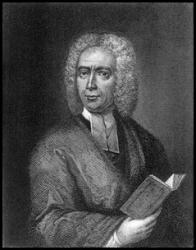
1674 - 1748 Person Name: Isaac Watts (1674-1748) Topics: The Word of God; Church Universal; Creation; Creation and the Environment; Light; Scripture; Truth; Wisdom Author of "The heavens declare thy glory, Lord" in Ancient and Modern Isaac Watts was the son of a schoolmaster, and was born in Southampton, July 17, 1674. He is said to have shown remarkable precocity in childhood, beginning the study of Latin, in his fourth year, and writing respectable verses at the age of seven. At the age of sixteen, he went to London to study in the Academy of the Rev. Thomas Rowe, an Independent minister. In 1698, he became assistant minister of the Independent Church, Berry St., London. In 1702, he became pastor. In 1712, he accepted an invitation to visit Sir Thomas Abney, at his residence of Abney Park, and at Sir Thomas' pressing request, made it his home for the remainder of his life. It was a residence most favourable for his health, and for the prosecution of his literary labours. He did not retire from ministerial duties, but preached as often as his delicate health would permit.
The number of Watts' publications is very large. His collected works, first published in 1720, embrace sermons, treatises, poems and hymns. His "Horae Lyricae" was published in December, 1705. His "Hymns" appeared in July, 1707. The first hymn he is said to have composed for religious worship, is "Behold the glories of the Lamb," written at the age of twenty. It is as a writer of psalms and hymns that he is everywhere known. Some of his hymns were written to be sung after his sermons, giving expression to the meaning of the text upon which he had preached. Montgomery calls Watts "the greatest name among hymn-writers," and the honour can hardly be disputed. His published hymns number more than eight hundred.
Watts died November 25, 1748, and was buried at Bunhill Fields. A monumental statue was erected in Southampton, his native place, and there is also a monument to his memory in the South Choir of Westminster Abbey. "Happy," says the great contemporary champion of Anglican orthodoxy, "will be that reader whose mind is disposed, by his verses or his prose, to imitate him in all but his non-conformity, to copy his benevolence to men, and his reverence to God." ("Memorials of Westminster Abbey," p. 325.)
--Annotations of the Hymnal, Charles Hutchins, M.A., 1872.
=================================
Watts, Isaac, D.D. The father of Dr. Watts was a respected Nonconformist, and at the birth of the child, and during its infancy, twice suffered imprisonment for his religious convictions. In his later years he kept a flourishing boarding school at Southampton. Isaac, the eldest of his nine children, was born in that town July 17, 1674. His taste for verse showed itself in early childhood. He was taught Greek, Latin, and Hebrew by Mr. Pinhorn, rector of All Saints, and headmaster of the Grammar School, in Southampton. The splendid promise of the boy induced a physician of the town and other friends to offer him an education at one of the Universities for eventual ordination in the Church of England: but this he refused; and entered a Nonconformist Academy at Stoke Newington in 1690, under the care of Mr. Thomas Rowe, the pastor of the Independent congregation at Girdlers' Hall. Of this congregation he became a member in 1693.
Leaving the Academy at the age of twenty, he spent two years at home; and it was then that the bulk of the Hymns and Spiritual Songs (published 1707-9) were written, and sung from manuscripts in the Southampton Chapel. The hymn "Behold the glories of the Lamb" is said to have been the first he composed, and written as an attempt to raise the standard of praise. In answer to requests, others succeeded. The hymn "There is a land of pure delight" is said to have been suggested by the view across Southampton Water. The next six years of Watts's life were again spent at Stoke Newington, in the post of tutor to the son of an eminent Puritan, Sir John Hartopp; and to the intense study of these years must be traced the accumulation of the theological and philosophical materials which he published subsequently, and also the life-long enfeeblement of his constitution.
Watts preached his first sermon when he was twenty-four years old. In the next three years he preached frequently; and in 1702 was ordained pastor of the eminent Independent congregation in Mark Lane, over which Caryl and Dr. John Owen had presided, and which numbered Mrs. Bendish, Cromwell's granddaughter, Charles Fleetwood, Charles Desborough, Sir John Hartopp, Lady Haversham, and other distinguished Independents among its members. In this year he removed to the house of Mr. Hollis in the Minories. His health began to fail in the following year, and Mr. Samuel Price was appointed as his assistant in the ministry. In 1712 a fever shattered his constitution, and Mr. Price was then appointed co-pastor of the congregation which had in the meantime removed to a new chapel in Bury Street. It was at this period that he became the guest of Sir Thomas Abney, under whose roof, and after his death (1722) that of his widow, he remained for the rest of his suffering life; residing for the longer portion of these thirty-six years principally at the beautiful country seat of Theobalds in Herts, and for the last thirteen years at Stoke Newington. His degree of D.D. was bestowed on him in 1728, unsolicited, by the University of Edinburgh. His infirmities increased on him up to the peaceful close of his sufferings, Nov. 25, 1748. He was buried in the Puritan restingplace at Bunhill Fields, but a monument was erected to him in Westminster Abbey.
His learning and piety, gentleness and largeness of heart have earned him the title of the Melanchthon of his day. Among his friends, churchmen like Bishop Gibson are ranked with Nonconformists such as Doddridge. His theological as well as philosophical fame was considerable. His Speculations on the Human Nature of the Logos, as a contribution to the great controversy on the Holy Trinity, brought on him a charge of Arian opinions. His work on The Improvement of the Mind, published in 1741, is eulogised by Johnson. His Logic was still a valued textbook at Oxford within living memory. The World to Come, published in 1745, was once a favourite devotional work, parts of it being translated into several languages. His Catechisms, Scripture History (1732), as well as The Divine and Moral Songs (1715), were the most popular text-books for religious education fifty years ago. The Hymns and Spiritual Songs were published in 1707-9, though written earlier. The Horae Lyricae, which contains hymns interspersed among the poems, appeared in 1706-9. Some hymns were also appended at the close of the several Sermons preached in London, published in 1721-24. The Psalms were published in 1719. The earliest life of Watts is that by his friend Dr. Gibbons. Johnson has included him in his Lives of the Poets; and Southey has echoed Johnson's warm eulogy. The most interesting modern life is Isaac Watts: his Life and Writings, by E. Paxton Hood. [Rev. H. Leigh Bennett, M.A.]
A large mass of Dr. Watts's hymns and paraphrases of the Psalms have no personal history beyond the date of their publication. These we have grouped together here and shall preface the list with the books from which they are taken.
(l) Horae Lyricae. Poems chiefly of the Lyric kind. In Three Books Sacred: i.To Devotion and Piety; ii. To Virtue, Honour, and Friendship; iii. To the Memory of the Dead. By I. Watts, 1706. Second edition, 1709. (2) Hymns and Spiritual Songs. In Three Books: i. Collected from the Scriptures; ii. Composed on Divine Subjects; iii. Prepared for the Lord's Supper. By I. Watts, 1707. This contained in Bk i. 78 hymns; Bk. ii. 110; Bk. iii. 22, and 12 doxologies. In the 2nd edition published in 1709, Bk. i. was increased to 150; Bk. ii. to 170; Bk. iii. to 25 and 15 doxologies. (3) Divine and Moral Songs for the Use of Children. By I. Watts, London, 1715. (4) The Psalms of David Imitated in the Language of the New Testament, And apply'd to the Christian State and Worship. By I. Watts. London: Printed by J. Clark, at the Bible and Crown in the Poultry, &c, 1719. (5) Sermons with hymns appended thereto, vol. i., 1721; ii., 1723; iii. 1727. In the 5th ed. of the Sermons the three volumes, in duodecimo, were reduced to two, in octavo. (6) Reliquiae Juveniles: Miscellaneous Thoughts in Prose and Verse, on Natural, Moral, and Divine Subjects; Written chiefly in Younger Years. By I. Watts, D.D., London, 1734. (7) Remnants of Time. London, 1736.
454 Hymns and Versions of the Psalms, in addition to the centos are all in common use at the present time.
--Excerpts from John Julian, Dictionary of Hymnology (1907)
==================================
Watts, I. , p. 1241, ii. Nearly 100 hymns, additional to those already annotated, are given in some minor hymn-books.
--John Julian, Dictionary of Hymnology, Appendix, Part II (1907)
=================
Watts, I. , p. 1236, i. At the time of the publication of this Dictionary in 1892, every copy of the 1707 edition of Watts's Hymns and Spiritual Songs was supposed to have perished, and all notes thereon were based upon references which were found in magazines and old collections of hymns and versions of the Psalms. Recently three copies have been recovered, and by a careful examination of one of these we have been able to give some of the results in the revision of pp. 1-1597, and the rest we now subjoin.
i. Hymns in the 1709 ed. of Hymns and Spiritual Songs which previously appeared in the 1707 edition of the same book, but are not so noted in the 1st ed. of this Dictionary:—
On pp. 1237, L-1239, ii., Nos. 18, 33, 42, 43, 47, 48, 60, 56, 58, 59, 63, 75, 82, 83, 84, 85, 93, 96, 99, 102, 104, 105, 113, 115, 116, 123, 124, 134, 137, 139, 146, 147, 148, 149, 162, 166, 174, 180, 181, 182, 188, 190, 192, 193, 194, 195, 197, 200, 202.
ii. Versions of the Psalms in his Psalms of David, 1719, which previously appeared in his Hymns and Spiritual Songs, 1707:—
On pp. 1239, U.-1241, i., Nos. 241, 288, 304, 313, 314, 317, 410, 441.
iii. Additional not noted in the revision:—
1. My soul, how lovely is the place; p. 1240, ii. 332. This version of Ps. lxiv. first appeared in the 1707 edition of Hymns & Spiritual Songs, as "Ye saints, how lovely is the place."
2. Shine, mighty God, on Britain shine; p. 1055, ii. In the 1707 edition of Hymns & Spiritual Songs, Bk. i., No. 35, and again in his Psalms of David, 1719.
3. Sing to the Lord with [cheerful] joyful voice, p. 1059, ii. This version of Ps. c. is No. 43 in the Hymns & Spiritual Songs, 1707, Bk. i., from which it passed into the Ps. of David, 1719.
A careful collation of the earliest editions of Watts's Horae Lyricae shows that Nos. 1, 7, 9, 10, 11, 12, 14, 16, p. 1237, i., are in the 1706 ed., and that the rest were added in 1709. Of the remaining hymns, Nos. 91 appeared in his Sermons, vol. ii., 1723, and No. 196 in Sermons, vol. i., 1721. No. 199 was added after Watts's death. It must be noted also that the original title of what is usually known as Divine and Moral Songs was Divine Songs only.
--John Julian, Dictionary of Hymnology, New Supplement (1907)
===========
See also in:
Hymn Writers of the Church
Isaac Watts
John Bacchus Dykes
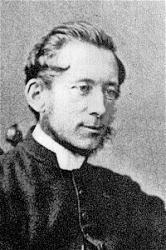
1823 - 1876 Person Name: John Bacchus Dykes, 1823-1876 Topics: God: His Attributes, Works and Word The Holy Trinity; God: His Attributes, Works and Word The Holy Spirit; The Church The Sanctuary; The Christian Life Penitence and Faith Composer of "RIVAULX" in The Book of Praise As a young child John Bacchus Dykes (b. Kingston-upon-Hull' England, 1823; d. Ticehurst, Sussex, England, 1876) took violin and piano lessons. At the age of ten he became the organist of St. John's in Hull, where his grandfather was vicar. After receiving a classics degree from St. Catherine College, Cambridge, England, he was ordained in the Church of England in 1847. In 1849 he became the precentor and choir director at Durham Cathedral, where he introduced reforms in the choir by insisting on consistent attendance, increasing rehearsals, and initiating music festivals. He served the parish of St. Oswald in Durham from 1862 until the year of his death. To the chagrin of his bishop, Dykes favored the high church practices associated with the Oxford Movement (choir robes, incense, and the like). A number of his three hundred hymn tunes are still respected as durable examples of Victorian hymnody. Most of his tunes were first published in Chope's Congregational Hymn and Tune Book (1857) and in early editions of the famous British hymnal, Hymns Ancient and Modern.
Bert Polman
John Bacchus Dykes
Henri F. Hemy
1818 - 1888 Person Name: Henri Frederick Hemy Topics: Church in the World D; Brotherhood/Sisterhood; Calling and Response; Church Community in Christ; Commitment; Confirmation; Courage; Faith; Faithfulness; Freedom; Heritage; Jesus Christ Cross; Joy; Men; Nation; Oppression; Sacrifice; Saints; Suffering; Trials; Trust; Unity; Witness; Women; Word of God; World; Zeal; Lent 2 Year A; Proper 5 Year A; Proper 8 Year A; Proper 14 Year A; Proper 24 Year A; Proper 10 Year B; Proper 16 Year B; Lent 2 Year C; Proper 14 Year C; Proper 15 Year C; Proper 21 Year C; All Saints Year C; New Year Year ABC Composer of "ST CATHERINE" in Voices United Henri F. Hemy, born in the United Kingdom. Hemy spent time at sea as a young man, emigrating to Australia in 1850 with his family. Unable to make a decent living in Melbourne, he returned to Newcastle England. He was organist at St. Andrews Roman Catholic Church in Newcastle, later teaching professor of music at Tynemouth and at St. Cuthbert's College in Durham. He was pianist to Lord Ravensworth, Music Director of Ushaw College, and his orchestra played at fashionable venues in the region. He sang baritone as well. He composed waltzes, polkas, quadrilles, and galops. 3 music works: Easy Hymn Tunes for Catholic Schools; Royal Modern Tutor for Pianoforte; Crown of Jesus. He was active in local politics and published a manifesto in the daily newspaper. He lost a ward election. He also painted artwork. He set most of Longfellow's works to music.
John Perry
Henri F. Hemy





