

 My Starred Hymns
 My FlexScores
 My Hymnals
 My Purchased Files
Planning worship?
Check out our sister site, ZeteoSearch.org,
for 20+ additional resources related to your search.
- |
User Links
Person Results
Louis Bourgeois
1510 - 1561 Composer of "OLD HUNDREDTH" in The Service Song Book Louis Bourgeois (b. Paris, France, c. 1510; d. Paris, 1561). In both his early and later years Bourgeois wrote French songs to entertain the rich, but in the history of church music he is known especially for his contribution to the Genevan Psalter. Apparently moving to Geneva in 1541, the same year John Calvin returned to Geneva from Strasbourg, Bourgeois served as cantor and master of the choristers at both St. Pierre and St. Gervais, which is to say he was music director there under the pastoral leadership of Calvin. Bourgeois used the choristers to teach the new psalm tunes to the congregation.
The extent of Bourgeois's involvement in the Genevan Psalter is a matter of scholarly debate. Calvin had published several partial psalters, including one in Strasbourg in 1539 and another in Geneva in 1542, with melodies by unknown composers. In 1551 another French psalter appeared in Geneva, Eighty-three Psalms of David, with texts by Marot and de Beze, and with most of the melodies by Bourgeois, who supplied thirty four original tunes and thirty-six revisions of older tunes. This edition was republished repeatedly, and later Bourgeois's tunes were incorporated into the complete Genevan Psalter (1562). However, his revision of some older tunes was not uniformly appreciated by those who were familiar with the original versions; he was actually imprisoned overnight for some of his musical arrangements but freed after Calvin's intervention. In addition to his contribution to the 1551 Psalter, Bourgeois produced a four-part harmonization of fifty psalms, published in Lyons (1547, enlarged 1554), and wrote a textbook on singing and sight-reading, La Droit Chemin de Musique (1550). He left Geneva in 1552 and lived in Lyons and Paris for the remainder of his life.
Bert Polman
Louis Bourgeois
Thomas Ken
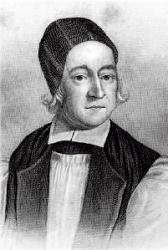
1637 - 1711 Author of "Old Hundredth" in The Service Song Book Thomas Ken (b. Berkampstead, Hertfordshire, England, 1637; d. Longleat, Wiltshire, England, 1711) studied at Winchester College, Hart Hall, and New College, Oxford, England. Ordained in the Church of England in 1662, he served variously as pastor, chaplain at Winchester College (1669-1679), chaplain to Princess (later Queen) Mary in The Hague, and bishop of Bath and Wells (1685-1691). He was a man of conscience and independent mind who did not shirk from confrontations with royalty. When King Charles II came to visit Winchester, he took along his mistress, the famous actress Nell Gwynne. Ken was asked to provide lodging for her. The story is told that Ken quickly declared his house under repair and had a builder take off the roof! He later was dismissed from the court at The Hague when he protested a case of immorality. Then, later in 1688, Bishop Ken refused to read King James II's Declaration of Indulgence in the churches, which granted greater religious freedom in England, and he was briefly imprisoned in the Tower of London. A few years later he refused to swear allegiance to King William, and he lost his bishopric.
Ken wrote many hymns, which were published posthumously in 1721 and republished in 1868 as Bishop Ken's Christian Year, or Hymns and Poems for the Holy Days and Festivals of the Church. But he is best known for his morning, evening, and midnight hymns, each of which have as their final stanza the famous doxology “Praise God, from Whom All Blessings Flow.”
Bert Polman
===============
Ken, Thomas, D.D. The bare details of Bishop Ken's life, when summarised, produce these results:—-Born at Berkhampstead, July, 1637; Scholar of Winchester, 1651; Fellow of New College, Oxford, 1657; B.A., 1661; Rector of Little Easton, 1663; Fellow of Winchester, 1666; Rector of Brighstone, 1667; Rector of Woodhay and Prebendary of Winchester, 1669; Chaplain to the Princess Mary at the Hague, 1679; returns to Winchester, 1680; Bishop of Bath and Wells, 1685; imprisoned in the Tower, 1688; deprived, 1691; died at Longleat, March 19, 1711.
The parents of Ken both died during his childhood, and he grew up under the guardianship of Izaak Walton, who had married Ken's elder sister, Ann. The dominant Presbyterianism of Winchester and Oxford did not shake the firm attachment to the English Church, which such a home had instilled. His life until the renewal of his connection with Winchester, through his fellowship, his chaplaincy to Morley (Walton's staunch friend, then bishop of Winchester), and his prebend in the Cathedral, calls for no special remark here. But this second association with Winchester, there seems little doubt, originated his three well-known hymns. In 1674 he published A Manual of Prayers for the Use of the Scholars of Winchester College, and reference is made in this book to three hymns, for "Morning," "Midnight," and "Evening," the scholars being recommended to use them. It can scarcely be questioned that the Morning, Evening, and Midnight hymns, published in the 1695 edition of The Manual, are the ones referred to. He used to sing these hymns to the viol or spinet, but the tunes he used are unknown. He left Winchester for a short time to be chaplain to the Princess Mary at the Hague, but was dismissed for his faithful remonstrance against a case of immorality at the Court, and returned to Winchester. A similar act of faithfulness at Winchester singularly enough won him his bishopric. He stoutly refused Nell Gwynne the use of his house, when Charles II. came to Winchester, and the easy king, either from humour or respect for his honesty, gave him not long afterwards the bishopric of Bath and Wells. Among the many acts of piety and munificence that characterised his tenure of the see, his ministration to the prisoners and sufferers after the battle of Sedgmoor and the Bloody Assize are conspicuous. He interceded for them with the king, and retrenched his own state to assist them. He attended Monmouth on the scaffold. James II. pronounced him the most eloquent preacher among the Protestants of his time; the judgment of Charles II. appears from his pithy saying that he would go and hear Ken "tell him of his faults." Among the faithful words of the bishops at Charles's death-bed, none were so noble in their faithfulness as his.
He was one of the Seven Bishops who refused to read the Declaration of Indulgence, and were imprisoned in the Tower by James for their refusal, but triumphantly acquitted on their trial. At the accession of William III, he refused, after some doubt on the subject, to take the oaths, and was at length (1691) deprived of his see. His charities had left him at this time only seven hundred pounds, and his library, as a means of subsistence; but he received hospitality for his remaining years with his friend Lord Weymouth, at Longleat. The see of Bath and Wells was again offered him, but in vain, at the death of his successor, Bishop Kidder. He survived all the deprived prelates. His attitude as a nonjuror was remarkable for its conciliatory spirit. The saintliness of Ken's character, its combination of boldness, gentleness, modesty and love, has been universally recognised. The verdict of Macaulay is that it approached "as near as human infirmity permits to the ideal perfection of Christian virtue." The principal work of Ken's that remains is that on the Catechism, entitled The Practice of Divine Love. His poetical works were published after his death, in four volumes. Among the contents are, the Hymns for the Festivals, which are said to have suggested to Keble the idea of The Christian Year; the Anodynes against the acute physical sufferings of his closing years; and the Preparatives for Death. Although many passages in them are full of tender devotion, they cannot rank either in style or strength with the three great hymns written at Winchester. The best biographies of Ken are he Life of Ken by a Layman, and, specially, his Life, by the Very Rev. E. H. Plumptre, Dean of Wells, 1888. [Rev. H. Leigh Bennett, M.A.]
Bishop Ken is known to hymnody as the author of the Morning, Evening, and Midnight Hymns, the first and second of which at least have found a place in almost every English collection for the last 150 years. The general history of these hymns, as we now know it, is as follows:—
1. In 1674 Ken published his Manual of Prayers for Winchester Scholars as
A Manual of Prayers For the Use of the Scholars of Winchester College [here arms of William of Wykeham within a border]. London, Printed for John Martyn, 1674, 12 mo, pp. 69.
From a passage in this work it may fairly be inferred that the author had already composed hymns for the use of the scholars. He says:—
“Be sure to sing the Morning and Evening Hymn in your chamber devoutly, remembering that the Psalmist, upon happy experience, assures you that it is a good thing to tell of the loving kindness of the Lord early in the morning and of his truth in the night season."
Two hymns only seem to be here referred to, but the expression "night season" may include both the Evening and Midnight hymns, and the latter would be only used occasionally. The hymns are not given in the Manual of 1674, or succeeding editions, until that of 1695, when the three hymns are added as an Appendix. The title of this edition is:—
A Manual of Prayers For the Use of the Scholars of Winchester College. And all other Devout Christians. To which is added three Hymns for Morning, Evening, and Midnight; not in former Editions: By the Same Author. Newly Revised. London, Printed for Ctarles Brome at the Ovn, at the West end of St. Paul's Church, 1695.
2. In 1704 Richard Smith, a London publisher, issued a book similar in appearance to the Manual, and entitled Conference between the Soul and Body concerning the Present and Future State. This edition contained a strong recommendation by Dodwell, an intimate friend of Ken, but no hymns. To the 2nd edition, however (1705), were added two (Morning and Evening) hymns, with Ken's name appended, but containing two additional verses to the Evening hymn, and differing in several other respects from the text of the Manual. Thereupon Charles Brome, to whom the copyright of the latter belonged, issued a new edition with an Advertisement stating that Ken "absolutely disowned" the hymns appended to the Conference, "as being very false and uncorrect," and that the genuine text was that given in the Manual only. Brome's Advertisementreads:—
"Advertisement—-Whereas at the end of a Book lately Publish'd call'd, 'A Conference between the Soul and Body,' there are some Hymns said to be writ by Bishop Ken, who absolutely disowns them, as being very false and uncorrect; but the Genuine ones are to be had only of Charles Brome, Bookseller, whose just Propriety the Original copy is."
3. In 1709, however, the spurious hymns were again published as Ken's in a book entitled A New Year's Gift: in Two Parts: to which is added A Morning and Evening Hymn. By Thomas, late L. B. of Bath and Wells. The Third Edition with additions. London Printed by W. Olney. 1709.
Brome met this, as before, with a new edition of the Manual, in which the Advertisement of 1705 as above was repeated, but the text of the hymns considerably revised. This revised text was followed in all subsequent editions of the Manual, but as, until lately, it was thought to have appeared first in the edition of 1712, published soon after Ken's death, its genuineness was suspected by many. The question as it then stood was fully discussed in an able letter by Sir Roundell Palmer (Lord Selborne), prefixed to the reprint of Ken's Hymns, published by D. Sedgwick in 1864. Since that time the discovery in the Bodleian Library of a copy of the Manual of 1709 shows that the revision was made in that year, and confirms the conclusion at which Lord Selborne had previously arrived, that it was Ken's genuine revised text. The title of this edition is:—
A Manual of Prayers For the Use of the Scholars of Winchester College, And all other Devout Christians, To which is added three Hymns for Morning, Evening, and Midnight; By the same Author. Newly Revised. London: Printed for Charles Brome at the Gun, the West end of St. Paul's Church, 1709.
The Advertisement before referred to is at p. 130. The alterations of 1709 may therefore be accepted as being made by Ken himself, and it seems not improbable that the revision was suggested by the recent republication of the spurious text in spite of Brome's disclaimer in 1705, and possibly by adverse criticism of the original text. Lord Selborne pointed out in his Letter that Ken altered a passage in his Practice of Divine Love (1st ed., 1685) because "some Roman Catholic writer professed to discover the doctrine of Transubstantiation" therein. This alteration was made in the 2nd ed., 1686, and explained in the Preface to have been made "to prevent all misunderstanding for the future." A passage also in the Manual—-"Help me, then, ye blessed Hosts of Heaven, to celebrate that unknown sorrow, &c." — was claimed in a Roman Catholic pamphlet as a passage which taught the scholars of Winchester to invocate the whole Court of Heaven." This passage Ken altered "to prevent all future misinterpretations," and prefixed an Advertisement to the 1687 edition of the Manual explaining why he had done so. In looking through the texts of the three hymns for 1695, and 1709, and especially at the doxologies, and at st. x. and xi. in the Evening Hymn, "You my Blest Guardian, whilst I sleep," &c. (1695); and "O may my Guardian while I sleep," &c. (1709), do we not see a good and sufficient reason to account for the revision of the hymns?
4. With regard to the text given in the Conference, Lord Selborne observes that it is not improbable that alterations and various readings, originating with Ken himself, might have obtained private circulation among his friends, long before he had made up his own mind to give them to the public; a suggestion which may possibly help to explain the fact, that a writer, patronised by Dodwell, was misled into believing (for such a writer ought not lightly to be accused of a wilful fraud) that the text, published in the Conference in Ken's name was really from his hand. That Ken occasionally altered passages in his writings when for any reason he considered it necessary, is certain ; and there can be little doubt that the text of the three Winchester hymns was more or less unsettled before 1695. At any rate, before their first appearance in that year in the Manual the Evening hymn had found its way into print. It was published in
”Harmonia Sacra; or Divine Hymns and Dialogues .. . Composed by the Best Masters . . . The Words by several Learned and Pious Persons. The Second Book," London, Henry Playford, 1693.
The first volume, of this work appeared in 1688, and was dedicated to Ken. It is not improbable therefore that Playford, when collecting materials for his second volume, obtained the words of the Evening Hymn directly from the author.
The hymn was set by Clarke as a Cantata for a solo voice, with the Doxology as a chorus in four parts.
5. The various Morning Hymns by Ken which have appeared in the Appendix to Tate and Brady's Version of the Psalms, and in most hymnals published during the past 150 years are compilations from this hymn, with, in many instances, slight alterations of the text either of 1695 or of that of 1709. In some modern hymnals the difficulty of the length of the hymn is overcome by dividing it into two or more parts.
A reference to the text given in Harmonia Sacra shows that the change from "Glory" to "All praise" in line 1. is only a restoration of the original reading; and without being aware of this fact, Lord Selborne points out that the expression "All praise" is remarkably consistent with Ken's frequent use of it in other writings. The same alteration was made in 1709 in the Morning Hymn, stanza 9, and in the Midnight Hymn, st. 7; while at the same time "Glory" in the Morning Hymn, st. v. 1. 4, is changed to "High Praise."
As in the case of "Awake my soul," this hymn has been divided, subdivided, and rearranged in a great many ways during the last 150 years. In one form or another it will be found in most hymnals published during that period.
Like the Morning and Evening Hymns, this hymn has been divided and rearranged in various ways, and is found in one form or another in most hymnals published during the last 150 years.
6. The various centos from these hymns which are in common use in English-speaking countries are:—
i. From the Morning Hymn.
1. All praise to Thee Who safe hast kept.
2. Awake, my soul, and with the sun.
3. Glory to Thee Who safe hast kept.
4. I wake, I wake, ye heavenly choirs.
5. I would not wake nor rise again.
6. Wake, and lift up thyself, my heart.
ii. From the Evening Hymn.
1. All praise to Thee, my God, this night.
2. Glory to Thee, my God, this night.
iii. From the Midnight Hymn.
1. All praise to Thee in light array'd.
2. Glory to Thee in light array'd.
3. Lord, now my sleep doth me forsake.
4. My God, now [when] I from sleep awake.
7. Bishop Ken has not escaped the not unusual charge of plagiarism, in connection with his celebrated hymns. Charges of this kind have been made from time to time, the nature and value of which we will endeavour to summarize. These are: (1) he borrowed from Sir Thomas Browne; (2) he did the same from Thomas Flatman; (3) he did neither, but Paraphrased from the Latin.
8. The title of Bishop Ken's hymns on the Festivals of the Church, published posthumously in 1721, is: Hymns for all the Festivals of the Year. They were republished by Pickering as: Bishop Ken's Christian Year or Hymns and Poems for the Holy Days and Festivals of the Church, Lond., 1868. From this work the following centos have come into common use:—
1. All human succours now are flown. Visitation of the Sick.
2. I had one only thing to do. A New Creature.
3. O purify my soul from stain. 10th Sunday after Trinity, or A Prayer for Purity.
4. 0 Lord, when near the appointed hour. Holy Communion.
5. Unction the Christian name implies. Confirmation. [George Arthur Crawford, M.A.]
-- John Julian, Dictionary of Hymnology (1907)
========================
Ken, T. , p. 422, i. Since this article was electrotyped the following details concerning Bishop Ken's three hymns have come to light:—In a Catalogue of the Society for Promoting Christian Knowledge, published in 1707, there appears an entry of a tract entitled, Three Hymns for Morning, Evening; and Midnight, by the Author of the Manual of Prayers for Winchester Scholars. A copy of this hitherto unknown tract has lately come into the hands of Mr. W. T. Brooke, and by him has been passed on to the British Museum Library. It is bound up in a volume with two other pamphlets, of which the respective titles are:
(1) An Exposition on the Church Catechism, or the Practice of Divine Love. Revised. Composed for the Diocese of Bath and Wells. Printed for Charles Brome, at the Gun of the West end of St. Paul's Churchyard, 1703; (2) Directions for Prayer for the Dioceses of Bath and Wells. Price 2d. pp. 16; (3) A Morning, Evening, and Midnight Hymn by the Author of the Manual of Prayers for Winchester Scholars. Nos. 2 and 3 have no title, but on the last page of No. 3 is "London, Printed at the Gun, at the West End of St. Paul's Church."
The text of this tract of the "Three Hymns" agrees absolutely with that of 1709, except that in the 10th stanza of the Morning Hymns it reads "not rise again," as in 1705. We may therefore conclude that Ken's revisions, with this exception, were made between 1705 and 1707, the date of the Society for Promoting Christian Knowledge Catalogue.
We may add that another cento from Ken's Midnight Hymn is "Blest Jesu! Thou, on heaven intent." in Rice's Hymns, 1870.
The Life of Bishop Ken by the late Dean Plumptre was published in 1888, in 2 volumes. It is by far the best and most exhaustive life of the Bishop, and is worthy of the author's great reputation. [George Arthur Crawford, M.A.]
--John Julian, Dictionary of Hymnology, Appendix I (1907)
Thomas Ken
William Kethe
? - 1594 Author of "All People That on Earth Do Dwell" in Trinity Hymnal (Rev. ed.) William Kethe (b. Scotland [?], d. Dorset England, c. 1594). Although both the time and place of Kethe's birth and death are unknown, scholars think he was a Scotsman. A Protestant, he fled to the continent during Queen Mary's persecution in the late 1550s. He lived in Geneva for some time but traveled to Basel and Strasbourg to maintain contact with other English refugees. Kethe is thought to be one of the scholars who translated and published the English-language Geneva Bible (1560), a version favored over the King James Bible by the Pilgrim fathers. The twenty-five psalm versifications Kethe prepared for the Anglo-Genevan Psalter of 1561 were also adopted into the Scottish Psalter of 1565. His versification of Psalm 100 (All People that on Earth do Dwell) is the only one that found its way into modern psalmody.
Bert Polman
========================
Kethe, William, is said by Thomas Warton in his History of English Poetry, and by John Strype in his Annals of the Reformation, to have been a Scotsman. Where he was born, or whether he held any preferment in England in the time of Edward VI., we have been unable to discover. In the Brieff discours off the troubles begonne at Franckford, 1575, he is mentioned as in exile at Frankfurt in 1555, at Geneva in 1557; as being sent on a mission to the exiles in Basel, Strassburg, &c, in 1558; and as returning with their answers to Geneva in 1559. Whether he was one of those left behind in 1559 to "finishe the bible, and the psalmes bothe in meeter and prose," does not appear. The Discours further mentions him as being with the Earl of Warwick and the Queen's forces at Newhaven [Havre] in 1563, and in the north in 1569. John Hutchins in his County history of Dorset, 1774, vol. ii. p. 316, says that he was instituted in 1561 as Rector of Childe Okeford, near Blandford. But as there were two Rectors and only one church, leave of absence might easily be extended. His connection with Okeford seems to have ceased by death or otherwise about 1593.
The Rev. Sir Talbot H. B. Baker, Bart., of Ranston, Blandford, who very kindly made researches on the spot, has informed me that the Registers at Childe Okeford begin with 1652-53, that the copies kept in Blandford date only from 1732 (the earlier having probably perished in the great fire there in 1731), that no will can be found in the district Probate Court, and that no monument or tablet is now to be found at Childe Okeford.
By a communication to me from the Diocesan Registrar of Bristol, it appears that in a book professing to contain a list of Presentations deposited in the Consistory Court, Kethe is said to have been presented in 1565 by Henry Capel, the Patron of Childe Okeford Inferior. In the 1813 edition of Hutchins, vol. iii. pp. 355-6, William Watkinson is said to have been presented to this moiety by Arthur Capel in 1593.
Twenty-five Psalm versions by Kethe are included in the Anglo-Genevan Psalter of 1561, viz. Ps. 27, 36, 47, 54, 58, 62, 70, 85, 88, 90, 91, 94, 100, 101, 104, 107, 111, 112, 113, 122, 125, 126, 134, 138, 142,—the whole of which were adopted in the Scottish Psalter of 1564-65. Only nine, viz. Ps. 104, 107, 111, 112, 113, 122, 125, 126, 134, were included in the English Psalter of 1562; Ps. 100 being however added in 1565. Being mostly in peculiar metres, only one, Ps. 100, was transferred to the Scottish Psalter of 1650. The version of Ps. 104, "My soul, praise the Lord," is found, in a greatly altered form, in some modern hymnals.
Warton calls him ”a Scotch divine, no unready rhymer," says he had seen a moralisation of some of Ovid by him, and also mentions verses by him prefixed to a pamphlet by Christopher Goodman, printed at Geneva in 1558; a version of Ps. 93 added to Knox's Appellation to the Scottish Bishops, also printed at Geneva in 1558; and an anti-papal ballad, "Tye the mare Tom-boy." A sermon he preached before the Sessions at Blandford on Jan. 17, 1571, was printed by John Daye in 1571 (preface dated Childe Okeford, Jan. 29,157?), and dedicated to Ambrose Earl of Warwick. [Rev James Mearns, M.A].
-- John Julian, Dictionary of Hymnology (1907)
====================
Kethe, William, p. 624, i., line 30. The version which Warton describes as of Psalm 93 is really of Psalm 94, and is that noted under Scottish Hymnody, p. 1022, ii., as the version of Psalms 94 by W. Kethe.
--John Julian, Dictionary of Hymnology, Appendix, Part II (1907)
William Kethe
John L. Bell
b. 1949 Person Name: John Bell, b. 1949 Author of "For All The Saints Who Showed Your Love" in Sing! A New Creation John Bell (b. 1949) was born in the Scottish town of Kilmarnock in Ayrshire, intending to be a music teacher when he felt the call to the ministry. But in frustration with his classes, he did volunteer work in a deprived neighborhood in London for a time and also served for two years as an associate pastor at the English Reformed Church in Amsterdam. After graduating he worked for five years as a youth pastor for the Church of Scotland, serving a large region that included about 500 churches. He then took a similar position with the Iona Community, and with his colleague Graham Maule, began to broaden the youth ministry to focus on renewal of the church’s worship. His approach soon turned to composing songs within the identifiable traditions of hymnody that began to address concerns missing from the current Scottish hymnal:
"I discovered that seldom did our hymns represent the plight of poor people to God. There was nothing that dealt with unemployment, nothing that dealt with living in a multicultural society and feeling disenfranchised. There was nothing about child abuse…,that reflected concern for the developing world, nothing that helped see ourselves as brothers and sisters to those who are suffering from poverty or persecution." [from an interview in Reformed Worship (March 1993)]
That concern not only led to writing many songs, but increasingly to introducing them internationally in many conferences, while also gathering songs from around the world. He was convener for the fourth edition of the Church of Scotland’s Church Hymnary (2005), a very different collection from the previous 1973 edition. His books, The Singing Thing and The Singing Thing Too, as well as the many collections of songs and worship resources produced by John Bell—some together with other members of the Iona Community’s “Wild Goose Resource Group,” —are available in North America from GIA Publications.
Emily Brink
John L. Bell
Isaac Watts
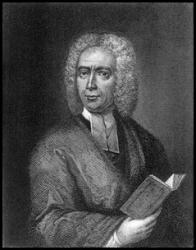
1674 - 1748 Author of "From all that dwell below the skies" in The Hymnal Isaac Watts was the son of a schoolmaster, and was born in Southampton, July 17, 1674. He is said to have shown remarkable precocity in childhood, beginning the study of Latin, in his fourth year, and writing respectable verses at the age of seven. At the age of sixteen, he went to London to study in the Academy of the Rev. Thomas Rowe, an Independent minister. In 1698, he became assistant minister of the Independent Church, Berry St., London. In 1702, he became pastor. In 1712, he accepted an invitation to visit Sir Thomas Abney, at his residence of Abney Park, and at Sir Thomas' pressing request, made it his home for the remainder of his life. It was a residence most favourable for his health, and for the prosecution of his literary labours. He did not retire from ministerial duties, but preached as often as his delicate health would permit.
The number of Watts' publications is very large. His collected works, first published in 1720, embrace sermons, treatises, poems and hymns. His "Horae Lyricae" was published in December, 1705. His "Hymns" appeared in July, 1707. The first hymn he is said to have composed for religious worship, is "Behold the glories of the Lamb," written at the age of twenty. It is as a writer of psalms and hymns that he is everywhere known. Some of his hymns were written to be sung after his sermons, giving expression to the meaning of the text upon which he had preached. Montgomery calls Watts "the greatest name among hymn-writers," and the honour can hardly be disputed. His published hymns number more than eight hundred.
Watts died November 25, 1748, and was buried at Bunhill Fields. A monumental statue was erected in Southampton, his native place, and there is also a monument to his memory in the South Choir of Westminster Abbey. "Happy," says the great contemporary champion of Anglican orthodoxy, "will be that reader whose mind is disposed, by his verses or his prose, to imitate him in all but his non-conformity, to copy his benevolence to men, and his reverence to God." ("Memorials of Westminster Abbey," p. 325.)
--Annotations of the Hymnal, Charles Hutchins, M.A., 1872.
=================================
Watts, Isaac, D.D. The father of Dr. Watts was a respected Nonconformist, and at the birth of the child, and during its infancy, twice suffered imprisonment for his religious convictions. In his later years he kept a flourishing boarding school at Southampton. Isaac, the eldest of his nine children, was born in that town July 17, 1674. His taste for verse showed itself in early childhood. He was taught Greek, Latin, and Hebrew by Mr. Pinhorn, rector of All Saints, and headmaster of the Grammar School, in Southampton. The splendid promise of the boy induced a physician of the town and other friends to offer him an education at one of the Universities for eventual ordination in the Church of England: but this he refused; and entered a Nonconformist Academy at Stoke Newington in 1690, under the care of Mr. Thomas Rowe, the pastor of the Independent congregation at Girdlers' Hall. Of this congregation he became a member in 1693.
Leaving the Academy at the age of twenty, he spent two years at home; and it was then that the bulk of the Hymns and Spiritual Songs (published 1707-9) were written, and sung from manuscripts in the Southampton Chapel. The hymn "Behold the glories of the Lamb" is said to have been the first he composed, and written as an attempt to raise the standard of praise. In answer to requests, others succeeded. The hymn "There is a land of pure delight" is said to have been suggested by the view across Southampton Water. The next six years of Watts's life were again spent at Stoke Newington, in the post of tutor to the son of an eminent Puritan, Sir John Hartopp; and to the intense study of these years must be traced the accumulation of the theological and philosophical materials which he published subsequently, and also the life-long enfeeblement of his constitution.
Watts preached his first sermon when he was twenty-four years old. In the next three years he preached frequently; and in 1702 was ordained pastor of the eminent Independent congregation in Mark Lane, over which Caryl and Dr. John Owen had presided, and which numbered Mrs. Bendish, Cromwell's granddaughter, Charles Fleetwood, Charles Desborough, Sir John Hartopp, Lady Haversham, and other distinguished Independents among its members. In this year he removed to the house of Mr. Hollis in the Minories. His health began to fail in the following year, and Mr. Samuel Price was appointed as his assistant in the ministry. In 1712 a fever shattered his constitution, and Mr. Price was then appointed co-pastor of the congregation which had in the meantime removed to a new chapel in Bury Street. It was at this period that he became the guest of Sir Thomas Abney, under whose roof, and after his death (1722) that of his widow, he remained for the rest of his suffering life; residing for the longer portion of these thirty-six years principally at the beautiful country seat of Theobalds in Herts, and for the last thirteen years at Stoke Newington. His degree of D.D. was bestowed on him in 1728, unsolicited, by the University of Edinburgh. His infirmities increased on him up to the peaceful close of his sufferings, Nov. 25, 1748. He was buried in the Puritan restingplace at Bunhill Fields, but a monument was erected to him in Westminster Abbey.
His learning and piety, gentleness and largeness of heart have earned him the title of the Melanchthon of his day. Among his friends, churchmen like Bishop Gibson are ranked with Nonconformists such as Doddridge. His theological as well as philosophical fame was considerable. His Speculations on the Human Nature of the Logos, as a contribution to the great controversy on the Holy Trinity, brought on him a charge of Arian opinions. His work on The Improvement of the Mind, published in 1741, is eulogised by Johnson. His Logic was still a valued textbook at Oxford within living memory. The World to Come, published in 1745, was once a favourite devotional work, parts of it being translated into several languages. His Catechisms, Scripture History (1732), as well as The Divine and Moral Songs (1715), were the most popular text-books for religious education fifty years ago. The Hymns and Spiritual Songs were published in 1707-9, though written earlier. The Horae Lyricae, which contains hymns interspersed among the poems, appeared in 1706-9. Some hymns were also appended at the close of the several Sermons preached in London, published in 1721-24. The Psalms were published in 1719. The earliest life of Watts is that by his friend Dr. Gibbons. Johnson has included him in his Lives of the Poets; and Southey has echoed Johnson's warm eulogy. The most interesting modern life is Isaac Watts: his Life and Writings, by E. Paxton Hood. [Rev. H. Leigh Bennett, M.A.]
A large mass of Dr. Watts's hymns and paraphrases of the Psalms have no personal history beyond the date of their publication. These we have grouped together here and shall preface the list with the books from which they are taken.
(l) Horae Lyricae. Poems chiefly of the Lyric kind. In Three Books Sacred: i.To Devotion and Piety; ii. To Virtue, Honour, and Friendship; iii. To the Memory of the Dead. By I. Watts, 1706. Second edition, 1709. (2) Hymns and Spiritual Songs. In Three Books: i. Collected from the Scriptures; ii. Composed on Divine Subjects; iii. Prepared for the Lord's Supper. By I. Watts, 1707. This contained in Bk i. 78 hymns; Bk. ii. 110; Bk. iii. 22, and 12 doxologies. In the 2nd edition published in 1709, Bk. i. was increased to 150; Bk. ii. to 170; Bk. iii. to 25 and 15 doxologies. (3) Divine and Moral Songs for the Use of Children. By I. Watts, London, 1715. (4) The Psalms of David Imitated in the Language of the New Testament, And apply'd to the Christian State and Worship. By I. Watts. London: Printed by J. Clark, at the Bible and Crown in the Poultry, &c, 1719. (5) Sermons with hymns appended thereto, vol. i., 1721; ii., 1723; iii. 1727. In the 5th ed. of the Sermons the three volumes, in duodecimo, were reduced to two, in octavo. (6) Reliquiae Juveniles: Miscellaneous Thoughts in Prose and Verse, on Natural, Moral, and Divine Subjects; Written chiefly in Younger Years. By I. Watts, D.D., London, 1734. (7) Remnants of Time. London, 1736.
454 Hymns and Versions of the Psalms, in addition to the centos are all in common use at the present time.
--Excerpts from John Julian, Dictionary of Hymnology (1907)
==================================
Watts, I. , p. 1241, ii. Nearly 100 hymns, additional to those already annotated, are given in some minor hymn-books.
--John Julian, Dictionary of Hymnology, Appendix, Part II (1907)
=================
Watts, I. , p. 1236, i. At the time of the publication of this Dictionary in 1892, every copy of the 1707 edition of Watts's Hymns and Spiritual Songs was supposed to have perished, and all notes thereon were based upon references which were found in magazines and old collections of hymns and versions of the Psalms. Recently three copies have been recovered, and by a careful examination of one of these we have been able to give some of the results in the revision of pp. 1-1597, and the rest we now subjoin.
i. Hymns in the 1709 ed. of Hymns and Spiritual Songs which previously appeared in the 1707 edition of the same book, but are not so noted in the 1st ed. of this Dictionary:—
On pp. 1237, L-1239, ii., Nos. 18, 33, 42, 43, 47, 48, 60, 56, 58, 59, 63, 75, 82, 83, 84, 85, 93, 96, 99, 102, 104, 105, 113, 115, 116, 123, 124, 134, 137, 139, 146, 147, 148, 149, 162, 166, 174, 180, 181, 182, 188, 190, 192, 193, 194, 195, 197, 200, 202.
ii. Versions of the Psalms in his Psalms of David, 1719, which previously appeared in his Hymns and Spiritual Songs, 1707:—
On pp. 1239, U.-1241, i., Nos. 241, 288, 304, 313, 314, 317, 410, 441.
iii. Additional not noted in the revision:—
1. My soul, how lovely is the place; p. 1240, ii. 332. This version of Ps. lxiv. first appeared in the 1707 edition of Hymns & Spiritual Songs, as "Ye saints, how lovely is the place."
2. Shine, mighty God, on Britain shine; p. 1055, ii. In the 1707 edition of Hymns & Spiritual Songs, Bk. i., No. 35, and again in his Psalms of David, 1719.
3. Sing to the Lord with [cheerful] joyful voice, p. 1059, ii. This version of Ps. c. is No. 43 in the Hymns & Spiritual Songs, 1707, Bk. i., from which it passed into the Ps. of David, 1719.
A careful collation of the earliest editions of Watts's Horae Lyricae shows that Nos. 1, 7, 9, 10, 11, 12, 14, 16, p. 1237, i., are in the 1706 ed., and that the rest were added in 1709. Of the remaining hymns, Nos. 91 appeared in his Sermons, vol. ii., 1723, and No. 196 in Sermons, vol. i., 1721. No. 199 was added after Watts's death. It must be noted also that the original title of what is usually known as Divine and Moral Songs was Divine Songs only.
--John Julian, Dictionary of Hymnology, New Supplement (1907)
===========
See also in:
Hymn Writers of the Church
Isaac Watts
Thomas H. Troeger
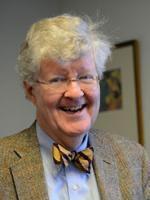
1945 - 2022 Adapter of "All People That on Earth Do Dwell" in The New Century Hymnal Thomas Troeger (1945-2022), professor of Christian communication at Yale Divinity school, was a well known preacher, poet, and musician. He was a fellow of Silliman College, held a B.A. from Yale University; B.D. Colgate Rochester Divinity School; S.T. D. Dickinson College, and was awarded an honorary D.D. from Virginia Theological Seminary. He was ordained in the Presbyterian Church in 1970 and the Episcopal Church in 1999, and remained dually aligned with both traditions. Troerger led conferences and lectures in worship and preaching throughout North America, as well as in Denmark, Holland, Australia, Japan, and Africa. He served as national chaplain to the American Guild of Organists, and for at least three years he hosted the Season of Worship broadcast for Cokesbury. He was president of the Academy of Homiletics as well as Societas Homiletica. He had, as of 2009, written 22 books in the areas of preaching, poetry, hymnody, and worship. Many of his hymn texts are found in New Hymns for the Lectionary (Oxford, 1992), and God, You Made All Things for Singing (Oxford, 2009).
Laura de Jong
Thomas H. Troeger
Nikolaus Herman
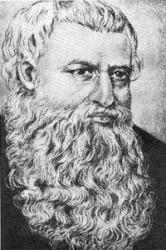
1500 - 1561 Person Name: Nicolaus Herman Author of "The happy sunshine all is gone" in Evangelical Lutheran hymnal Herman, Nicolaus, is always associated with Joachimsthal in Bohemia, just over the mountains from Saxony. The town was not of importance till the mines began to be extensively worked about 1516. Whether Herman was a native of this place is not known, but he was apparently there in 1518, and was certainly in office there in 1524. For many years he held the post of Master in the Latin School, and Cantor or Organist and Choirmaster in the church. Towards the end of his life he suffered greatly from gout, and had to resign even his post as Cantor a number of years before his death. He died at Joachimsthal, May 3, 1561. (Koch, i. 390-398; Allgemeine Deutsche Biographie, xii. 186-188, &c.)
He was a great friend and helper of J. Mathesius (q.v.) (who in 1532 became rector of the school, but in 1541 diaconus and in 1545 pastor of the church), and it was said that whenever Mathesius preached a specially good sermon Herman straightway embodied its leading ideas in a hymn. His hymns, however, were not primarily written for use in church, but were intended for the boys and girls in the schools, to supplant profane songs in the mouths of the young men and women, or for the daily life of the “housefathers and housemothers" in Joachimsthal, at home, and in their work in the mines. He is a poet of the people, homely, earnest, and picturesque in style; by his naiveté reminding us of Hans Sachs. He was an ardent lover of music and a very good organist. The chorales which he published with his hymns are apparently all of his own composition, and are among the best of the Reformation period.
Many of Herman's hymns soon passed into Church use in Germany, and a number are found in almost all books in present use. About 190 in all, they appeared principally in:—
(1) Die Sontags Evangelia uber des gantze Jar, in Gesenge verfasset, für die Kinder und christlichen Haussvetter, &c, Wittenberg, 1560 (dedication by Herman dated Trinity Sunday, 1559), with 101 hymns and 17 melodies. The best are those interspersed specially meant for children and not directly founded on the Gospel for the day. (2) Die Historien von der Sindfludt, Joseph, Mose, Helia, Elisa und der Susanna, sampt etlichen Historien aus den Evangelisten, &c., Wittenberg, 1562 (preface by Herman dated St. Bartholomew's Day, 1560), with 73 hymns and 20 melodies. In this case also the general hymns are the best. A selection of 60 (really 61) of his hymns, with a memoir by K. F. Ledderhose, was published at Halle, 1855.
One of Herman's hymns is noted under “Wenn mein Stündlein vorhanden ist." The others which have passed into English are:—
i. Bescher uns, Herr, das täglioh Brod. Grace before Meat. 1562, as above, and thence in Wackernagel, iii. p. 1228, in 6 stanzas of 4 lines; in Ledderhose, p. 70; and in the Berlin Geistliche Lieder, ed. 1863, No. 1133. Translated as:—
1. Thou art our Father and our God. This, by P. H. Molther, a translation of stanza vi., as No. 180 in the Moravian Hymn Book, 1789 (1849, No. 220, st. v.).
2. As children we are owned by Thee, a translation of stanza vi., as st. iii. of No. 191 in the Moravian Hymn Book, 1801 (1849, No. 220, stanza iii.).
ii. Die helle Sonn leucht jetzt herfür. Morning. 1560, as above, and thence in Wackernagel, iii. p. 1184, in 4 stanzas of 4 lines, in Ledderhose, p. 87; and in the Unverfälschter Liedersegen, 1851, No. 450. Translated as:—
The morning beam revives our eyes, a good and full translation by. A. T. Russell, as No. 71 in the Dalston Hospital Hymn Book 1848.
iii. Erschienen ist der herrliche Tag. Easter. 1560, as above, in 14 stanzas of 4 lines, entitled, "A new Spiritual Song of the Joyful Resurrection of our Saviour Jesus Christ; for the maidens of the girls' school in Joachimsthal”; and thence in Wackernagel, iii. p. 1175; in Ledderhose p. 23, and Unverfälschter Liedersegen, 1851, No. 134. It has reminiscences of the "Erstanden ist der heil'ge Christ". Translated as:—
The day hath dawn'd—-the day of days, a good translation by A. T. Russell of stanzas i., ii., xiii., xiv., as No. 113 in his Psalms & Hymns, 1851.
Another tr. is, "At length appears the glorious day," by Dr. G. Walker, 1860, p. 28.
iv. Hinunter ist der Sonnen Schein. Evening. 1560, as above, and thence in Wackernagel, iii. p. 1184, in 4 stanzas of 4 lines; in Ledderhose, p. 88; and in the Unverfälschter Liedersegen1851, No. 523. Some of the phrases may have been suggested by the "Christe qui lux es et dies" (q. v.). Translated as:—
1. Sunk is the sun's last beam of light, a full and good translation by Miss Cox in her Sacred Hymns from the German, 1841, p. 57. Included in Alford's Psalms & Hymns, 1844, and Tear of Praise, 1867; in Dale's English Hymn Book, 1875; in the Pennsylvania Lutheran Church Book, 1868, and others. It is also given considerably altered and beginning, "Sunk is the Sun! the daylight gone," in W. J. Blew's Church Hymn and Tune Book, 1851-55.
2. The happy sunshine all is gone, in full, by Miss Winkworth in her Lyra Germanica, 1st Ser., 1855, p. 225; repeated in her Chorale Book for England, 1863, and the Ohio Lutheran Hymnal, 1880.
Other translations are: (1) "Did I perhaps Thee somewhat grieve," a translation of stanza iii. in the Moravian Hymn Book, 1789, No. 756. In the 1801 and later eds. (1886, No. 1181, st. iii.), it begins, "Where'er I Thee this day did grieve." (2) "The sun’s fair sheen is past and gone," by H. J. Buckoll, 1842, p. 68. (3) "The sun hath run his daily race," by Lady E. Fortescue, 1843, p. 14.
v. Lobt Gott, ihr Christen alle gleich. Christmas. Written c. 1554, but first published 1560 as above, as the first of "Three Spiritual Christmas Songs of the new-born child Jesus, for the children in Joachimsthal." Thence in Wackernagel iii. p. 1169, in 8 stanzas of 4 lines; in Ledderhose, p. 1; and in the Unverfälschter Liedersegen, 1851, No. 47. It is one of the most popular German Christmas hymns. The melody set to it in 1560 is also by Herman; in 1554 to his "Kommt her ihr liebsten Schwesterlein" [in the Hymnal Companioncalled "St. George's (old)"]. Translated as :—
1. Let all together praise our God, a good translation of stanzas i., iii., vi., viii., by A. T. Russell, as No. 52 in his Psalms & Hymns, 1851. Repeated in Kennedy, 1863, adding a translation of st. ii., and beginning, "Let all creation praise our God."
2. Praise ye the Lord, ye Christians I yea, in full, by E. Cronenwett, as No. 31 in the Ohio Lutheran Hymnal 1880.
Other translations are: (1) "A wondrous change He with us makes," a tr. of stanza viii., ix. as No. 438 in pt. i. of the Moravian Hymn Book, 1754, repeated 1789-1826. (2) "Come, brethren, lets the song arise," by Dr. G. Walker, 1860, p. 26. (3) "Praise God, now Christians, all alike," by Miss Manington, 1864, p. 9. (4) "Praise God, upon His throne on high," in the Sunday Magazine, 1874, p. 384, signed "P. J." The hymn “Shepherds rejoice, lift up your eyes," given by J. C. Jacobi in his Psalmodia Germanica, 1722, p. 8, to Herman's melody (which was first published 1554) is, as stated in his Preface, taken from Bk. i. of Isaac Watts's Horse Lyricae
vi. So wahr ich leb, spricht Gott der Herr. Absolution. 1560, as above, in 11 stanzas of 4 lines, entitled "A hymn on the power of the keys and the virtue of holy absolution; for the children in Joachimsthal." Thence in Wackernagel, iii. p. 1183; in Ledderhose, p. 47; and the Unverfälschter Liedersegen, 1851, No. 429. It probably suggested the better known hymn, "So wahr ich lebe," q. v., by Johann Heermann. Translated as:—
Yea, as I live, Jehovah saith, I do not wish the sinner's death, in full, by Dr. M. Loy, as No. 245, in the Ohio Lutheran Hymnal, 1880. [Rev. James Mearns, M.A.]
--John Julian, Dictionary of Hymnology (1907)
Nikolaus Herman
Johann Franck
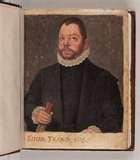
1618 - 1677 Person Name: J. Franck Translator (Swedish) of "All People That on Earth Do Dwell" in Christian Worship Johann Franck (b. Guben, Brandenburg, Germany, 1618; d. Guben, 1677) was a law student at the University of Köningsberg and practiced law during the Thirty Years' War. He held several positions in civil service, including councillor and mayor of Guben. A significant poet, second only to Paul Gerhardt in his day, Franck wrote some 110 hymns, many of which were published by his friend Johann Crüger in various editions of the Praxis Pietatis melica. All were included in the first part of Franck’s Teutsche Gedichte bestehend im geistliche Sion (1672).
Bert Polman
=============
Franck, Johann, son of Johann Franck, advocate and councillor at Guben, Brandenburg, was born at Guben, June 1, 1618. After his father's death, in 1620, his uncle by marriage, the Town Judge, Adam Tielckau, adopted him and sent him for his education to the schools at Guben, Cottbus, Stettin and Thorn. On June 28, 1638, he matriculated as a student of law at the University of Königsberg, the only German university left undisturbed by the Thirty Years' War. Here his religious spirit, his love of nature, and his friendship with such men as Simon Dach and Heinrich Held, preserved him from sharing in the excesses of his fellow students. He returned to Guben at Easter, 1640, at the urgent request of his mother, who wished to have him near her in those times of war during which Guben frequently suffered from the presence of both Swedish and Saxon troops. After his return from Prague, May, 1645, he commenced practice as a lawyer. In 1648 he became a burgess and councillor, in 1661 burgomaster, and in 1671 was appointed the deputy from Guben to the Landtag (Diet) of Lower Lusatia. He died at Guben, June 18, 1677; and on the bicentenary of his death, June 18, 1877, a monumental tablet to his memory was affixed to the outer wall of the Stadtkirche at Guben (Koch, iii. 378-385; Allgemeine Deutsche Biographie, vii. 211-212; the two works by Dr. Hugo Jentsch of Guben, Johann Franck, 1877, and Die Abfassungszeit der geistlichen Lieder Johann Franck's, 1876).
Of Franck's secular poems those before 1649 are much the best; his later productions becoming more and more affected and artificial, long-winded and full of classical allusions, and much inferior to those of Dach or Opitz. As a hymn writer he holds a high rank and is distinguished for unfeigned and firm faith, deep earnestness, finished form, and noble, pithy, simplicity of expression. In his hymns we miss the objectivity and congregational character of the older German hymns, and notice a more personal, individual tone; especially the longing for the inward and mystical union of Christ with the soul as in his "Jesus, meine Freude." He stands in close relationship with Gerhardt, sometimes more soaring and occasionally more profound, but neither on the whole so natural nor so suited for popular comprehension or Church use.
His hymns appeared mostly in the works of his friends Weichmann, Crüger and Peter. They were collected in his Geistliches Sion, Guben, 1674, to the number of 110; and of these the 57 hymns (the other 53 being psalm versions of no great merit) were reprinted with a biographical preface by Dr. J. L. Pasig as Johann Franck's Geistliche Lieder, Grimma, 1846. Two of those translated into English are from the Latin of J. Campanus (q. v.). Four other hymns are annotated under their own first lines:—"Brunquell aller Güter"; "Dreieinigkeit der Gottheit wahrer Spiegel"; "Jesu, meine Freude"; "Schmücke dich, o liebe Secle." The rest are:—
i. Hymns in English common use: --
i. Erweitert eure Pforten . [Advent]. Founded on Psalm xxiv. 7-10. First published in C. Peter's Andachts-Zymbeln, Freiberg, 1655, p. 25, in 7 stanzas of 8 lines; repeated 1674, p. 3, and 1846, p. 3, as above. Included in the 1688 and later editions of Crüger's Praxis pietatis, in Bollhagen's Gesang-Buch, 1736, &c.
The only translation in common use is:—-
Unfold your gates and open, a translation of st. 1, 3, 6, by A. T. Russell, as No. 30 in his Hymns & Psalms, 1851; repeated altered as No. 30 in Kennedy, 1863, and thus as No. 102 in Holy Song, 1869.
ii. Herr Gott dich loben wir, Regier. Thanksgiving for Peace. Evidently written as a thanksgiving for the conclusion of the Thirty Years' War, by the Peace of Westphalia, Oct. 24, 1648. First published in the Crüger-Runge Gesang-Buch, Berlin, 1653, No. 306, in 9 st. of 8 l., as the first of the "Hymns of Thanksgiving for Peace attained"; and repeated 1674, p. 182, and 1846, p. 77, as above. Included in Crüger's Praxis, 1653, and many later collections, and, as No. 591, in the Unverfälschter Liedersegen, 1851. The only translation in common use is:—
Lord God, we worship Thee, a very good version of st. 2, 3, 6, 8, by Miss Winkworth in her Chorale Book for England, 1863, No. 183. Repeated in full in the Society for Promoting Christian Knowledge Church Hymns, 1871; the Hymnary, 1872; the Psalmist, 1878; and in America in the Pennsylvania Lutheran Church Book, 1868. In the American Protestant Episcopal Collection, 1871; the Hymns & Songs of Praise, N. Y. 1874; and the Ohio Lutheran Hymnal, 1880, the translation of stanza 8 is omitted.
iii. Herr ich habe missgehandelt. Lent. Of this fine hymn of penitence stanza i. appeared as No. 19 in Cruger's Geistliche Kirchenmelodien , Leipzig, 1649. The full form in 8 stanzas of 6 lines is No. 41 in the Crüger-Runge Gesang-Buch, Berlin, 1653, entitled "For the forgiveness of sins," repeated 1674, p. 39, and 1846, p. 37, as above. Included in Crüger's Praxis, 1653, and others, and in the Unverfälschter Liedersegen, 1851. The only translation in common use is:—
Lord, to Thee I make confession, a very good translation, omitting st. 4, 5, 6, by Miss Winkworth in her Chorale Book for England, 1863, No. 44, repeated in the Appendix to the Hymnal for St. John's, Aberdeen, 1865-1870; and in the Pennsylvania Lutheran Ch. Book, 1868; Evangelical Hymnal, N. Y., 1880; Ohio Lutheran Hymnal, 1880. Another translation is: "Lord, how oft I have offended," by N. L. Frothingham, 1870, p. 177.
iv. Herr Jesu, Licht der Heiden. Presentation in the Temple. Founded on the account in St. Luke ii., and probably the finest hymn on the subject. Dr. Jentsch, 1876, p. 9, thinks it was written before Dec. 8, 1669, as C. Peter, who died then, left a melody for it. We have not found the full text earlier than 1674, as above, p. 10, in 6 stanzas of 8 lines, entitled "On the Festival of the Purification of Mary" (1846, p. 10). Included in the 1688 and later editions of Crüger's Praxis, and in the Unverfälschter Liedersegen, 1851, No. 197. The translations in common use are:—
1. Light of the Gentile world , a translation, omitting st. 6, by Miss Winkworth in the first service of her Lyra Germanica, 1855, p. 193 (ed. 1876, p. 195), and thence as No. 147 in the Pennsylvania Lutheran Hymn Book, 1865. This version is in S.M. Double.
2. Light of the Gentile Nations, a good translation, omitting st. 6, by Miss Winkworth in her Chorale Book for England, 1863, No. 80. Repeated in Dr. Thomas's Augustine Hymn Book, 1866, and in America in the Pennsylvania Lutheran Church Book, 1868, and the Ohio Lutheran Hymnal, 1880.
ii. Hymns not in English common use:
v. Du geballtes Weltgebäude. Christ above all earthly things. Stanza i. in Cruger's Kirchenmelodien, 1649, No. 116. The full text (beginning "Du o schönes) is No. 239 in the Crüger-Runge Gesang-Buch, 1653, in 8 stanzas, entitled "Longing after Eternal Life." Repeated, 1674, p. 194, and 1846, p. 60, as above. The translations are: (1) "Let who will in thee rejoice," by Miss Winkworth, 1855, p. 180 (1876, p. 182). (2) "O beautiful abode of earth," by Miss Warner, 1858 (1861, p. 233). (3) "Thou, O fair Creation-building," by N. L. Frothingham, 1870, p. 232.
vi. Unsre müden Augenlieder. Evening. Probably written while a student at Königsberg. First published in J. Weichmann's Sorgen-lägerin, Königsberg, 1648, Pt. iii., No. 4, in 7 st.; repeated 1674, p. 213, and 1846, p. 91, as above. The only translation is by H. J. Buckoll, 1842, p. 79, beginning with st. vi., "Ever, Lord, on Thee relying." [Rev. James Mearns, M.A.]
--John Julian, Dictionary of Hymnology (1907)
Johann Franck
Gerhardt Tersteegen
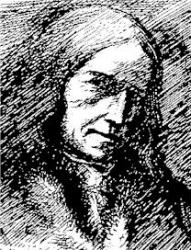
1697 - 1769 Person Name: Gerhard Tersteegen Author of "Lo, God is here! let us adore" in Services for Congregational Worship. The New Hymn and Tune Book Tersteegen, Gerhard, a pious and useful mystic of the eighteenth century, was born at Mörs, Germany, November 25, 1697. He was carefully educated in his childhood, and then apprenticed (1715) to his older brother, a shopkeeper. He was religiously inclined from his youth, and upon coming of age he secured a humble cottage near Mühlheim, where he led a life of seclusion and self-denial for many years. At about thirty years of age he began to exhort and preach in private and public gatherings. His influence became very great, such was his reputation for piety and his success in talking, preaching, and writing concerning spiritual religion. He wrote one hundred and eleven hymns, most of which appeared in his Spiritual Flower Garden (1731). He died April 3, 1769.
Hymn Writers of the Church by Charles S. Nutter and Wilbur F. Tillett, 1911
====================================================
Gerhardt Tersteegen or ter Stegen, was born at Moers, Netherlands [sic. Germany] , November 25, 1697. He was destined for the Reformed ministry, but after his father's death when the boy was only six, his mother was unable to send him to the university. He studied at the Gymnasium in Moers, and then earned a meager living as a silk weaver, sharing his frugal daily fare with the poor. Malnutrition and privation undermined his health to such an extent that he suffered a serious depression for some five years, following which he wrote a new covenant with God, signing it in his own blood. A strong mystic, he did not attend the services of the Reformed Church after 1719. Although forming no sect of his own, he became well known as a religious teacher and leader. His house was known as "The Pilgrim's Cottage" -- a retreat for men seeking a way of life, while he himself was known as "the physician of the poor and forsaken." Barred from preaching in his own country until 1750, he visited Holland annually from 1732 to 1755, holding meetings. In addition to his other labors he carried on a tremendous correspondence. Overwork resulted in physical breakdown, so that during the latter years of his life he could speak only to small gatherings. He died at Muhlheim on April 3, 1769. One of the three most important of Reformed hymn writers, he is also regarded as the chief representative of the mystics. He wrote 111 hymns. His important Geisliches Blumengartlein was published in 1729. H.E. Govan published The Life of Gerhard Tersteegen, with selctions from his writings, in 1902.
--The Hymnal 1940 Companion
===========================
Tersteegen, Gerhard, son of Heinrich Tersteegen (otherwise ter Stegen or zur Stiege), merchant at Mörs (Meurs), in Rhenish Prussia, was born at Mors, Nov. 25, 1697. His parents intended that he should become a minister of the Reformed Church in Germany. His father however died in 1703, and his mother found that after giving him a thorough classical training in the Latin school at Mörs she was unable to afford the cost of his University course. He was accordingly apprenticed, in 1713, to his brother-in-law, a merchant at Mühlheim on the Ruhr, and in 1717 started in business on his own account, at Mühlheim. As he found his time much broken up, and his opportunities of meditation few, he gave up his business in 1719; and, after a short trial of linen weaving, took up the easier and much more lucrative occupation of weaving silk ribbons. During the years 1719-24 he passed through a period of spiritual depression, at the end of which his faith in the reconciling grace of Christ became assured (see No. xxxiv. below), and on Maundy Thursday, 1724, he wrote out a solemn covenant with God which he signed with his own blood. Previous to this, even before 1719, he had ceased to attend the ordinary services of the Reformed Church; and also absented himself from Holy Communion on the ground that he could not in conscience communicate along with open sinners. About the beginning of 1725 he began to speak at the prayer meetings which had been held at Mühlheim, since 1710, by Wilhelm Hoffmann, who was a candidate of theology (licensed preacher) of the Reformed Church. Tersteegen soon became known as a religious teacher among the "Stillen im Lande," as the attenders on these meetings were called, and in 1728 gave up his handicraft in order to devote himself entirely to the translation of works by medieval and recent Mystics and Quietists, including Madame Guyon and others, and the composition of devotional books, to correspondence on religious subjects, and to the work of a spiritual director of the "awakened souls." From this date to his death he was supported by a small regular income which was subscribed by his admirers and friends.
About 1727 a house at Otterbeck, between Mühlheim and Elberfeld, was set apart as a "Pilgerhütte," where the "awakened souls" could go into a spiritual retreat, under the direction of Tersteegen. This house, with accommodation for eight persons, was retained until about 1800. Tersteegen, however, did not confine himself to Mühlheim, but travelled over the district, addressing gatherings of like-minded Christians, giving special attention to Elberfeld, Barmen, Solingen, and Crefeld. From 1732 to 1755 he also went regularly every year to Holland, to visit his spiritual kinsfolk at Amsterdam and elsewhere. From 1730 to 1750 a law against conventicles was strictly enforced, and Tersteegen could not hold meetings except on his visits to Holland. During this period he removed to a house which had been Wilhelm Hoffmann's, where he preached, and provided food and simple medicines for the poor. After 1750 he resumed his public speaking until 1756, when he overstrained himself, and had to confine himself to the smallest gatherings absolutely. In 1769, dropsy set in, and after patient endurance for a season he died on April 3, 1769, at Mühlheim (Koch, vi. 46). Up to the end of his life Tersteegen remained outside the Reformed Church, but never set up a sect of his own. After his death his followers as a rule reunited themselves with it, especially when a less formal type of religion began to prevail therein.
Tersteegen's most important hymnological work was his Geistliches Blümen-Gärtlein, of which many editions were published. Tersteegen ranks as one of the three most important hymnwriters associated with the Reformed Church in Germany, the other two being F. A. Lampe and Joachim Neander.
He is however more closely allied, both as a Mystic and as a Poet, with Johann Scheffler than with either of his co-religionists. He almost equals Scheffler in power of expression and beauty of form, and if Scheffler has more pictorial grace, and a more vivid imagination, Tersteegen has more definiteness of teaching, a firmer grasp of the Christian verities, and a greater clearness in exposition. Inner union of the soul with God and Christ, the childlike simplicity and trust which this brings, renunciation of the world and of self, and daily endeavour to live as in the presence of God and in preparation for the vision of God, are the keynotes of his hymns. To his intense power of realising the unseen, his clear and simple diction, and the evident sincerity with which he sets forth his own Christian experience, his hymns owe much of their attractiveness and influence. During his lifetime they did not come much into use except through the Harfenspiel, as above, and they did not meet the taste of compilers during the Rationalistic period. But since Bunsen in his Yersuch, 1833, and Knapp in his Evangelischer Lieder-Schatz, 1837, brought his hymns once more into notice they have been received in greater or less measure into almost all the German hymnbooks, among the Lutherans as well as among the Reformed, the most popular of all being his “Gott ist gegenwärtig".
A number of Tersteegen's hymns are noted under their own first lines. They appeared, almost all for the first time, in the successive editions of his Geistliches Blümen-Gärtlein, viz., in the 1st ed., 1729; 2nd ed., 1735; 3rd ed., 1738; 4th ed., 1745; 5th ed., 1751; 6th ed., 1757; 7th ed., 1768; and in each case (after 1729) in the Third Book of that work. Those which have passed into English are as follows:—
i. Freue dich, du Kinder-Orden. Christmas. Translated as:—
Little children, God above, 1858, p. 78. Another tr. is: "Children rejoice, for God is come to earth." By Miss Dunn, 1857, p. 30.
ii. Jedes Herz will etwas lieben. Love to Christ. In the 4th ed., 1745, as above, Bk. iii., No. 70, in 8 stanzas of 4 lines, entitled "The Soul wishes to take Jesus as her best Beloved." Translated as:—
1. The heart of man must something love. A cento beginning with st. ii. “Though all the world my choice deride," is in Spurgeon's Our Own Hymn Book, 1866, and also in the Plymouth Collection, 1855, and other American hymnals.
2. Something every heart is loving. A full and good translation by Mrs. Bevan, in her Songs of Eternal Life, 1858, p. 58.
iii. Jesu, der du bist alleine. Communion of Saints. In the 2nd ed., 1735, in 11 stanzas of 6 lines, entitled "Prayer on behalf of the brethren." Translated as:—
Jesus, whom Thy Church doth own. By Miss Winkworth, omitting st. iii., in her Lyra Germanica, 2nd Ser., 1858, p. 99.
iv. Jesu, mein Erbarmer! höre. Lent or Penitence. In the 2nd ed., 1735, in 12 stanzas of 6 lines, entitled "In outward and inward sufferings and Temptations." Translated as:—
Jesus, pitying Saviour, hear me. In full, by Miss Winkworth, in her Lyra Germanica, 2nd Ser., 1858, p. 133. In her Christian Singer, 1869, p. 298, she gave st. ii., v., vi., beginning "Lost in darkness, girt with dangers."
v. Nun so will ich denn mein Leben. Self-Surrender. Translated (omitting st. ii., iii., vi., x.) as:—
1. Lo! my choice is now decided. By Miss Cox, in her Sacred Hymns from the German, 1841, p. 125. Her translations of st. viii., ix., vii., altered and beginning, "One thing first and only knowing," are repeated in Hedge & Huntington's Hymns for the Church of Christ, Boston, U.S., 1853.
2. Now at last I end the strife. By Miss Winkworth, in herLyra Germanica, 2nd Ser., 1858.
vi. 0 liebe Seele! könntst du werden. The Childlike Spirit. Translated as:—
Soul! couldst thou, while on earth remaining. In Miss Cox'sHymns from German, 1864, p. 197, it begins "Soul, while on earth thou still remainest."
Other trs. are: (1) "Wouldst thou, my soul, the secret find." By Lady E. Fortescue, 1843, p. 47. (2) “Dear soul, couldst thou become a child." By Miss Winkworth, 1855, p. 22.
vii. Siegesfürste, Ehrenkönig. Ascension. Translated as:—
Conquering Prince and Lord of Glory, By Miss Winkworth, omitting st. ii., in her Lyra Germanica, 2nd Ser., 1858, p. 48.
viii. Wie gut ists, wenn man abgespehnt. Lent or Self-Renunciation. In the first edition, entitled "Of the sweetness of the hidden life of Christians." Translated as:—
How sweet it is, when, wean'd from all. This is a good and full translation by S. Jackson, in his Life of Tersteegen, 1832 (1837, p. 417).
Other hymns by Tersteegen which have been rendered into English are:—
ix. Ach Gott, es taugt doch draussen nicht. On the Vanity of Earthly Things. Tr. as, "Ah God! the world has nought to please." By Miss Winkworth, 1869, p. 304.
x. Ach, könnt ich stille sein. Peace in God. Translated as (1) "Oh! could I but be still." By Mrs. Bevan, 1859, p. 134. (2) "Ah, could I but be still." By Lady Durand, 1873, p. 77.
xi. Allgenugsam Wesen. God's All-sufficiency . The trs. are (1) "Thou All-sufficient One! Who art." By Miss Warner, 1858, p. 601, repeated in Hymns of the Ages, Boston, U.S., 1865, p. 163. (2) "Thou, whose love unshaken."
xii. Bald endet sich mein Pilgerweg. Eternal Life. Translated as “Weary heart, be not desponding." By Lady Durand, 1873, p. 84.
xiii. Berufne Seelen! schlafet nicht. Lent. The translations are (1) "Ye sleeping souls, awake From dreams of carnal ease." By S. Jackson, in his Life of Tersteegen, 1832 (1837, p, 413). (2) "Sleep not, 0 Soul by God awakened." By Lady Durand, 1873, p. 98.
xiv. Das äussre Sonnenlicht ist da. Morning. Tr. as (1) "The World's bright Sun is risen on high." By H. J. Buckoll, 1842, p. 51. (2) "The outer sunlight now is there." By Lady Durand, 1873, p. 75.
xv. Das Kreuz ist dennoch gut. Cross and Consolation. Translated as "The Cross is ever good." By Mrs. Findlater in Hymns from the Land of Luther, 1862, p. 72 (1884, p. 234).
xvi. Die Blümlein klein und gross in meines Herren Garten. On the Graces of the New Testament. The trs. are (l) "Flowers that in Jesu's garden have a place." By Miss Dunn in her translation of Tholuck's Stunden, 1853, p. 114. (2) "Full many flowers, in my Lord's garden blooming." By Dr. R. Menzies in his translation of Tholuck's Stunden, 1870, p. 182.
xvii. Die Liebe will was gauzes haben.Entire Consecration. Tr. as "Love doth the whole—not part—desire." By Miss Warner, 1869, p. 12.
xviii. Für dich sei ganz mein Herz und Leben. Consecration to Christ. The trs. are (1) "Constrain'd by love so warm and tender." By R. Massie in the British Herald, April, 1865, p. 55. (2) "My soul adores the might of loving." By Mrs. Edmund Ashley in the British Herald, Sept., 1867, p. 136, repeated in Reid's Praise Book, 1872, No. 582.
xix. Grosser Gott, in dem ich schwebe. God's Presence. Translated as "God, in Whom I have my being." By Lady Durand, 1873, p. 81.
xx. Jauchzet ihr Himmel! frohlocket ihr englische Chören. Christmas. Tr. as "Triumph, ye heavens! rejoice ye with high adoration."
xxi. Jesu, den ich meine. Life in Christ. Tr. as ”Jesus, whom I long for." By Lady Durand, 1873, p. 92.
xxii. Jesus-Nam, du höchster Name. The Name of Jesus. Translated as "Jesu's name, thou highest name." By S. Jackson in his Life of Tersteegen, 1832 (1837, p. 415).
xxiii. Liebwerther, süsser Gottes-Wille. Resignation to the Will of God. The translations are (1) "Thou sweet beloved Will of God." By Mrs. Bevan, 1858, p. 14. (2) “Will of God, all sweet and perfect." By Lady Durand, 1873, p. 96.
xxiv. Mein ganzer Sin. Lent. Turning to God. Tr. as "My whole desire Doth deeply turn away." By Miss Warner, 1869, p. 30.
xxv. Mein Gott, mein Gott, mein wahres Leben. Self-Dedication. Tr. as "My God, my God, my life divine!" By S. Jackson in his Life of Tersteegen, 1832 (1837, p. 414).
xxvi. Mein Herz, ein Eisen grob und alt. Cross and Consolation. Tr. as "A rough and shapeless block of iron is my heart." By Lady Durand, 1873, p. 79.
xxvii. Mein'n ersten Augenblick. Morning. Tr. as "Each moment I turn me."
xxviii. Nun lobet alle Gottes Sohn. Praise to Christ. Tr. as "Give glory to the Son of God." By Mrs. Bevan, 1858, p. 75.
xxix. 0 Jesu, König, hoch zu ehren. Self-surrender. Tr. as “0 Jesus, Lord of majesty." By Miss Winkworth, 1858, p. 136.
xxx. So gehts von Schritt zu Schritt. For the Dying. Tr. as "Thus, step by step, my journey to the Infinite." By Lady Durand, 1873, p. 105.
xxxi. So ist denn doch nun abermal ein Jahr. New Year. Tr. as "Thus, then another year of pilgrim-life." By Lady Durand, 1873, p. 73.
xxxii. Sollt ich nicht gelassen sein. Cross and Consolation. Tr. as “Should I not be meek and still." By Mrs. Bevan, 1858, p. 45.
xxxiii. Von allen Singen ab. Turning to God. Tr. as "From all created things." By Lady Durand, 1873, p. 100.
xxxiv. Wie bist du mir so innig gut. The Grace of Christ. Written in 1724 at the close of his time of spiritual despondency. “This state of spiritual darkness continued five years; until at length whilst on a journey to a neighbouring town, the day-spring from on high again visited him; and the atoning mercy of Jesus Christ was made so deeply and convincingly apparent to him, that his heart was set entirely at rest. On this occasion he composed that beautiful hymn, &c." Translated as “How gracious, kind, and good, My great High Priest art Thou" (st. i.-v.), No. 74 in Dr. Leifchild's Original Hymns, 1842.
xxxv. Wiederun ein Augenblick. The Flight of Time. Tr. as: (1) “Of my Time one Minute more." (2) "One more flying moment." By Lady Durand, 1873, p. 26.
xxxvi. Willkomm'n, verklarter Gottes Sohn. Easter. This is translated as "O Glorious Head, Thou livest now." By Miss Winkworth, 1855, p. 89. Repeated in Schaff’s Christ in Song, 1870.
The first Book of the Blumen-Gärtlein contains short poems, more of the nature of aphorisms than of hymns. In the ed. of I76S there are in all 568 pieces in Book i., and of these Miss Winkworth has translated Nos. 429, 474, 565, 573, 575, 577 in her Christian Singers, 1869. Others are tr. by Lady Durand, in her Imitations from the German of Spitta and Terstsegen, 1873, as above, and by S. Jackson, in his Life of Tersteegen, 1832. [Rev. James Mearns, M.A.]
-- Excerpts from John Julian, Dictionary of Hymnology (1907)
==================
See also in:
Hymn Writers of the Church
Gerhardt Tersteegen
John Newton
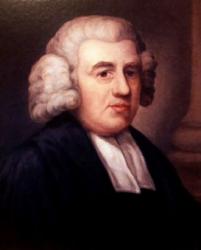
1725 - 1807 Person Name: J. Newton Author of "The peace which God alone reveals" in Song-Hymnal of Praise and Joy John Newton (b. London, England, 1725; d. London, 1807) was born into a Christian home, but his godly mother died when he was seven, and he joined his father at sea when he was eleven. His licentious and tumultuous sailing life included a flogging for attempted desertion from the Royal Navy and captivity by a slave trader in West Africa. After his escape he himself became the captain of a slave ship. Several factors contributed to Newton's conversion: a near-drowning in 1748, the piety of his friend Mary Catlett, (whom he married in 1750), and his reading of Thomas à Kempis' Imitation of Christ. In 1754 he gave up the slave trade and, in association with William Wilberforce, eventually became an ardent abolitionist. After becoming a tide-surveyor in Liverpool, England, Newton came under the influence of George Whitefield and John and Charles Wesley and began to study for the ministry. He was ordained in the Church of England and served in Olney (1764-1780) and St. Mary Woolnoth, London (1780-1807). His legacy to the Christian church includes his hymns as well as his collaboration with William Cowper (PHH 434) in publishing Olney Hymns (1779), to which Newton contributed 280 hymns, including “Amazing Grace.”
Bert Polman
==================
Newton, John, who was born in London, July 24, 1725, and died there Dec. 21, 1807, occupied an unique position among the founders of the Evangelical School, due as much to the romance of his young life and the striking history of his conversion, as to his force of character. His mother, a pious Dissenter, stored his childish mind with Scripture, but died when he was seven years old. At the age of eleven, after two years' schooling, during which he learned the rudiments of Latin, he went to sea with his father. His life at sea teems with wonderful escapes, vivid dreams, and sailor recklessness. He grew into an abandoned and godless sailor. The religious fits of his boyhood changed into settled infidelity, through the study of Shaftesbury and the instruction of one of his comrades. Disappointing repeatedly the plans of his father, he was flogged as a deserter from the navy, and for fifteen months lived, half-starved and ill-treated, in abject degradation under a slave-dealer in Africa. The one restraining influence of his life was his faithful love for his future wife, Mary Catlett, formed when he was seventeen, and she only in her fourteenth year. A chance reading of Thomas à Kempis sowed the seed of his conversion; which quickened under the awful contemplations of a night spent in steering a water-logged vessel in the face of apparent death (1748). He was then twenty-three. The six following years, during which he commanded a slave ship, matured his Christian belief. Nine years more, spent chiefly at Liverpool, in intercourse with Whitefield, Wesley, and Nonconformists, in the study of Hebrew and Greek, in exercises of devotion and occasional preaching among the Dissenters, elapsed before his ordination to the curacy of Olney, Bucks (1764).
The Olney period was the most fruitful of his life. His zeal in pastoral visiting, preaching and prayer-meetings was unwearied. He formed his lifelong friendship with Cowper, and became the spiritual father of Scott the commentator. At Olney his best works—-Omicron's Letters (1774); Olney Hymns (1779); Cardiphonia, written from Olney, though published 1781—were composed. As rector of St. Mary Woolnoth, London, in the centre of the Evangelical movement (1780-1807) his zeal was as ardent as before. In 1805, when no longer able to read his text, his reply when pressed to discontinue preaching, was, "What, shall the old African blasphemer stop while he can speak!" The story of his sins and his conversion, published by himself, and the subject of lifelong allusion, was the base of his influence; but it would have been little but for the vigour of his mind (shown even in Africa by his reading Euclid drawing its figures on the sand), his warm heart, candour, tolerance, and piety. These qualities gained him the friendship of Hannah More, Cecil, Wilberforce, and others; and his renown as a guide in experimental religion made him the centre of a host of inquirers, with whom he maintained patient, loving, and generally judicious correspondence, of which a monument remains in the often beautiful letters of Cardiphonia. As a hymnwriter, Montgomery says that he was distanced by Cowper. But Lord Selborne's contrast of the "manliness" of Newton and the "tenderness" of Cowper is far juster. A comparison of the hymns of both in The Book of Praise will show no great inequality between them. Amid much that is bald, tame, and matter-of-fact, his rich acquaintance with Scripture, knowledge of the heart, directness and force, and a certain sailor imagination, tell strongly. The one splendid hymn of praise, "Glorious things of thee are spoken," in the Olney collection, is his. "One there is above all others" has a depth of realizing love, sustained excellence of expression, and ease of development. "How sweet the name of Jesus sounds" is in Scriptural richness superior, and in structure, cadence, and almost tenderness, equal to Cowper's "Oh! for a closer walk with God." The most characteristic hymns are those which depict in the language of intense humiliation his mourning for the abiding sins of his regenerate life, and the sense of the withdrawal of God's face, coincident with the never-failing conviction of acceptance in The Beloved. The feeling may be seen in the speeches, writings, and diaries of his whole life. [Rev. H. Leigh Bennett, M.A.]
A large number of Newton's hymns have some personal history connected with them, or were associated with circumstances of importance. These are annotated under their respective first lines. Of the rest, the known history of which is confined to the fact that they appeared in the Olney Hymns, 1779, the following are in common use:—
1. Be still, my heart, these anxious cares. Conflict.
2. Begone, unbelief, my Saviour is near. Trust.
3. By the poor widow's oil and meal. Providence.
4. Chief Shepherd of Thy chosen sheep. On behalf of Ministers.
5. Darkness overspreads us here. Hope.
6. Does the Gospel-word proclaim. Rest in Christ.
7. Fix my heart and eyes on Thine. True Happiness.
8. From Egypt lately freed. The Pilgrim's Song.
9. He Who on earth as man was Known. Christ the Rock.
10. How blest are they to whom the Lord. Gospel Privileges.
11. How blest the righteous are. Death of the Righteous.
12. How lost was my [our] condition. Christ the Physician.
13. How tedious and tasteless the hours. Fellowship with Christ.
14. How welcome to the saints [soul] when pressed. Sunday.
15. Hungry, and faint, and poor. Before Sermon.
16. In mercy, not in wrath, rebuke. Pleading for Mercy.
17. In themselves, as weak as worms. Power of Prayer.
18. Incarnate God, the soul that knows. The Believer's Safety.
19. Jesus, Who bought us with His blood. The God of Israel. "Teach us, 0 Lord, aright to plead," is from this hymn.
20. Joy is a [the] fruit that will not grow. Joy.
21. Let hearts and tongues unite. Close of the Year. From this "Now, through another year," is taken.
22. Let us adore the grace that seeks. New Year.
23. Mary to her [the] Saviour's tomb. Easter.
24. Mercy, 0 Thou Son of David. Blind Bartimeus.
25. My harp untun'd and laid aside. Hoping for a Revival. From this "While I to grief my soul gave way" is taken.
26. Nay, I cannot let thee go. Prayer. Sometimes, "Lord, I cannot let Thee go."
27. Now may He Who from the dead. After Sermon.
28. 0 happy they who know the Lord, With whom He deigns to dwell. Gospel Privilege.
29. O Lord, how vile am I. Lent.
30. On man in His own Image made. Adam.
31. 0 speak that gracious word again. Peace through Pardon.
32. Our Lord, Who knows full well. The Importunate Widow. Sometimes altered to "Jesus, Who knows full well," and again, "The Lord, Who truly knows."
33. Physician of my sin-sick soul. Lent.
34. Pleasing spring again is here. Spring.
35. Poor, weak, and worthless, though I am. Jesus the Friend.
36. Prepare a thankful song. Praise to Jesus.
37. Refreshed by the bread and wine. Holy Communion. Sometimes given as "Refreshed by sacred bread and wine."
38. Rejoice, believer, in the Lord. Sometimes “Let us rejoice in Christ the Lord." Perseverance.
39. Salvation, what a glorious plan. Salvation.
40. Saviour, shine and cheer my soul. Trust in Jesus. The cento "Once I thought my mountain strong," is from this hymn.
41. Saviour, visit Thy plantation. Prayer for the Church.
42. See another year [week] is gone. Uncertainty of Life.
43. See the corn again in ear. Harvest.
44. Sinner, art thou still secure? Preparation for the Future.
45. Sinners, hear the [thy] Saviour's call. Invitation.
46. Sovereign grace has power alone. The two Malefactors.
47. Stop, poor sinner, stop and think. Caution and Alarm.
48. Sweeter sounds than music knows. Christmas.
49. Sweet was the time when first I felt. Joy in Believing.
50. Ten thousand talents once I owed. Forgiveness and Peace.
51. The grass and flowers, which clothe the field. Hay-time.
52. The peace which God alone reveals. Close of Service.
53. Thy promise, Lord, and Thy command. Before Sermon.
54. Time, by moments, steals away. The New Year.
55. To Thee our wants are known. Close of Divine Service.
56. We seek a rest beyond the skies. Heaven anticipated.
57. When any turn from Zion's way. Jesus only.
58. When Israel, by divine command. God, the Guide and Sustainer of Life.
59. With Israel's God who can compare? After Sermon.
60. Yes, since God Himself has said it. Confidence.
61. Zion, the city of our God. Journeying Zionward.
-- John Julian, Dictionary of Hymnology (1907)
=================
Newton, J., p. 803, i. Another hymn in common use from the Olney Hymns, 1779, is "Let me dwell on Golgotha" (Holy Communion).
--John Julian, Dictionary of Hymnology, Appendix, Part II (1907)
-----
John Newton was born in London, July 24, 1725. His mother died when he was seven years old. In his eleventh year he accompanied his father, a sea captain, on a voyage. For several years his life was one of dissipation and crime. He was disgraced while in the navy. Afterwards he engaged in the slave trade. Returning to England in 1748, the vessel was nearly wrecked in a storm. This peril forced solemn reflection upon him, and from that time he was a changed man. It was six years, however, before he relinquished the slave trade, which was not then regarded as an unlawful occupation. But in 1754, he gave up sea-faring life, and holding some favourable civil position, began also religious work. In 1764, in his thirty-ninth year, he entered upon a regular ministry as the Curate of Olney. In this position he had intimate intercourse with Cowper, and with him produced the "Olney Hymns." In 1779, Newton became Rector of S. Mary Woolnoth, in London, in which position he became more widely known. It was here he died, Dec. 21, 1807, His published works are quite numerous, consisting of sermons, letters, devotional aids, and hymns. He calls his hymns "The fruit and expression of his own experience."
--Annotations of the Hymnal, Charles Hutchins, M.A. 1872
See also in:
Hymn Writers of the Church
=======================
John Newton
Pages