

 My Starred Hymns
 My FlexScores
 My Hymnals
 My Purchased Files
Planning worship?
Check out our sister site, ZeteoSearch.org,
for 20+ additional resources related to your search.
- |
User Links
Search Results


Brother, hast thou wandered far
Author: James Freeman Clarke Appears in 102 hymnals Used With Tune: WANDERER
Brother, hast thou wandered far
Time is earnest, passing by
Author: Unknown Appears in 45 hymnals Used With Tune: WANDERER
Time is earnest, passing by

Brother, hast thou wandered far
Author: James Freeman Clarke Hymnal: Songs of Work and Worship #86 (1899) Languages: English Tune Title: WANDERER
Brother, hast thou wandered far
Time is earnest, passing by
Author: Unknown Hymnal: Songs of Work and Worship #87 (1899) Languages: English Tune Title: WANDERER
Time is earnest, passing by

Anonymous
Person Name: Unknown Author of "Time is earnest, passing by" in Songs of Work and Worship In some hymnals, the editors noted that a hymn's author is unknown to them, and so this artificial "person" entry is used to reflect that fact. Obviously, the hymns attributed to "Author Unknown" "Unknown" or "Anonymous" could have been written by many people over a span of many centuries.
Anonymous
James Freeman Clarke
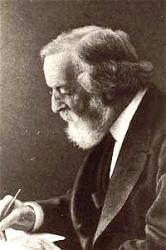
1810 - 1888 Author of "Brother, hast thou wandered far" in Songs of Work and Worship Clarke, James Freeman, D.D., is a grandson of James Freeman (q. v.)> from whom he was named. He was born at Hanover, New Hampshire, April 4, 1810, and graduated at Harvard College, in Arts, in 1829, and in Divinity, 1833. Receiving ordination as a Unitarian Minister, he was Pastor at Louisville, Kentucky, from 1833 to 1840; of the Church of the Disciples, Boston, from 1811 to 1830; and also from 1853. Dr. Clarke for some time edited, whilst at Louisville, The Western Messenger, and is the author of Orthodoxy, its Truths and Errors, 1866; The Christian Doctrine of Forgiveness, 1852; The Christian Doctrine of Prayer, 1854, and other works. In 1844 he published the Hymn Book for the Church of the Disciples. This he enlarged in 1852. To each edition be contributed five hymns. Of these ten hymns five are found in the Lyra Sacra Americana The best known of Dr. Clarke's hymns are:—
1. Father, to us Thy children, humbly kneeling. [thoughts desired.] Dr. Clarke says this was manufactured from:—
2. Infinite Spirit, who art round us ever. [Holy thoughts desired], “which was written in Kentucky about 1833, and printed in the Dial soon after."
3. Brother, hast thou wandered far! [The Prodigal Son.] This appeared in his Disciples' Hymn Book, 1844, and is somewhat extensively used. It appeared in an Brother abbreviated form as, "Hast thou wasted all the powers?" beginning with stanza ii., in Hymns for the Church of Christ, Boston, 1853; Beecher's Plymouth Collection, 1855, and subsequently in others in Great Britain and America. The next three are also in one or two English collections.
4. To Thee, 0 God, in heaven. [Holy Baptism.] 1844.
5. To Him who children blessed. [Holy Baptism.] 1844.
6. Friend, whose presence in the house. [Christ's presence desired.] 1855. The beauty and value of this last hymn have been partly, and deserve to be more fully, recognized. It is found in Lyra Sac. Amer., which also has the following on "The Protestant Reformation":—
7. For all Thy gifts we praise Thee, Lord. This hymn was sung at the collation given by the Unitarians of New York and Brooklyn to the Members of the Convention assembled in the former city, Oct. 22, 1845. As originally written it contained 8 stanzas; the last two are omitted from both Lyra Sac. Americana and Putnam's Singers and Songs of the Liberal Faith. [Rev. F. M. Bird, M.A.]
--John Julian, Dictionary of Hymnology (1907)
James Freeman Clarke
James Carter
b. 1853 Person Name: Rev. James Carter Composer of "WANDERER" in Songs of Work and Worship 19th Century
James Carter