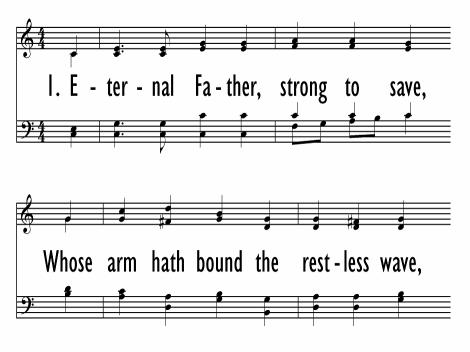
1 Eternal Father, strong to save,
Whose arm does bind the restless wave,
Who bids the mighty ocean deep
Its own appointed limits keep;
O hear us when we cry to Thee
For those in peril on the sea.
2 O Savior, whose almighty word
The winds and waves submissive heard,
Who walked upon the foaming deep,
And calm amid the rage did sleep;
O hear us when we cry to Thee
For those in peril on the sea.
3 O Holy Spirit, who did brood
Upon the waters dark and rude,
And bid their angry tumult cease,
And give for wild confusion peace;
O hear us when we cry to Thee
For those in peril on the sea.
4 O Trinity of love and pow'r,
Your children shield in danger's hour;
From rock and tempest, fire, and foe,
Protect them where-so-e'er they go;
Thus, evermore shall rise to Thee
Glad hymns of praise from land and sea.
Baptist Hymnal, 1991
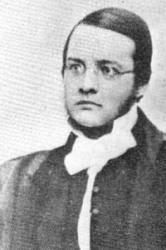
William Whiting was born in Kensington, November 1, 1825, and was educated at Clapham and Winchester Colleges. He was later master of Winchester College Choristers' School, where he wrote Rural Thoughts and Other Poems, 1851. He died at Winchester.
--The Hymnal 1940 Companion… Go to person page >| First Line: | Eternal Father, strong to save, Whose arm hath bound the restless wave |
| Title: | Eternal Father! strong to save |
| Author: | William Whiting (1860) |
| Meter: | 8.8.8.8.8.8 |
| Language: | English |
| Refrain First Line: | O hear us when we cry to Thee |
| Notes: | Spanish translation: See "Eterno y poderoso Dios" by Anonymous |
| Copyright: | Public Domain |
| Liturgical Use: | Prayer Songs |
Eternal Father, strong to save. W. Whiting. [For those at Sea.] Of this hymn the following texts are known :—
1. The original manuscript, 1860, a reprint of which is preserved in Biggs's Annotated Hymns Ancient & Modern, 1867, pp.270-271.
2. The revised text by the Compilers of Hymns Ancient & Modern, 1861, No. 222. This is most widely used of any.
3. A revision by the author made for the Appendix to the Society for Promoting Christian Knowledge Psalms and Hymns, 1869, and repeated in Church Hymns, 1871, No. 321.
4. A Latin version also by Whiting, in Biggs's Annotated Hymns Ancient & Modern, 1867, pp. 270-71. This version is of the Hymns Ancient & Modern, revised text of 1861, and not of the original manuscript.
The lack of hymns for those at sea, together with its merits as a hymn, rendered it exceedingly popular from its first publication, and its use has become most extensive in English-speaking countries. Hodges, of Frome, has published a short tale founded thereupon, and entitled "Hymn 222." Original text as above, authorized text, Church Hymns, No. 321.
--John Julian, Dictionary of Hymnology (1907)
William Whiting wrote this hymn in 1860 in England. It was modified in 1861 by the editors of Hymns Ancient and Modern, where it was first published. Whiting also revised it a few times. It has become a favorite of seafaring people in English-speaking countries, both civilian and military. In America, its affiliation as the “Navy Hymn” is prompted in part by the practice dating from 1879 of concluding the Sunday services at the Naval Academy at Annapolis with the first stanza of this hymn. The first three stanzas of this hymn appeal to the Trinity with Scripture passages where each Person controlled the sea, while the final stanza summarizes the hymn and promises continued praise “from land and sea.”
MELITA is named after the island where Paul was shipwrecked (Acts 28:1 KJV; modern Bible translations have “Malta”). It is a fitting name for a tune associated with a text about safety on the seas. MELITA was composed by John B. Dykes especially for this text in 1861, and they were published together in Hymns Ancient and Modern.
This tune is well-known and should pose little problem for congregational singing. However, the rhythm is consistently steady, with no obvious places for breathing, so worship leaders should choose a moderate tempo and indicate the ends of phrases. There is quite a bit of chromaticism throughout, which adds intensity to the mood.
Because of this hymn's association with the navy, it is used for services connected to the armed forces, such as Memorial Day. It is also used for sailors' funerals. Although this familiar tune is not hard to sing, congregation members may be more familiar with hearing instrumental versions, such as are found in “All Nature Sings” for piano with the melody in varying registers, or “Eternal Father, Strong to Save” a piano and organ duet that begins in a quiet, prayerful mood but swells to a majestic climax.
Tiffany Shomsky, Hymnary.org
My Starred Hymns