
1 Glory be to God the Father,
glory be to God the Son,
glory be to God the Spirit:
great Jehovah, Three in One!
Glory, glory while eternal ages run!
2 Glory be to him who loved us,
washed us from each spot and stain;
glory be to him who bought us,
made us kings with him to reign!
Glory, glory to the Lamb that once was slain!
3 Glory to the King of angels,
glory to the Church’s King,
glory to the King of nations;
heav'n and earth your praises bring!
Glory, glory, to the King of glory sing!
4 Glory, blessing, praise eternal!
thus the choir of angels sings;
Honor, riches, pow'r, dominion!
thus its praise creation brings.
Glory, glory to the King of kings!
Source: Christian Worship: Hymnal #608
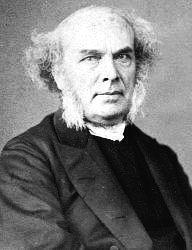
Horatius Bonar was born at Edinburgh, in 1808. His education was obtained at the High School, and the University of his native city. He was ordained to the ministry, in 1837, and since then has been pastor at Kelso. In 1843, he joined the Free Church of Scotland. His reputation as a religious writer was first gained on the publication of the "Kelso Tracts," of which he was the author. He has also written many other prose works, some of which have had a very large circulation. Nor is he less favorably known as a religious poet and hymn-writer. The three series of "Hymns of Faith and Hope," have passed through several editions.
--Annotations of the Hymnal, Charles Hutchins, M.A. 1872… Go to person page >| First Line: | Glory be to God the Father! Glory be to God the Son! |
| Title: | Glory Be to God the Father |
| Author: | Horatius Bonar (1866) |
| Meter: | 8.7.8.7.4.7 |
| Language: | English |
| Notes: | Esperanto translation: "Gloron al la dia Patro" by Mantagu C. Butler |
| Copyright: | Public Domain |
Glory be to God the Father. H. Bonar. [Praise.] Published in his Hymns of Faith and Hope, 3rd series, 1866, in 4 stanzas of 6 lines, and entitled "Praise." It is included in several collections in Great Britain and America, in its original form. In the Supplement to the New Congregational Hymnal, 1874, and that to the Baptist Psalms & Hymns, 1880, the stanzas are transposed, ii., iv., iii., i., and the hymn begins, "Glory be to Him Who loved us." The last stanza is sometimes used as a doxology distinct from the hymn itself.
--John Julian, Dictionary of Hymnology (1907)
My Starred Hymns