You help make Hymnary.org possible. More than 10 million people from 200+ countries found hymns, liturgical resources and encouragement on Hymnary.org in 2025, including you. Every visit affirms the global impact of this ministry.

If Hymnary has been meaningful to you this year, would you take a moment today to help sustain it? A gift of any size—paired with a note of encouragement if you wish—directly supports the server costs, research work and curation that keep this resource freely available to the world.

Give securely online today, or mail a check to:
Hymnary.org
Calvin University
3201 Burton Street SE
Grand Rapids, MI 49546

Thank you for your partnership, and may the hope of Advent fill your heart.

Person Results

Text Identifier:"^kyrie_eleison_christe_eleison$"
In:people

Planning worship? Check out our sister site, ZeteoSearch.org, for 20+ additional resources related to your search.
Showing 11 - 20 of 79Results Per Page: 102050

Christopher Walker

b. 1947 Person Name: Christopher Walker, b. 1947 Composer of "[Kyrie eleison]" in Journeysongs (2nd ed.)

Betty Pulkingham

1928 - 2019 Person Name: Betty Carr Pulkingham Composer of "[Kyrie eleison]" in Wonder, Love, and Praise Betty Carr Pulkingham was born in 1928 in Burlington, North Carolina. She received a B.S. in Music in 1949 from the University of North Carolina, Greensboro and she did graduate studies at the Eastman School of Music. She was Instructor of Music Theory at the University of Texas. In 1951, she married a seminarian Graham Pulkingham. They ministered together in various places in the U.S., England and Scotland; they were founding members of the Community of Celebration, an Anglican religious order. She travelled widely with "The Fisherfolk," an outreach music ministry connected with the Community of Celebration. Betty Pulkingham was a well known composer and arranger. She co-edited and published a number of songbooks and books on worship; and served on the Episcopal Church's Standing Commission on Church Music from 1988-1994. She and her husband returned to Burlington and then she later moved to Austin, Texas to live with family. She died in Austin, May 9, 2019 at the age of 90. Dianne Shapiro, from Obituary (https://www.richandthompson.com/tributes/Betty-Pulkingham) (accessed 6-21-2019)

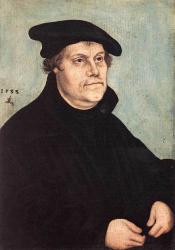
Martin Luther

1483 - 1546 Person Name: ks. Marcin Luter Composer of "KYRIE ELEISON" in Śpiewnik Ewangelicki Luther, Martin, born at Eisleben, Nov. 10, 1483; entered the University of Erfurt, 1501 (B.A. 1502, M.A.. 1503); became an Augustinian monk, 1505; ordained priest, 1507; appointed Professor at the University of Wittenberg, 1508, and in 1512 D.D.; published his 95 Theses, 1517; and burnt the Papal Bull which had condemned them, 1520; attended the Diet of Worms, 1521; translated the Bible into German, 1521-34; and died at Eisleben, Feb. 18, 1546. The details of his life and of his work as a reformer are accessible to English readers in a great variety of forms. Luther had a huge influence on German hymnody. i. Hymn Books. 1. Ellich cristlich lider Lobgesang un Psalm. Wittenberg, 1524. [Hamburg Library.] This contains 8 German hymns, of which 4 are by Luther. 2. Eyn Enchiridion oder Handbuchlein. Erfurt, 1524 [Goslar Library], with 25 German hymns, of which 18 are by Luther. 3. Geystliche Gesangk Buchleyn. Wittenberg, 1524 [Munich Library], with 32 German hymns, of which 24 are by Luther. 4. Geistliche Lieder auffs new gebessert. Wittenberg. J. Klug, 1529. No copy of this book is now known, but there was one in 1788 in the possession of G. E. Waldau, pastor at Nürnberg, and from his description it is evident that the first part of the Rostock Gesang-Buch, 1531, is a reprint of it. The Rostock Gesang-Buch, 1531, was reprinted by C. M. Wiechmann-Kadow at Schwerin in 1858. The 1529 evidently contained 50 German hymns, of which 29 (including the Litany) were by Luther. 5. Geistliche Lieder auffs new gebessert. Erfurt. A. Rauscher, 1531 [Helmstädt, now Wolfenbüttel Library], a reprint of No. 4. 6. Geistliche Lieder. Wittenberg. J. Klug, 1535 [Munich Library. Titlepage lost], with 52 German hymns, of which 29 are by Luther. 7. Geistliche Lieder auffs new gebessert. Leipzig. V. Schumann, 1539 [Wernigerode Library], with 68 German hymns, of which 29 are by Luther. 8. Geistliche Lieder. Wittenberg. J. Klug, 1543 [Hamburg Library], with 61 German hymns, of which 35 are by Luther. 9. Geystliche Lieder. Leipzig. V. Babst, 1545 [Gottingen Library]. This contains Luther's finally revised text, but adds no new hymns by himself. In pt. i. are 61 German hymns, in pt. ii. 40, of which 35 in all are by Luther. For these books Luther wrote three prefaces, first published respectively in Nos. 3, 4, 9. A fourth is found in his Christliche Geseng, Lateinisch und Deudsch, zum Begrebnis, Wittenberg, J. Klug, 1542. These four prefaces are reprinted in Wackernagel’s Bibliographie, 1855, pp. 543-583, and in the various editions of Luther's Hymns. Among modern editions of Luther's Geistliche Lieder may be mentioned the following:— Carl von Winterfeld, 1840; Dr. C. E. P. Wackernagel, 1848; Q. C. H. Stip, 1854; Wilhelm Schircks, 1854; Dr. Danneil, 1883; Dr. Karl Gerok, 1883; Dr. A. F. W. Fischer, 1883; A. Frommel, 1883; Karl Goedeke, 1883, &c. In The Hymns of Martin Luther. Set to their original melodies. With an English version. New York, 1883, ed. by Dr. Leonard Woolsey Bacon and Nathan H. Allen, there are the four prefaces, and English versions of all Luther's hymns, principally taken more or less altered, from the versions by A. T. Russell, R. Massie and Miss Winkworth [repub. in London, 1884]. Complete translations of Luther's hymns have been published by Dr. John Anderson, 1846 (2nd ed. 1847), Dr. John Hunt, 1853, Richard Massie, 1854, and Dr. G. Macdonald in the Sunday Magazine, 1867, and his Exotics, 1876. The other versions are given in detail in the notes on the individual hymns. ii. Classified List of Luther's Hymns. Of Luther's hymns no classification can be quite perfect, e.g. No. 3 (see below) takes hardly anything from the Latin, and No. 18 hardly anything from the Psalm. No. 29 is partly based on earlier hymns (see p. 225, i.). No. 30 is partly based on St. Mark i. 9-11, and xvi., 15, 16 (see p. 226, ii.). No. 35 is partly based on St. Luke ii. 10-16. The following arrangement, however, will answer all practical purposes. A. Translations from the Latin. i. From Latin Hymns: 1. Christum wir sollen loben schon. A solis ortus cardine 2. Der du bist drei in Einigkeit. O Lux beata Trinitas. 3. Jesus Christus unser Heiland, Der von. Jesus Christus nostra salus 4. Komm Gott Schopfer, heiliger Geist. Veni Creator Spiritus, Mentes. 5. Nun komm der Beidenheiland. Veni Redemptor gentium 6. Was flirchst du Feind Herodes sehr. A solis ortus cardine ii. From Latin Antiphons, &c.: 7. Herr Gott dich loben wir. Te Deum laudamus. 8. Verleih uns Frieden gnädiglich. Dapacem, Domine 9. Wir glauben all an einen Gott. iii. Partly from the Latin, the translated stanzas being adopted from Pre-Reformation Versions: 10. Komm, heiliger Geist, Herre Gott. 11. Mitten wir im Leben sind. Media vita in morte sumus. B. Hymns revised and enlarged from Pre-Reformation popular hymns. 12. Gelobet seist du Jesus Christ. 13. Gott der Vater wohn uns bei. 14. Gott sei gelobet und gebenedeiet. 15. Nun bitten wir den heiligen Geist. C. Psalm versions. 16. Ach Gott vom Himmel, sieh darein. 17. Aus tiefer Noth schrei ich zu dir. 18. Ein' feste Burg ist unser Gott. 19. Es spricht der Unweisen Mund wohl. 20. Es wollt uns Gott genädig sein. 21. War Gott nicht mit uns diese Zeit. 22. Wohl dem, der in Gotten Furcht steht. D. Paraphrases of other portions of Holy Scripture. 23. Diess sind die heilgen zehn Gebot. 24. Jesaia dem Propheten das geschah. 25. Mensch willt du leben seliglich. 26. Mit Fried und Freud ich fahr dahin. 27. Sie ist mir lieb die werthe Magd. 28. Vater unser im Himmelreich. E. Hymns mainly Original. 29. Christ lag in Todesbanden. 30. Christ unser Herr zum Jordan kam. 31. Ein neues Lied wir heben an. 32. Erhalt uns Herr bei deinem Wort. 33. Jesus Christus unser Heiland, Der den, 34. Nun freut euch lieben Christengemein. 35. Vom Himmel hoch da komm ich her. 36. Vom Himmel kam der Engel Schaar. In addition to these — 37. Fur alien Freuden auf Erden. 38. Kyrie eleison. In the Blätter fur Hymnologie, 1883, Dr. Daniel arranges Luther's hymns according to what he thinks their adaptation to modern German common use as follows:— i. Hymns which ought to be included in every good Evangelical hymn-book: Nos. 7-18, 20, 22, 28, 29, 30, 32, 34, 35, 36, 38. ii. Hymns the reception of which into a hymn-book might be contested: Nos. 2, 3, 4, 19, 21, 22, 23, 24, 25, 33. iii. Hymns not suited for a hymn-book: Nos. 1, 5, 6, 27, 31, 37. [Rev. James Mearns, M.A.] --John Julian, Dictionary of Hymnology (1907)

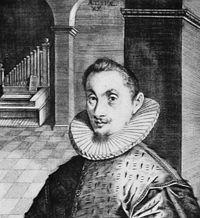
Hans Leo Hassler

1564 - 1612 Person Name: Hans Leo Hassler, 1564-1612 Composer of "[Kyrie eleison]" in The Hymnal 1982 Hans Leo Hassler Germany 1564-1612. Born at Nuremberg, Germany, he came from a family of famous musicians and received early education from his father. He then studied in Venice, Italy, with Andrea Gabrieli, uncle of Giovanni Gabrieli, his friend, with whom he composed a wedding motet. The uncle taught him to play the organ. He learned the polychoral style and took it back to Germany after Andrea Gabrieli's death. He served as organist and composer for Octavian Fugger, the princely art patron of Augsburg (1585-1601). He was a prolific composer but found his influence limited, as he was Protestant in a still heavily Catholic region. In 1602 he became director of town music and organist in the Frauenkirche in Nuremberg until 1608. He married Cordula Claus in 1604. He was finally court musician for the Elector of Saxony in Dresden, Germany, evenually becoming Kapellmeister (1608-1612). A Lutheran, he composed both for Roman Catholic liturgy and for Lutheran churches. He produced two volumns of motets, a famous collection of court songs, and a volume of simpler hymn settings. He published both secular and religious music, managing to compose much for the Catholic church that was also usable in Lutheran settings. He was also a consultant to organ builders. In 1596 he, with 53 other organists, had the opportunity to examine a new instrument with 59 stops at the Schlosskirche, Groningen. He was recognized for his expertise in organ design and often was called on to examine new instruments. He entered the world of mechanical instrument construction, developing a clockwork organ that was later sold to Emperor Rudolf II. He died of tuberculosis in Frankfurt, Germany. John Perry

Lucien Deiss

1921 - 2007 Composer of "[Kyrie eleison]" in Cantos del Pueblo de Dios = Songs of the People of God (2nd ed.) Born: 1921, Par­is, France. Died: Oc­to­ber 9, 2007, Île-de-France, France. Buried: Seminaire des Mis­sions, Che­vil­ly-La­rue, Île-de-France, France. A mem­ber of the Ho­ly Spir­it Fa­thers, Deiss at­tende­d the Gre­gor­i­an Un­i­ver­si­ty in Rome and taught the­ol­o­gy at the Grand Scho­las­ti­cat of Che­ville in Paris, France. His works in­clude: Early Sources of the Li­tur­gy, 1967 It’s the Lord’s Sup­per/, 1976 Spring Time of the Li­tur­gy, 1979 Sources: Brink & Polman, P. 313 --www.hymntime.com/tch/ ================= Fr. Deiss was pastor, liturgist, author, international lecturer, renowned Scripture scholar, and an expert on liturgical music. He was selected by Pope Paul VI to coordinate the Lectionary psalter following the Second Vatican Council. His Biblical Hymns and Psalms was the one of the first major collections of liturgical music in the vernacular, and gave us such songs as "All the Earth," "Keep in Mind," and "Grant to Us, O Lord." A tireless advocate of the reforms of Vatican II, Fr. Deiss continually encouraged those who worked in liturgical reform to remain fervent in prayer, and he dedicated much of his life to liturgical catechesis through workshops and writings. --www.decanimusic.co.uk/

Ronald F. Krisman

Arranger of "[Kyrie eleison]" in Worship (4th ed.)

Michel Guimont

b. 1950 Composer of "[Kyrie eleison]" in Worship (4th ed.)

Geoff Weaver

b. 1943 Arranger of "[Kyrie eleison]" in In Every Corner Sing

María Eugenia Cornou

b. 1969 Person Name: María Eugenia Cornou, b. 1969 Translator (Spanish) of "Kyrie eleison (Lord, Have Mercy) (Ten misericordia)" in Santo, Santo, Santo

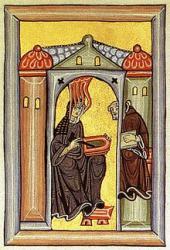
Saint Hildegard

1098 - 1179 Person Name: Hildegard of Bingen (1098-1179) Composer of "[Kyrie eleison]" in Wonder, Love, and Praise Hildegard, St., Virgin and Abbess, was born at Bockelheim, or Bockenheim, Frankfurt, 1098. Her father, Hildebert, was one of the Knights of Meginhard, Count of Spanheim. When eight years old she was committed to tho care of a sister of the Count, Jutta, the Abbess of St. Disibod, a position in which she was succeeded by Hildegard in 1136. Under the rule of Hildegard the convent became so crowded that a new one was built at Rupertsberg, near Bingen, into which, in 1147, Hildegard removed with eighteen Sisters. Hildegard gained great notoriety in very early life on account of visions to which, it is said, she was subject from her 6th to her 15th year. In later life she filled a considerable place in the history of her times, not only as a writer who had the courage of her opinions, and spared neither high nor low in her vigorous denunciations of their shortcomings, political as well as moral, but as a prophetess and preacher. At the instigation of St. Bernard she took a most prominent part in stirring up the unfortunate crusade which he preached, and engaged in many controversies with the hierarchy of her Church. Though she never ceased to be the abbess of the convent she had founded, much of her time was spent in travelling about the Continent, preaching and prophesying. She died in 1179, and was buried at Eupertsberg, but her remains were removed, on the destruction of that convent by the Swedes, to Eilingen, in 1622. Though St. Hildegard was a voluminous writer her contributions to the hymnody of her day were neither numerous nor important. Mone gives three sequences which are attributed to her, viz., one on the Holy Spirit, “0 ignis Spiritus paracliti"; another on the Blessed Virgin Mary, "0 Virga ac diadema purpurae Regis"; and a third on St. Disibod, "0 praesul verae civitatis." [Rev. Digby S. Wrangham, M.A.] -- John Julian, Dictionary of Hymnology

Pages


Export as CSV
It looks like you are using an ad-blocker. Ad revenue helps keep us running. Please consider white-listing Hymnary.org or getting Hymnary Pro to eliminate ads entirely and help support Hymnary.org.