You help make Hymnary.org possible. More than 10 million people from 200+ countries found hymns, liturgical resources and encouragement on Hymnary.org in 2025, including you. Every visit affirms the global impact of this ministry.

If Hymnary has been meaningful to you this year, would you take a moment today to help sustain it? A gift of any size—paired with a note of encouragement if you wish—directly supports the server costs, research work and curation that keep this resource freely available to the world.

Give securely online today, or mail a check to:
Hymnary.org
Calvin University
3201 Burton Street SE
Grand Rapids, MI 49546

Thank you for your partnership, and may the hope of Advent fill your heart.

Person Results

Tune Identifier:"^trust_mendelssohn$"
In:person

Planning worship? Check out our sister site, ZeteoSearch.org, for 20+ additional resources related to your search.
Showing 11 - 20 of 38Results Per Page: 102050

Christopher Newman Hall

1816 - 1902 Person Name: Newman Hall Author of "Friend of sinners! Lord of glory!" in Common Praise Hall, Christopher Newman, LL.B., son of J. Vine Hall, was born at Maidstone, May 22, 1816, and educated at Totteridge School, and Highbury College, London. In 1841 he graduated B.A. at the University of London, and LL.B. in 1856. From 1842 to 1854 he was minister of Albion Church, Hull; and from 1854 he has been in charge of Surrey Chapel, and its continuation, Christ Church, Westminster. He was also chairman of the Congregational Union of England and Wales in 1876. In addition to several prose works, and numerous tracts (one of which, "Come to Jesus," has been translated into 30 languages and has reached a circulation of two millions), he published:— (1) Hymns composed at Bolton Abbey, and Other Rhymes, Lond., Nisbet, 1858; (2) Cloud and Sunshine, Lond., Hamilton, Adams & Co., 1870; (3) Christ Church Hymnal, for the use of the Congregation of Christ Church, Westminster Road, Lond., Nisbet, 1876; (4) Pilgrim Songs in Sunshine and Shade, Lond. 1870 (this is No. 1 with additional verses); (5) Supplemental Pilgrim Songs; and (6) Songs of Earth and Heaven, Lond., Hodder & Stoughton, 1886. In the Christ Church Hymnal, 1876, there are 82 original hymns by Mr. Hall, 10 of which previously appeared in his Hymns composed at Bolton Abbey, &c, 1858. All the 82 hymns are signed “N. H." Of his hymns the most popular are, "Accepting, Lord, Thy gracious call"; "Friend of sinners, Lord of glory"; and "Hallelujah, joyful raise" (q.v.). In addition the following are also in common use outside of his Hymnal:— 1. Come, Lord, to earth again (1876). Advent. 2. Day again is dawning (1872). Morning. 3. Friend of sinners, hear my cry (1844). Lent. 4. God bless our dear old England (1876). National Hymn. 5. I know who makes the daisies. Providence. 6. Lord, we do not ask to know (1876). Missions. 7. O Jesus, Who to favoured friend (1876). B. V. M. given into the charge of St. John. [Rev. W. Garrett Horder] -- John Julian, Dictionary of Hymnology ===================== Hall, C. N., p. 481, i. Several recent hymns are included in his Lyrics of a Long Life, 1894. The additional hymns which have come into use since 1890 include:— 1. Come to Jesus! Friend of sinners. [Jesus the Saviour.] Lyrics, 1894, p. 176. Previously in Congregational Sunday School, Supplement, 1891, and School Hymns, 1891, as "Come to Jesus! Mighty Saviour." 2. I want to live and be a man. [Manliness.] Lyrics, 1894, p. 240, headed "A Boy's Hymn." A response to "I want to be an Angel" [p. 559, i.]. Previously in School Hymns, 1891, No. 334. 3. I've wandered far from home. [The Prodigal.] Pilgrim Songs, 1871, p. 17; Christian Endeavour Hymnal, 1896. 4. Lord! we obey Thy kind command. [Repentance.] Lyrics, 1894, p. 193. Previously in School Hymns, 1891, No. 137, as "Lord! I obey." 5. 0 for the love, the perfect love. [Fearless Love.] Lyrics, 1894, p. 199. Previously in School Hymns, 1891, No. 482. 6. To David's Son, Hosanna. [Hosanna to Jesus.] In Christ Church Hymnal, 1876, No. 550, the Sunday School Hymnary, 1905, &c. Mr. Hall died Feb. 18, 1902. [Rev. James Mearns, M.A.] --John Julian, Dictionary of Hymnology, New Supplement (1907)

Thomas Hastings

1784 - 1872 Author of "He that goeth forth with weeping" in The American Hymnal for Chapel Service Hastings, Thomas, MUS. DOC., son of Dr. Seth Hastings, was born at Washington, Lichfield County, Connecticut, October 15, 1784. In 1786, his father moved to Clinton, Oneida Co., N. Y. There, amid rough frontier life, his opportunities for education were small; but at an early age he developed a taste for music, and began teaching it in 1806. Seeking a wider field, he went, in 1817, to Troy, then to Albany, and in 1823 to Utica, where he conducted a religious journal, in which he advocated his special views on church music. In 1832 he was called to New York to assume the charge of several Church Choirs, and there his last forty years were spent in great and increasing usefulness and repute. He died at New York, May 15, 1872. His aim was the greater glory of God through better musical worship; and to this end he was always training choirs, compiling works, and composing music. His hymn-work was a corollary to the proposition of his music-work; he wrote hymns for certain tunes; the one activity seemed to imply and necessitate the other. Although not a great poet, he yet attained considerable success. If we take the aggregate of American hymnals published duriug the last fifty years or for any portion of that time, more hymns by him are found in common use than by any other native writer. Not one of his hymns is of the highest merit, but many of them have become popular and useful. In addition to editing many books of tunes, Hastings also published the following hymnbooks:— (1) Spiritual Songs for Social Worship: Adapted to the Use of Families and Private Circles in Seasons of Revival, to Missionary Meetings, &c, Utica, 1831-2, in which he was assisted by Lowell Mason; (2) The Mother's Hymn-book, 1834; (3) The Christian Psalmist; or, Watts's Psalms and Hymns, with copious Selections from other Sources, &c, N. Y., 1836, in connection with "William Patton; (4) Church Melodies, N. Y., 1858, assisted by his son, the Rev. T. S. Hastings; (5) Devotional Hymns and Poems, N. Y., 1850. The last contained many, but not all, of his original hymns. (6) Mother's Hymn-book, enlarged 1850. The authorship of several of Hastings's hymns has been somewhat difficult to determine. All the hymns given in the Spiritual Songs were without signatures. In the Christian Psalmist some of his contributions were signed "Anon." others "M. S.," whilst others bore the names of the tune books in which they had previously appeared; and in the Church Melodies some were signed with his name, and others were left blank. His MSS [manuscript] and Devotional Hymns, &c, enable us to fix the authorship of over 50 which are still in common use. These, following the chronological order of his leading work, are:— i. From the Spiritual Songs, 1831:— 1. Before Thy footstool kneeling. In Sickness. No. 358, in 3 stanzas of 8 lines. 2. Bleeding hearts defiled by sin. Fulness of Christ. No. 261, in 5 stanzas of 4 lines. 3. Child of sin and sorrow, Filled with dismay. Lent. No. 315, in 2 stanzas of 8 lines. It is sometimes given as "Child of sin and sorrow, Where wilt thou flee?" It is in extensive use. 4. Delay not, delay not, 0 sinner draw near. Exhortation to Repentance. No. 145, in 5 stanzas of 4 lines. Given in several important collections. 5. Forgive us, Lord, to Thee we cry. Forgiveness desired. No. 165, in 4 stanzas of 4 lines. 6. Gently, Lord, 0 gently lead us. Pilgrimage of Life. No. 29, in 2 stanzas of 8 lines. It is given in several collections. The first two lines are taken from a hymn which appeared in the Christian Lyre, 1830. 7. Go forth on wings of fervent prayer. For a blessing on the distribution of Books and Tracts. No. 250, in 4 stanzas of 5 lines. It is sometimes given as “Go forth on wings of faith and prayer," as in the Baptist Praise Book, N. Y., 1871, No. 1252; but the alterations are so great as almost to constitute it a new hymn. 8. Hail to the brightness of Zion's glad morning. Missionary Success. No. 239, in 4 stanzas of 4 lines. In several hymnbooks in Great Britain and America. 9. How calm and beautiful the morn. Easter. No. 291, in 5 stanzas of 6 lines. Very popular. 10. In this calm, impressive hour. Early Morning. No. 235, pt. i. in 3 stanzas of 6 lines. In several collections. 11. Jesus, save my dying soul. Lent. No. 398, in 4 stanzas of 4 lines. A deeply penitential hymn. 12. Now be the gospel banner. Missions. No. 178, in 2 stanzas of 8 lines. In several collections (see below). 13. Now from labour, and from care. Evening. No. 235. Pt. ii. in 3 stanzas of 6 lines. This hymn, with No. 10 above, "In this calm," &c, constitute one hymn of 6 st. in the Spiritual Songs, but divided into two parts, one for Morning and the other for Evening. Both parts are popular as separate hymns. 14. 0 God of Abraham, hear. Prayer on behalf of Children. No. 288, in 5 stanzas of 4 lines. In use in Great Britain. 15. 0 tell me, Thou Life and delight of my soul. Following the Good Shepherd. No. 151, in 5 stanzas of 4 lines, on Cant. i. 7, 8. 16. Return, O wanderer, to thy home. The Prodigal recalled. No. 183, in 3 stanzas of 4 lines, with the refrain, " Return, return " (see below). 17. Soft and holy is the place. Public Worship. No. 351, in 4 stanzas of 4 lines. In Dr. Hatfield's Church Hymn Book, N. Y., 1872, and some other collections, the opening line is altered to "Sweet and holy is the place." 18. That warning voice, 0 sinner, hear. Exhortation to Repentance. No. 231, in 4 stanzas of 6 lines. 19. To-day the Saviour calls. Lent. No. 176, in 4 stanzas of 4 lines. Dr. Hastings says, in a communication to Dr. Stevenson (Hymns for Church and Home, 1873), this hymn “was offered me in a hasty sketch which I retouched." The sketch was by the Rev. S. F. Smith. 20. Why that look of sadness. Consolation. No. 268, in 3 stanzas of 8 lines. 21. Zion, dreary and in anguish. The Church Comforted. No. 160, in 4 stanzas of 4 lines. Concerning the two hymns, No. 12, "Now be the gospel banner"; and No. 16, "Beturn, O wanderer, to thy home," Dr. Stevenson has the following note in his Hymns for Church and Home, London, 1873:— "In a letter to the Editor, Dr. Hastings wrote, not more than a fortnight before his death, 'These two hymns of mine were earlier compositions, the former ["Now be," &c.] for a Utica Sunday School celebration, the latter ["Return, 0 wanderer," &c.] after hearing a stirring revival sermon on the Prodigal Son, by the Rev. Mr. Kint, at a large union meeting in the Presbyterian Church, where two hundred converts were present. The preacher at the close eloquently exclaimed with tender emphasis, "Sinner, come home! come home! come home!" It was easy afterwards to write, "Return, 0 wanderer."'" Several additional hymns in the Spiritual Songs, 1831, have been ascribed to Dr. Hastings, but without confirmation. The sum of what can be said on his behalf is that the hymns are in his style, and that they have not been claimed by others. They are:— 22. Drooping souls, no longer mourn. Pardon promised. No. 40, in 3 stanzas of 8 1., of which st. i., ii. are altered from J. J. Harrod's Public, Parlour, and Cottage Hymns, Baltimore, 1823, that is, 8 years before the Spiritual Songs were published. 23. Dying souls, fast bound in sin. Pardon offered. No. 41, in 5 stanzas of 8 lines. It is usually given in an abridged form. ii. From his Mother's Hymn Book, 1834:—- 24. Forbid them not, the Saviour cried. Holy Baptism. No. 44. 25. God of mercy, hear our prayer. On behalf of Cliildrcn, No. 48, in 5 stanzas of 4 lines. It was included in J. Campbell's Comprehensive Hymn Book, Lond., 1837, and subsequently in several collections. 26. God of the nations, bow Thine ear. Missions. No. 115, in 4 stanzas of 6 lines. In several collections. 27. How tender is Thy hand. Affliction. No. 99, in 5 stanzas of 41. 28. Jesus, while our hearts are bleeding. Death. Resignation. No. 95, in 5 stanzas of 4 lines. This is in extensive use and is one of his best and most popular hymns. 29. Lord, I would come to Thee. Self-dedication of a Child. No. 72, in 4 stanzas of 4 lines. 30. 0 Lord, behold us at Thy feet. Lent. No. 59, in 4 stanzas of 4 lines. It is doubtful if this is by Hastings. It is sometimes signed "Mrs. T." 31. The rosy light is dawning. Morning. No. 11, in 3 stanzas of 8 lines. 32. The Saviour bids us [thee] watch and pray. Watch and Pray. No. 119, in 4 stanzas of 4 lines. 33. Thou God of sovereign grace. On behalf of Children. No. 66, in 6 stanzas of 4 lines. 34. Wherever two or three may meet. Divine Service. No. 56. 35. Within these quiet walls, 0 Lord. Mothers' Meetings. No. 58, in 5 stanzas of 4 lines. In Spurgeon's Our Own Hymn Book, 1866, No. 1010, it begins, "Within these peaceful walls." This reading is from J. Campbell's Comprehensive Hymn Book, London, 1837. It is very doubtful if this is by Hastings. iii. From the Christian Psalmist, 1836:— 36. Children, hear the melting story. On the life of Christ. No. 430, in 3 stanzas of 6 lines. It is given as from the Union Minstrel, and the statement that it is by Hastings is very doubtful, no evidence to that effect being in the possession of his family. Dr. Hatfield, in his Church Hymn Book, dates it 1830, and gives it as "Anon." 37. Go, tune thy voice to sacred song. Praise No. 190, in 5 stanzas of 5 lines, and given as from "ms." 38. He that goeth forth with weeping. Missions No. 212, in 2 stanzas of 8 lines, and given as from "ms." It is in several collections. 39. I love the Lord, Whose gracious ear. Ps. cxvi. Page 186, in 4 stanzas of 6 lines, as from "ms." 40. Lord of the harvest, bend Thine ear. For the Increase of the Ministry. No. 407, in 6 stanzas of 4 lines, as from "ms." This hymn Dr. Hastings altered for his Devotional Hymns & Poems, 1850, but it has failed to replace the original in the hymnbooks. iv. From the Reformed Dutch Additional Hymns, 1846:— 41. Child of sorrow, child of care [woe]. Trust. No. 168, in 2 stanzas of 8 lines, appeared in W. Hunter's Minstrel of Zion, 1845. 42. Heirs of an immortal crown. Christian Warfare. No. 136, in 2 stanzas of 8 lines. 43. O Saviour, lend a listening ear. Lent. No. 175. Stanzas vi., i., iv., v., altered. 44. The Lord Jehovah lives. Ps. xviii. No. 26, in 4 stanzas of 6 lines. These three hymns, together with many others, are given in the Dutch Reformed Hymns of the Church, N. Y., 1869. In the 1847 Psalms & Hymns there were, including these, 38 hymns by Hastings, and 2 which are doubtful. v. From Dr. Hastings's Devotional Hymns and Religious Poems, 1850:— 45. In time of fear, when trouble's near. Encouragement in Trial. Page 95, in 3 stanzas of 4 lines. In use in Great Britain. vi. From Church Melodies, 1858:—- 46. For those in bonds as bound with them. Missions. No. 416, in 5 stanzas of 4 lines, on Heb. xiii. 3. 47. Forget thyself, Christ bids thee come. Holy Communion. No. 683, in 3 stanzas of 6 lines. 48. Jesus, Merciful and Mild. Leaning on Christ. No. 585, in 4 stanzas of 8 1. In several collections. 49. Pilgrims in this vale of sorrow. Self-denial. No. 397, in 4 stanzas of 4 lines. 50. Saviour, I look to Thee. Lent. In time of Trouble. No. 129, in 4 stanzas of 7 lines. 51. Saviour of our ruined race. Holy Communion. No. 379, in 3 stanzas of 6 lines. 52. Why that soul's commotion? Lent. No. 211, in 3 stanzas of 8 lines. It is doubtful if this is by Hastings. vii. In Robinson's Songs of the Church, 1862: 53. Be tranquil, 0 my soul. Patience in Affliction. No. 519, in 4 stanzas of 4 lines. Altered in Robinson's Songs for the Sanctuary, 1865. 54. Peace, peace, I leave with you. Peace, the benediction of Christ. No. 386, in 3 stanzas of 7 lines. 55. Saviour, Thy gentle voice. Christ All in All. No. 492, in 3 stanzas of 7 lines. viii. In Bobinson's Songs for the Sanctuary, 1865:— 56. God of the morning ray. Morning. No. 53, in 2 stanzas of 7 lines. Of Hastings's hymns about 40 are in the Reformed Dutch Psalms & Hymns, 1847; 39 in Robinson's Songs for the Sanctuary, 1865; 15 in Hatfield's Church Hymn Book, 1872; and 13 in the Lyra Sacra Americana, 1868. They are also largely represented in other collections. Many other of his compositions are found in collections now or recently in common use, but these are not of the highest merit. [Rev. F. M. Bird, M.A.] --John Julian, Dictionary of Hymnology (1907) ======================== Hastings, T., p. 494, i. Additional hymns are:— 1. Children hear the wondrous story; and "Sinners, hear the melting story," are altered forms of No. 36, on p. 495, i. 2. Father, we for our children plead. On behalf of Children. 3. Forgive my folly, O Lord most holy. Lent. 4. Hosanna to the King, That for, &c. Praise to Jesus. 5. I look to Thee, O Lord, alone. Pardon desired. 6. Jesus, full of every grace. Pardon desired. 7. O why should gloomy thoughts arise? The Mourner Encouraged. 8. Peace to thee, O favoured one. Peace in Jesus. 9. Saviour, hear us through Thy merit. Forgiveness. Of these hymns, No. 3 is in Hasting’s Spiritual Songs, 1831; No. 9 in his Mother's Hymn Book, 1834, and his Devotional Hymns, 1850; and Nos. 4, 5 & 8 in his Devotional Hymns, 1850. --John Julian, Dictionary of Hymnology, Appendix, Part II (1907)

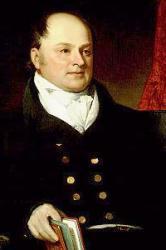
John Quincy Adams

1767 - 1848 Author of "Heav'n is here, where hymns of gladness" in The American Hymnal for Chapel Service Adams, John Quincy. (Braintree, Mass., July 11, 1767-February 21, 1848, Washington, D.C.). Most of Adams' verse, both religious and secular, was written after he had left the Presidency. In his later years he composed a metrical version of the Psalms, best described as a free rendering in fairly good verse of what he felt was the essential idea of each Psalm. When his minister, William P. Lunt, of the First Parish, (Unitarian), Quincy, Mass., undertook the preparation of his hymn book The Christian Psalter, Mrs. Adams put the manuscript of her husband's metrical Psalms into Lunt's hands, and the latter included 17 of them in his book, and five other hymns by his distinguished parishioner. The effect on Adams is recorded in a moving entry in his Journal which reveals an aspect of his character quite unknown to those who regarded him as an opinionated and uncompromising though sincere and upright politician. He wrote on June 29, 1845: "Mr. Lunt preached this morning, Eccles. III, 1. For everything there is a season. He had given out as the first hymn to be sung the 138th of the Christian Psalter, his compilation and the hymn-book now used in our church. It was my version of the 65th Psalm; and no words can express the sensations with which I heard it sung. Were it possible to compress into one pulsation of the heart the pleasure which, in the whole period of my life, I have enjoyed in praise from the lips of mortal man, it would not weigh a straw to balance the ecstasy of delight which streamed from my eyes as the organ pealed and the choir of voices sung the praise of Almighty God from the soul of David, adapted to my native tongue by me. There was one drawback. In the printed book, the fifth line of the second stanza reads, "The morning's dawn, the evening's shade," and so it was sung, but the corresponding seventh line of the same stanza reads, "The fields from thee the rains receive," totally destroying the rhyme. I instantly saw that the fifth line should read, "The morning's dawn, the shades of eve," but whether this enormous blunder was committed by the copyist of the pressman I am left to conjecture." After Adams' death his verses, both religious and secular, were published in a small volume entitled Poems of Religion and Society, New York, 1848, which ran to a fourth edition in 1854. This collection included the five hymns and 17 metrical Psalms printed in the Christian Psalmist, unchanged except that the opening line of each psalm has been substituted for the number of the psalm as its heading. Nor was the misprint which Adams lamented amended. --Henry Wilder Foote, DNAH Archives ================================= Adams, John Quincy. Born at Braintree (afterwards called Quincy), Mass., 1767, was a son of President Adams. After graduating at Harvard College he was, from 1794 to 1801, minister to the Netherlands, to England, and to Prussia. In 1806 he was appointed Professor of Rhetoric in Harvard College; in 1809 minister to Russia; 1817 Secretary of State; and, from 1824 to 1829, President of the United States. In 1831 he was elected a Member of the House of Representatives. Died suddenly, Feb. 21, 1848. His high position and principle are well known, as also the incidents of his political life. He was a member of the Unitarian body. His Memoir, by the Hon. Josiah Quincy, was published soon after his death, and also his Poems of Religion and Society, N. Y., 1848 (4th ed., 1854). He wrote, but never printed, an entire Version of the Psalms, seventeen of which, with five hymns, were inserted by his pastor, Dr. Lunt, in the Christian Psalmist, 1841. Of these the following are still in use:— 1. Sure to the mansions of the blest. [Burial.] This is part of a piece of 20 stanzas, which appeared in the Monthly Anthology and Boston Review, Jan., 1807. It is entitled "Lines addressed to a mother on the death of two infants, 19th Sept. 1803, and 19th Decr., 1806." 2. Alas! how swift the moments fly. [Time.] Sometimes given as "How swift, alas, the moments fly," was written for the 200th anniversary of the First Congregational Church, Quincy, Sept. 29, 1839. 3. Hark! 'tis the holy temple bell. [Sunday.] Of these Nos. 2 and 3 are found in Lyra Sacra Americana and 2 in Putnam's Singers and Songs of the Liberal Faith, 1875. [Rev. F. M. Bird, M.A.] -- John Julian, Dictionary of Hymnology (1907)

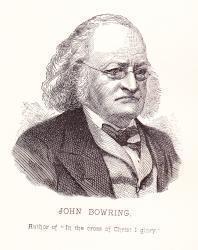
John Bowring

1792 - 1872 Person Name: Sir John Bowring, L.L.D., 1792-1872 Author of "God is love; His mercy brightens" in Methodist Hymn and Tune Book James Bowring was born at Exeter, in 1792. He possessed at an early age a remarkable power of attaining languages, and acquired some reputation by his metrical translations of foreign poems. He became editor of "The Westminster Review" in 1825, and was elected to Parliament in 1835. In 1849, he was appointed Consul at Canton, and in 1854, was made Governor of Hong Kong, and received the honour of knighthood. He is the author of some important works on politics and travel, and is the recipient of several testimonials from foreign governments and societies. His poems and hymns have also added to his reputation. His "Matins and Vespers" have passed through many editions. In religion he is a Unitarian. --Annotations of the Hymnal, Charles Hutchins, M.A., 1872 ======================================= Bowring, Sir John, LL.D., a distinguished man of letters, was born at Exeter, Oct. 17, 1792. His studies extended to philology, poetry, politics, and other branches of learning, whilst as editor of the Westminster Review for some years (he received the appointment in 1825) he did considerable work as a reviewer. He held several official appointments under the Government as Commissioner to France on commercial matters (1831-5); British Consul at Hong Kong (1849); and Governor of Hong Kong (1854). He was twice Member of Parliament, and was knighted in 1854. He died Nov. 23rd, 1872. His published works are very numerous, and display an astonishing acquaintance with various languages. Those specially bearing on poetry include:— (1) Russian Anthology, with Biographical and Critical notices of the Poets of Russia, 1821; (2) Specimens of the Russian Poets, 1823; (3) Ancient Poetry and Romance of Spain, 1824; (4) Batavian Anthology, or Specimens of Dutch Poets, 1824; (5) Servian Popular Poetry, 1821; (6) Specimens of Polish Poets, 1827; (1) Poetry of the Magyars, 1830; (8) History of the Poetical Literature of Bohemia, 1832, &c. In addition to these works, which are mainly translations, Sir John Bowring wrote original verse. This was published interspersed with a few translations, as follows:— (1) Matins and Vespers with Hymns and Occasional Devotional Pieces, Lond., 1823; 2nd edition, enlarged, 1824; 3rd edition, again enlarged, 1841; and the 4th, still further enlarged, in 1851. (2) Hymns: as a Sequel to the Matins, 1825. In addition he contributed to a few Unitarian hymnals, especially that of the Rev. J. R. Beard of Manchester, 1837. In that Collection many of the hymns added to the 3rd edition of Matins, &c, 1841, were first published A selection from these, together with a biographical sketch, was published by Lady Bowring in 1873, as a Memorial Volume of Sacred Poetry. This work contains hymns from the Matins and Vespers, together with others from Periodicals, and from his manuscripts. Of his hymns a very large percentage have come into common use. A few have been adopted by almost all denominations, as, "God is love, His mercy brightens;" "How sweetly flow'd the gospel sound;" "In the Cross of Christ I glory;" "Watchman, tell us of the night;"; and others, but the greater portion are confined to the Unitarian collections of Great Britain and America, of which denomination he was a member. In addition to the more important, which are annotated under their first lines, there are also the following in common use:—- 1. Clay to clay, and dust to dust. Burial. From his Hymns, 1825, into the Hymn & Tune Book, Boston, U.S., 1868, &c. 2. Come the rich, and come the poor. Divine Worship. Contributed to Beard's Collection, 1837, No. 290, and repeated in Bowring's Matins, &c., 3rd edition, 1841. It is in a few American collections. 3. Drop the limpid waters now. Holy Baptism. From Matins and Vespers, 3rd edition, 1841, into Kennedy, 1863. 4. Earth's transitory things decay. The Memory of the Just. From his Hymns, 1825, into Beard, 1837; the American Plymouth Collection, 1855; and the Songs for the Sanctuary, N.Y., 1865, &c. 5. Father, glorify Thy name. The Father glorified. Also from Hymns, 1825, into Beard, 1837; the Hymns of the Spirit, Boston, U.S., 1864, &c. 6. Father and Friend, Thy light, Thy love. Omnipresence. From Matins and Vespers, 2nd edition, 1824, into several collections, and sometimes in an abbreviated form. 7. Father of Spirits, humbly bent before Thee. Also in Hymns, 1825, and Dr. Martineau's Hymns of Praise & Prayer, 1873. In Longfellow and Johnson's Hymns of the Spirit, Boston, U.S., 1864, it is given as, "Father of Spirits, gathered now before Thee." 8. From all evil, all temptation. Preservation implored. Contributed to Beard's Collection, 1837. 9. From the recesses of a lowly spirit. Prayer of trust. From Matins and Vespers, 1st edition, 1823, into several American collections. 10. Gather up, 0 earth, thy dead. Published in his Matins & Vespers, 3rd ed., 1841, in 3 stanzas of 8 lines and repeated, slightly altered, in Kennedy, 1863, No. 753. 11. Gently the shades of night descends Evening. A cento from his poem on "Sunday Evening," in the Matins, &c, 1st edition, 1823, p. 6. It is given in the Boston Hymns of the Spirit, 1864; the Boston Hymn & Tune Book, 1868, and other collections. 12. How dark, how desolate. Hope. 1st published in his Matins, &c, 1823, p. 246. In Dr. Martineau's Hymns of Praise & Prayer, 1873, it is No. 515. 13. How shall we praise Thee, Lord of Light! Evening. A cento from the same poem as No. 7 above. It is given in the Hymns of the Spirit, 1864, and other American collections. 14. Lead us with Thy gentle sway. Divine Guidance desired. Hymns, 1825, into Hymns of the Spirit, 1864, and others. 15. Lord, in heaven, Thy dwelling-place. Praise. Contributed to Beard's Collection, 1837, No. 70, repeated in the author's Matins, &c, 3rd edition 1841, p. 235, and given in a few American collections. In the Hymns of the Spirit, 1864, it is altered to "Lord of every time and place." 16. 0 let my [thy] trembling soul be still. Resignation. From the 1st edition of the Matins, &c, 1823, p. 251, in 3 stanzas of 6 lines, into Beard's Collection, 1837; the Hymns of the Spirit, 1864, and others. It is sometimes given as, "0 let thy," &c. 17. 0, sweet it is to feel and know. Monday Morning. A poem in 16 stanzas of 4 lines, given in his Matins, &c, 1823, p. 60. In 1837 stanzas i.-iii. were given in Beard's Collection as No. 448, and entitled "God near in sorrow." In the 3rd edition of the Matins, &c, 1841, this cento was repeated (p. 245), with the same title, notwithstanding the full poem was in the same book. 18. On the dust I'm doomed to sleep. Resurrection. Appeared in his Matins, &c, 1st edition, 1823, p. 252, in 2 stanzas of 8 lines. In the 2nd edition, 1824, p. 232, it was altered to "In the dust," &c. This was repeated in 1841. In some hymnals it reads:— 19. The heavenly spheres to Thee, 0 God. Evening. This "Hymn to the Deity" appeared in the 2nd edition of his Matins, &c, 1824, pp. 235-6, in 4 stanzas of 4 double lines. It is also in the 3rd edition, 1841; the Boston Hymns of the Spirit, 1864 and other American collections. 20. When before Thy throne we kneel. Divine Worship. From his Hymns, 1825, into Beard's Collection, 1837, No. 93; the Boston Hymn & Tune Book, 1868, No. 21, and others. 21. Where is thy sting, 0 death! Death. Also from the Hymns, 1825, into the same collections as No. 20 above. It will be noted that Beard's Collection, 1837, is frequently named above. The full title of that hymnal is— A Collection of Hymns for Public and Private Worship. Compiled by John R. Board, Lond., John Green, 1837. The Rev. John Relly Beard was an Unitarian Minister in Manchester, and the collection is dedicated "To the Manchester Meeting of Ministers." It contained a large number of original hymns. Bowring contributed 82, of which 33 were published therein for the first time. Some of his hymns are of great merit, and most of them are characterised by great earnestness and deep devotion. -- John Julian, Dictionary of Hymnology (1907) ================== Bowring, Sir John, p. 166, i. In the article on Bowring the hymns numbered therein as 4 and 20 are stated to have appeared in his Hymns, 1825, but in error. The earliest date to which we can positively trace them is Beard's Collection, 1837. From the Hymns, 1825, we find, however, that the following are in modern hymnals:— 1. Our God is nigh. Divine Presence. 2. 'Tis not the gift; but 'tis the spirit. Outward and Inward Virtue. 3. When the storms of sorrow gather. God our Guide. From the various editions of his Matins and Vespers additional hymns arc also in modern use:— 4. If all our hopes and all our fears. Heaven Anticipated. (1823.) 5. In Thy courts let peace be found. Public Worship. (1841.) 6. The offerings to Thy throne which rise. Heart Worship. (1824.) 7. Who shall roll away the stone? Easter. In Beard's Collection, 1837, and Matins & Vespers, 1841. --John Julian, Dictionary of Hymnology, Appendix, Part II (1907)

William Bengo Collyer

1782 - 1854 Person Name: Collyer Author of "Cease, ye mourners, cease to languish" in New Manual of Praise William Bengo Collyer was born at Blackheath Hill, in 1782, and studied at Homerton College. Before completing his twentieth year he became pastor of a Congregational society at Peckham, continuing in that position through his life. He died in 1854. He received the degree of D.D. from the University of Edinburgh in 1808. For many years he was one of the most popular Dissenting ministers in London. He published many hymns and some works on theology. --Annotations of the Hymnal, Charles Hutchins, M.A. 1872. =================== Collyer, William Bengo, D.D., born at Blackheath, April 14, 1782, educated at Homerton College, where, when 16 years old, he was enrolled as a student for the ministry. At 20 he began his ministry at Peckham on Dec. 17, 1801 ordained pastor of a small church consisting of ten communicants. From 1814 to 1826 he was also pastor of a Church meeting in Salters' Hall. On June 17, 1817, a new chapel was opened for him at Peckham. There, from the time of his settlement in 1801, he laboured with great success and honour until Dec. 11, 1853, on which clay he preached for the last time. He died Jan. 8, 1854. Dr. Collyer was eminent in his day as an eloquent Evangelical preacher, when formalism in worship, and Arianism in doctrine, prevailed. He was a man of amiable disposition, polished manners, and Christian courtesy; popular with rich and poor alike. He was the author of a series of lectures on Divine Revelation, in seven volumes: Scripture Facts, Prophecies, Miracles, Parables, Doctrines, Duties, Comparisons. Dr. Collyer compiled a hymn-book with the title, Hymns partly collected and partly original, designed as a supplement to Dr. Watts's Psalms and Hymns, 1812. It was intended at first for the use of his own congregation only, and was to include many hymns composed by himself, to be sung after sermons which he had preached to them, but he was led to alter the plan. It comprises 979 hymns, 6 choruses, and 4 doxologics, arranged in groups according to their authors, and not subjects. Of this number 57 were written by Dr. Collyer, and are for the most part short descriptive or didactic poems, religious or moral essays in verse, and not hymns addressed to the Creator and Redeemer. Some of them are devoid of Christian truth, and are poems of nature or of sentiment. Some of them were written during the hard and sorrowful times of the wars of Bonaparte, and relate to famine and national calamity. Several were prepared for the public meetings of missionary and benevolent societies, which had their origin in his time. He also published Services suited to the Solemnization of Matrimony, Baptism, &c, 1837, which contained 89 of his hymns, &c.; Hymns for Israel, a Tribute of Love for God's Ancient People, 1848 (41 hymns). In Dr. Leifchild's Original Hymns, 1843, there are also 39 of his compositions. Many of his pieces appeared in the Evangelical Magazine, and were also appended to his numerous published Sermons. A few of his hymns are still in common use, including. "Another fleeting day is gone"; "Assembled at Thy great command"; "O Jesu, in this solemn hour"; "O Thou, the helpless orphan's hope"; "Return, O wanderer, return," and the fine cento, "Great God, what do I see and hear." [Rev. F. J. Faulding, D.D.] --John Julian, Dictionary of Hymnology (1907) ====================== Collyer, William Bengo, p. 243, ii. The following hymns by Dr. Collyer are also in common use:— 1. Another fleeting day is gone. Evening. (1812.) 2. 0 Jesus, in this solemn hour. Reception of Church Officers. (1842.) 3. O Thou, the helpless orphan's hope. On Behalf of Orphans. In the Evangelical Magazine, 1808, p. 48. 4. See the clouds upon the mountain. Sunday Morning. (1842.) 5. Soft be the gently breathing notes. Praise to the Redeemer. (1812.) 6. Softly the shade of evening falls. Evening. (1812.) From this, “Soon shall a darker night descend" is taken. 7. Thou Prince of glory slain for me. Good Friday. (1812.) The date 1812 is that of his Collection, and 1842 of Leifchild's Original Hymns. --John Julian, Dictionary of Hymnology, Appendix, Part II (1907)

Caroline L. Smith

1827 - 1886 Person Name: Caroline S. Smith Author of "Tarry with me, O my Savior" in The Christian Hymnal Smith, Caroline Louisa, née Sprague, was born at Salem, Massachusetts, and married to the Rev. Charles Smith, pastor of the South Congregational Church, Andover. Mrs. Smith is the author of:— Tarry with me, O my Saviour. An Old Man's Prayer. Mrs. Smith's account of this hymn is "About the year 1853 [in the summer of 1852], I heard the Rev. Dr. H. M. Dexter preach a sermon on 'The Adaptedness of Religion to the Wants of the Aged.' I went home and embodied the thought in the hymn 'Tarry with me, 0 my Saviour!' I sent it to Mr. Hallock, for The Messenger. He returned it as 'not adapted to the readers of the paper.' Years after I sent it, without any signature, to the little Andover paper .... I send it to you in its original form, in a little paper of which my sister, Mrs. Terry [Rochester, N.Y.], is editoress." (Hatfield's Poets of the Church, N.Y., 1884, p. 564.) Hatfield gives the full text in 1 stanza of 6 lines. In the Plymouth Collection, 1855, No. 1337, in 5 stanzas of 4 lines, was compiled from st. i., ii., vi., vii. This was repeated in The Sabbath Hymn Book, 1858, and others. Of this text st. ii. is sometimes omitted. --John Julian, Dictionary of Hymnology (1907)

Jeanne Marie Bouvier de La Motte Guyon

1648 - 1717 Person Name: Madame Guyon Author of "I would love thee, God and Father!" in New Manual of Praise Guyon, Madame. (1648-1717.) Jeanne Marie Bouyieres de la Mothe was the leader of the Quietist movement in France. The foundation of her Quietism was laid in her study of St. Francis de Sales, Madame de Chantal, and Thomas ä Kempis, in the conventual establishments of her native place, Montargis (Dep. Loiret), where she was educated as a child. There also she first learned the sentiment of espousal with Christ, to which later years gave a very marked development. She was married at sixteen to M. Guyon, a wealthy man of weak health, twenty-two years her senior, and her life, until his death, in 1676, was, partly from disparity of years, partly from the tyranny of her mother-in-law, partly from her own quick temper, an unhappy one. Her public career as an evangelist of Quietism began soon after her widowhood. Her first labours were spent in the diocese of Geneva, at Annecy, Gex, and Thonon, and in Grenoble. In 1686 she came to Paris, where she was at first imprisoned for her opinions in the Convent of St. Marie in the Faubourg St. Antoine, but released after eight months at the instance of Madame de Maintenon. She then rose to the zenith of her fame. Her life at all times greatly fascinated those around her; and the court, Madame de Maintenon, Fénelon (who ardently sympathised with her doctrine of pure and disinterested love of God), and Madame de Maintenon's College of Ladies at Cyr, came under the spell of her enthusiasm. But the affinity of her doctrines with those of Molinos, who was condemned in 1685, soon told against her. Her opinions were condemned by a commission, of which Bossuet was president. She then incurred Bossuet's displeasure by breaking the promises she had made to him to maintain a quiet attitude, and not return to Paris. She was imprisoned at Vincennes, Dec. 1695, and in the following year removed to Vaugirard, under a promise to avoid all receptions and correspondence, except by special permission. In 1698 she was immured in the Bastille, and not released until 1702. The Quietist controversy had meanwhile ruined the saintly Fénelon in the favour of Louis XIV., and obtained the condemnation by the Pope (1699) of his book (Maxima des Saints) written in defence of the doctrine of disinterested love. The remainder of Madame Guyon's life was spent in retirement with her daughter, the Marquise de Vaux, at Blois. She was visited there by numbers of persons of all ranks, some of them from foreign countries; and she had a considerable correspondence. She heard Mass daily, and died in full communion with the Roman Church. Madame Guyon's works fill 40 volumes. The principal ones are:— (1) Les Torrents (1683), a description of God's dealings with souls, founded on her own spiritual history. (2) Le Cantique des Cantiques interpreté selon le sens mystique. Le Moyen Court defaire oraison (1684). Her (3) Autobiography. (4) Poésies et Cantiques Spirituels (pub. 1722). The Cantiques Spirituels comprise nearly 900 pieces. The dates of composition are mainly to be gathered from internal evidence; some appear to have been written in the country; many were certainly written in her imprisonments at the Convent of St. Marie and Vincennes; many also apparently in her last sickness at Blois. They were composed to ballad tunes, and with an effortless facility, five or six hymns being often written in a day, while confined to her bed. She believed them to originate from the Divine impulse, more than from herself. The Cantiques are at once illustrated and interpreted by her Autobiography (which is one of the most remarkable books in the delineation of spiritual enthusiasm) and by her Commentary on the Song of Solomon, which applies its passionate love to the union of Christ with the soul. The leading ideas are, (1) the absorption of the soul, utterly emptied of self, into the Infinite Being of God: which is expressed at other times as the entire occupation of the soul, reduced to nothingness ("le néant, le rien"), and deprived of all independent will, by the Personality of God. The perfect state of the soul is one of complete passiveness; its energy is the energy of God directing and wielding the human powers; prayer becomes not the expression of desire, but rapt contemplation, wordless intercourse, and reception of the Divine Voice to the soul. (2) Pure and disinterested love of God, as Himself the Perfect Love, uninfluenced by any consideration of His favour and blessing either here or in eternity. If it be His will to cast the soul into hell itself, even this is to be accepted without fear or deprecation, if the Love of God remains as the joy of His creature. (3) The Love of God is consistent with terrible, often unintelligible or apparently capricious infliction of suffering and desertion on the soul He loves. A selection of 37 pieces from these poems was translated by the poet Cowper, in 1782 (published by his friend William Bull, in 1801). Bull had introduced the poems to him, and requested him to translate some of them. Whether Bull or Cowper selected the pieces for translation is uncertain, Their leading theme is that of Love unshaken, submissive, not asking for release, though under the extremity of desertion and suffering inflicted by God's Hand, which is heavy with anger and seems threatening destruction. Mixed with these awful seasons there are others, in which the manifestation of the Divine Love floods the soul with transport. The points of affinity with Cowper's thought are obvious; and Bull may have hoped that the spectacle of her unmoved belief in the hidden love of God might help to drive away the terrible delusion of his reprobation. The nervous style is very different from the flabby lines of the French: and Cowper designedly modified the amative metaphors, which, especially when they represent the dealings of Christ with her as His spouse, in language suggested by the caprice of Cupid or that of conjugal infidelity, are very painful and unconsciously irreverent. (See his letters to W. Unwin, 1782-3.) The most characteristic pieces are those beginning, "Twas my purpose on a day," "I suffer fruitless anguish," "Long plunged in sorrow," and "Source of Love, my brighter Sun." The translations from Madame Guyon's hymns which are in common use are mainly in American hymnbooks. They include :— 1. Ah! régnez sur toute la terre. Triumph of heavenly love desired. From her Cantique des Cantiques, vol. ii. No. 236. Translated by W. Cowper in his posthumous Poems Translated from the French of Madame de la Mothe Guion, fee., 1801, p. 14, in 3 stanzas of 4 lines, as, "Ah! reign, wherever man is found." It is in Spurgeon’s Our Own Hymnbook, 1866. 2. Amour que mon âme eat contente. The soul that loves God finds Him everywhere. From vol. ii., Cantique 108. Translated by W. Cowper, 1801, p. 33, in 9 stanzas of 4 lines, as "0 Thou, by long experience tried." This has been abbreviated and altered to "My Lord, how full of sweet content," in Hatfield's Church Hymn Book, N. Y., 1872, and others, and as "0 Lord, how full of sweet content," in the Andover Sabbath Hymn Book, 1858; the Songs for the Sanctuary, 1865, &c. It is also in use in its original form. Cowper's translation is more nervous than the original, but not always close thereto. 3. Divin objet, auquel nul objet n'est pareil. The Nativity. From her works, vol. iv., Poëmes Héroїques, 1. W. Cowper's translation of the poem (1801, p. 1) begins "Tis folly all—-let me no more be told." The cento in common use begins on p. 4 with "Infinite God, Thou great unrivall'd One," and is composed of 14 lines, not consecutive in all cases, and with extraneous additions. 4. Esprit Saint, viena dedans nos cœurs. Charity. From vol. ii., Cant. 96, beginning with stanza iii. Translated by W. Cowper, 1801, p. 26, as "Spirit of charity dispense.” This is in American common use. 5. Je n'aime plus d'un amour mien. Life in the love of God. From vol. iv., sect. 2, cant. 80. An anonymous translation of a part of this as "I love my God, but with no love of mine," appeared in the Andover Sabbath Hymn Book, 1858; the Church Praise Book, N. Y., 1881, &c, in 2 stanzas of 6 lines. Of this translation st. i. is apparently an expansion of the four first lines of this short hymn; stanza ii. may be only an expansion of the two remaining lines, or may have added to it some verse of a hymn not identified. Guyon, vol. iii., cant. 136, is somewhat similar, especially at its close, but is on a much larger scale. 6. L'amour me tient asservie. Divine love. From vol. ii., cant. 155. Translated by W. Cowper, 1801, p. 38, in 8 stanzas of 4 lines, as “Love is the Lord whom I obey." It is generally used in an abbreviated form. 7. La fontaine dans sa source. Living Water. From vol. iv., cant. 81. Translated by W. Cowper, 1801, p. 28, in 2 stanzas of 4 lines, as “The fountain in its source." In 1812 it was given in Collyer's Selections, No. 322, with an additional stanza by Collyer. This is the form of the text in common use in Great Britain and America. 8. Mon cœur depuis longtems plongé. The Joy of the Cross. From vol. iii., cant. 97. Translated by W. Cowper, 1801, pp. 81-84, in 12 stanzas of 6 lines, as "Long plung'd in sorrow, I resign." The following centos therefrom are in common use:— 1. "Long plunged in sorrow, I resign." 2. "O Lord, in sorrow I resign." 3. "Self-love no grace in sorrow sees." Of these centos 1 is in Spurgeon's Our Own Hymn Book, 1866; and 2 and 3 in American collections. 9. Nous portons un doux témoignage. God's Chosen. Vol. ii., cant. 78. Translated by W. Cowper, 1801, p. 35, as "How happy are the newborn race." This is usually altered to "O happy they, God's chosen race," as in Mercer, 1854, and others. 10. Souffrons, puisqu’l le faut, souffrons toute la vie. The love of God the end of Life. From vol ii., cant. 165. Translated by W. Cowper, 1801, p. 50, in 4 stanzas of 4 lines, as “Since life in sorrow must be spent." In the Songs for the Sanctuary, 1865, and other American collections it is altered to "If life in sorrow must be spent." In addition to these there are also translations of hymns in common use, the originals of which are attributed to Madame Guyon. These we have not identified in her poetical works:— 11. By suffering only can we know. Resignation. This is part of a poem written at nineteen. In a letter written from Blois in 1717, Madame Guyon thus alludes to it: "I remember that when I was quite young, only nineteen years of age, I composed a little song in which I expressed my willingness to suffer for God. ... A part of the verses to which I refer is as follows: ‘By suffering only can we know.’ ”The translation in the American Hymns for the Church of Christ, 1853, is anonymous. 12. I would love Thee, God and Father. This we cannot identify. It appeared in the Andover Sabbath Hymnbook, 1858, No. 649, in 5 stanzas of 4 lines. It is in Songs for the Sanctuary, 1865, Hatfield's Church Hymn Book, 1872, and others. 13. 'Tis not by skill of human art. Love. Not identified. The translation appeared in the Hymns for the Church of Christ, 1853, No. 606. [Rev. H. Leigh Bennett, M.A.] -- John Julian, Dictionary of Hymnology (1907) ===================== Guyon, Madame, p. 475, i. Other translations in common use are:— 1. From No. 3 on p. 476, i., the cento in Martineau's Hymns, 1840, No. 160, "Almighty Former of creation's plan" is taken. 2. Source of love, and Light of day. This in Martineau's Hymns, 1840, No. 425, is from W. Cowper's translation of Cantique 125, in 1801, p. 40. 3. To me remains nor place, nor time. This cento In Dale's English Hymn Book, 1874; "My country, Lord, art Thou alone," in Spurgeon's Our Own Hymn Book, 1866; and "All scenes alike engaging prove," are from No. 2 on p. 476, i. --John Julian, Dictionary of Hymnology, Appendix, Part II (1907)

Juan Bautista Cabrera Ivars

1837 - 1916 Person Name: J. B. Cabrera Author of "¿Oyes como el Evangelio" in El Himnario Evangelico Juan Bautista Cabrera Ivars was born in Benisa, Spain, April 23, 1837. He attended seminary in Valencia, studying Hebrew and Greek, and was ordained as a priest. He fled to Gibraltar in 1863 due to religious persecution where he abandoned Catholicism. He worked as a teacher and as a translator. One of the works he translated was E.H. Brown's work on the thirty-nine articles of the Anglican Church, which was his introduction to Protestantism. He was a leader of a Spanish Reformed Church in Gibraltar. He continued as a leader in this church when he returned to Spain after the government of Isabel II fell, but continued to face legal difficulties. He then organized the Spanish Reformed Episcopal Church and was consecrated as bishop in 1894. He recognized the influence of music and literature on evangelism which led him to write and translate hymns. Dianne Shapiro, from Real Academia de la Historia (https://dbe.rah.es/biografias/39825/juan-bautista-cabrera-ivars) and Himnos Cristanos (https://www.himnos-cristianos.com/biografia-juan-bautista-cabrera/) (accessed 7/30/2021)

Norman MacLeod

1812 - 1872 Person Name: Norman Macleod Author of "Our Guiding Star" in Union Hymnal, Songs and Prayers for Jewish Worship. 3rd ed. Revised and enlarged. Macleod, Norman, D.D., son of Dr. Norman Macleod, was born at Campbelton, Argyleshire, June 3, 1812. He studied at the Universities of Glasgow and Edinburgh, then went to Germany, and subsequently completed his course at the University of Glasgow, from which, in 1858, he received the degree of D.D. In 1838 he was appointed parish minister of Loudoun; Ayrshire, in 1843 of Dalkeith, and in 1851 of the Barony, Glasgow. He became one of the Queen's Chaplains in 1841, and in 1860 the editor of Good Words, which he continued to edit till his death. He was one of the most influential ministers in the Established Church of Scotland, and was Moderator of the General Assembly in 1869. He died at Glasgow, June 16, and was buried at Campsie, June 20, 1872. His works are numerous and popular. He was appointed a member of the Assembly's Hymnal Committee in 1854 and 1855. His best known hymn, "Trust in God, and do the right"(Right Doing), appeared in January 1857, in The Edinburgh Christian Magazine of which he was for some years the editor. [Rev. James Mearns, M.A.] -- John Julian, Dictionary of Hymnology (1907) ======================== http://en.wikipedia.org/wiki/Norman_Macleod_(1812–1872)

Sarah Flower Adams

1805 - 1848 Person Name: Sarah F. Adams Author of "Part in peace: is day before us?" in The Pilgrim Hymnal Adams, Sarah, nee Flower. born at Harlow, Essex, Feb. 22nd, 1805; died in London, Aug. 14, 1848, and was buried at Harlow, Aug. 21,1848. She was the younger daughter of Mr. Benjamin Flower, editor and proprietor, of The Cambridge Intelligencer; and was married, in 1834, to William B. Adams, a civil engineer. In 1841 she published Vivia Perpetua, a dramatic poem dealing with the conflict of heathenism and Christianity, in which Vivia Perpetua suffered martyrdom; and in 1845, The Flock at the Fountain; a catechism and hymns for children. As a member of the congregation of the Rev. W. J. Fox, an Unitarian minister in London, she contributed 13 hymns to the Hymns and Anthems, published by C. Fox, Lond., in 1841, for use in his chapel. Of these hymns the most widely known are— "Nearer,my God,to Thee," and "He sendeth sun, He sendeth shower." The remaining eleven, most of which have come into common use, more especially in America, are:— Creator Spirit! Thou the first. Holy Spirit. Darkness shrouded Calvary. Good Friday. Gently fall the dews of eve. Evening. Go, and watch the Autumn leaves. Autumn. O hallowed memories of the past. Memories. O human heart! thou hast a song. Praise. O I would sing a song of praise. Praise. O Love! thou makest all things even. Love. Part in Peace! is day before us? Close of Service. Sing to the Lord! for His mercies are sure. Praise. The mourners came at break of day. Easter. Mrs. Adams also contributed to Novello's musical edition of Songs for the Months, n. d. Nearly all of the above hymns are found in the Unitarian collections of Great Britain, and America. In Martineau's Hymns of Praise & Prayer, 1873, No. 389, there is a rendering by her from Fenelon: —" Living or dying, Lord, I would be Thine." It appeared in the Hymns and Anthems, 1841. -John Julian, Dictionary of Hymnology (1907)

Pages


Export as CSV
It looks like you are using an ad-blocker. Ad revenue helps keep us running. Please consider white-listing Hymnary.org or getting Hymnary Pro to eliminate ads entirely and help support Hymnary.org.