You help make Hymnary.org possible. More than 10 million people from 200+ countries found hymns, liturgical resources and encouragement on Hymnary.org in 2025, including you. Every visit affirms the global impact of this ministry.

If Hymnary has been meaningful to you this year, would you take a moment today to help sustain it? A gift of any size—paired with a note of encouragement if you wish—directly supports the server costs, research work and curation that keep this resource freely available to the world.

Give securely online today, or mail a check to:
Hymnary.org
Calvin University
3201 Burton Street SE
Grand Rapids, MI 49546

Thank you for your partnership, and may the hope of Advent fill your heart.

Person Results

Text Identifier:"^take_my_life_and_let_it_be$"
In:people

Planning worship? Check out our sister site, ZeteoSearch.org, for 20+ additional resources related to your search.
Showing 31 - 40 of 103Results Per Page: 102050

A. J. Showalter

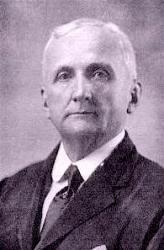
1858 - 1924 Composer of "SEWELL" in Choice Gospel Hymns Anthony Johnson Showalter USA 1858-1924/ Born in Cherry Grove, VA, he became an organist, gospel music composer, author, teacher, editor, and publisher. He was taught by his father and in 1876 received training at the Ruebush-Kieffer School of Music, Dayton, VA. He also attended George Root’s National Normal school at Erie, PA, and Dr Palmer’s International Normal at Meadville, PA. He was teaching music in shape note singing schools by age 14. He taught literary school at age 19, and normal music schools at age 22, when he also published his first book. In 1881 he married Lucy Carolyn (Callie) Walser of TX, and they had seven children: Tennie, Karl, Essie, Jennie, Lena, Margaret, and Nellie. At age 23 he published his “Harmony & composition” book, and years later his “Theory of music”. In 1884 he moved to Dalton, GA, and in 1890 formed the Showalter Music Company of Dalton. His company printed and published hymnals, songbooks, schoolbooks, magazines, and newspapers, and had offices in Texarkana, AR, and Chattanooga, TN. In 1888 he became a member of the M T N A (Music Teachers National Association) and was vice-president for his state for several years. In 1895 he went abroad to study methods of teachers and conductors in Europe. He held sessions of his Southern Normal Music Institute in a dozen or more states. He edited “The music teacher & home magazine” for 20 years. In 1895 he issued his “New harmony & composition” book. He authored 60+ books on music theory, harmony, and song. He published 130+ music books that sold over a million copies. Not only was he president of the A J Showalter Music Company of Dalton, GA, but also of the Showalter-Patton Company of Dallas, TX, two of the largest music publishing houses in the American south. He was a choir leader and an elder in the First Presbyterian Church in Dalton (and his daughter, Essie, played the organ there). He managed his fruit farm, looking after nearly 20,000 trees , of which 15,000 are the famous Georgia Elberta peaches, the rest being apples, plums, pecans, and a dozen other varieties of peaches. He was also a stockholder and director of the Cherokee Lumber Company of Dalton, GA, furnishing building materials to a large trade in many southern, central and eastern states. He died in Chattanooga, TN, and is buried in Dalton, GA. He loved hymns, and kept up with many of his students over the years, writing them letters of counsel and encouragement. In 2000 Showalter was inducted into the Southern Gospel Music Hall of Fame. Note: Showalter received two letters one evening from former music students, both of who were grieving over the death of their wives. He had heard a sermon about the arms of Moses being held up during battle, and managed to form a tune and refrain for a hymn, but struggled to find words for the verses that fit. He wrote to his friend in OH, Rev Elisha Hoffman, who had already composed many hymns and asked if he could write some lyrics, which he gladly did. John Perry

George C. Hugg

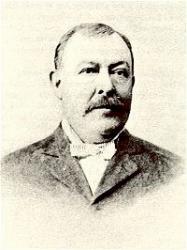
1848 - 1907 Person Name: Geo. C. Hugg Composer of "[Take my life, and let it be]" in On Wings of Song George Crawford Hugg USA 1848-1907. Born near Haddonfield, NJ, he became choirmaster at the Berlin, NJ, Presbyterian Church at age 12. At age 14 he published his first song, “Walk in the light”, which became very popular. He married Anne E Ketchum, and they had a daughter, Evangeline. He served as choirmaster of the Tabernacle Presbyterian Church in Philadelphia, and also the Broad Street and Arch Street Methodist Episcopal Churches there. He was also closely associated with the Harper Memorial Presbyterian Church there. He was a prolific composer with over 2000 works, publishing 18 books of revival and Sunday school music, and 90 songs for special occasions (Christmas, Easter, etc.). He died in Philadelphia, PA. John Perry

Samuel Sebastian Wesley

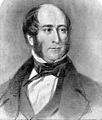
1810 - 1876 Person Name: Samuel Sebastian Wesley, 1810-1876 Harmonizer of "STREATLEY" in The Book of Praise Samuel Sebastian Wesley (b. London, England, 1810; d. Gloucester, England, 1876) was an English organist and composer. The grandson of Charles Wesley, he was born in London, and sang in the choir of the Chapel Royal as a boy. He learned composition and organ from his father, Samuel, completed a doctorate in music at Oxford, and composed for piano, organ, and choir. He was organist at Hereford Cathedral (1832-1835), Exeter Cathedral (1835-1842), Leeds Parish Church (1842­-1849), Winchester Cathedral (1849-1865), and Gloucester Cathedral (1865-1876). Wesley strove to improve the standards of church music and the status of church musicians; his observations and plans for reform were published as A Few Words on Cathedral Music and the Music System of the Church (1849). He was the musical editor of Charles Kemble's A Selection of Psalms and Hymns (1864) and of the Wellburn Appendix of Original Hymns and Tunes (1875) but is best known as the compiler of The European Psalmist (1872), in which some 130 of the 733 hymn tunes were written by him. Bert Polman

John R. Sweney

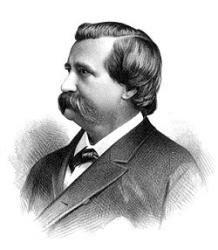
1837 - 1899 Person Name: Jno. R. Sweney Composer of "[Take my life, and let it be]" in The Quiver of Sacred Song John R. Sweney (1837-1899) was born in West Chester, Pennsylvania, and exhibited musical abilities at an early age. At nineteen he was studying with a German music teacher, leading a choir and glee club, and performing at children’s entertainments. By twenty-two he was teaching at a school in Dover, Delaware. Soon thereafter, he was put in charge of the band of the Third Delaware Regiment of the Union Army for the duration of the Civil War. After the war, he became Professor of Music at the Pennsylvania Military Academy, and director of Sweney’s Cornet Band. He eventually earned Bachelor and Doctor of Music degrees at the Academy. Sweney began composing church music in 1871 and became well-known as a leader of large congregations. His appreciators stated “Sweney knows how to make a congregation sing” and “He had great power in arousing multitudes.” He also became director of music for a large Sunday school at the Bethany Presbyterian Church in Philadelphia of which John Wanamaker was superintendent (Wanamaker was the founder of the first major department store in Philadelphia). In addition to his prolific output of hymn melodies and other compositions, Sweney edited or co-edited about sixty song collections, many in collaboration with William J. Kirkpatrick. Sweney died on April 10, 1899, and his memorial was widely attended and included a eulogy by Wanamaker. Joe Hickerson from "Joe's Jottings #9" used by permission

Ignaz Pleyel

1757 - 1831 Person Name: Ignaz Joseph Pleyel (1757-1831) Composer of "PLEYEL'S HYMN" in Many Voices; or, Carmina Sanctorum, Evangelistic Edition with Tunes Ignaz Joseph Pleyel; b. Ruppertstahl, near Vienna, 1757; d. Parice France, 1831 Evangelical Lutheran Hymnal, 1908

Adam Geibel

1855 - 1933 Composer of "[Take my life, and let it be]" in Consecrated Hymns Born: September 15, 1855, Neuenheim, Germany. Died: August 3, 1933, Philadelphia, Pennsylvania. Though blinded by an eye infection at age eight, Geibel was a successful composer, conductor, and organist. Emigrating from Germany probably around 1864, he studied at the Philadelphia Institute for the Blind, and wrote a number of Gospel songs, anthems, cantatas, etc. He founded the Adam Geibel Music Company, later evolved into the Hall-Mack Company, and later merged to become the Rodeheaver Hall-Mack Company. He was well known for secular songs like "Kentucky Babe" and "Sleep, Sleep, Sleep." In 1885, Geibel organized the J. B. Stetson Mission. He conducted the Stetson Chorus of Philadelphia, and from 1884-1901, was a music instructor at the Pennsylvania Institution for the Instruction of the Blind. His works include: Evening Bells, 1874 Saving Grace, with Alonzo Stone (Philadelphia, Pennsylvania: Stone & Bechter, Publishers, 1898) Consecrated Hymns, (Philadelphia, Pennsylvania: Geibel & Lehman, 1902) Uplifted Voices, co-editor with R. Frank Lehman (Philadelphia, Pennsylvania: Geibel & Lehman, 1901) World-Wide Hosannas, with R. Frank Lehman (Philadelphia, Pennsylvania: Geibel & Lehman, 1904) Hymns of the Kingdom, co-editor with R. Frank Lehman et al. (Philadelphia, Pennsylvania: Geibel & Lehman, 1905) --www.hymntime.com/tch/

F. E. Belden

1858 - 1945 Composer of "[Take my life, and let it be]" in The Gospel Song Sheaf Belden was born in Battle Creek, Michigan in 1858. He began writing music in his late teenage years after moving to California with his family. For health reasons he later moved to Colorado. He returned to Battle Creek with his wife in the early 1880s, and there he became involved in Adventist Church publishing. F. E. Belden wrote many hymn tunes, gospel songs, and related texts in the early years of the Seventh-day Adventist Church. Belden was able to rapidly write both music and poetry together which enabled him to write a song to fit a sermon while it was still being delivered. He also wrote songs for evang­el­ist Bil­ly Sun­day. Though Belden’s later years were marred by misunderstandings with the church leadership over his royalties, he did donate his papers and manuscripts to the church’s seminary at his death. He died on December 2, 1945 in Battle Creek, Michigan. N.N., Hymnary. Source: http://www.hymntime.com/tch/bio/b/e/l/belden_fe.htm

T. C. O'Kane

1830 - 1912 Composer of "[Take my life and let it be]" in Redeemer's Praise O'Kane, Tullius Clinton, an American writer, born March 10, 1830, is the author of "O sing of Jesus, Lamb of God" (Redemption); and "Who, who are these beside the chilly wave?" (Triumph in Death), in I. D. Sankey's Sacred Songs and Solos, 1878 and 1881. --John Julian, Dictionary of Hymnology, Appendix, Part II (1907) =========================== Tullius Clinton O'Kane was born in Fairfield County, Ohio, March 10, 1830. He resided with his parents in this vicinity until the spring of 1849, when he went to Delaware, Ohio, and entered the Ohio Wesleyan University, from which he graduated in 1852, with the degree A. B., and received his A. M. degree three years later from his Alma Mater. Immediately upon his graduation, he was tendered a position in the Faculty as Tutor of Mathematics, which he accepted and successfully filled for five years. The students always called him "Professor," by which title he is known to the present day. His musical abilities were early recognized in the University, and for years he was the musical precentor in the daily chapel devotions. He organized and maintained a Choral Society in the College, and was the first musical instructor in the Ohio Wesleyan Female College, which a few years ago was incorporated into the University. In 1857 he was elected to a principalship in the Cincinnati public schools, and served in that capacity until 1861, when he resigned his position to accept a place in the piano establishment of Philip Phillips & Co. He remained with this house until its removal to New York City in 1867, when, although urged to be transferred with the house to that city, he preferred to remove with his family back to Delaware, Ohio. For the ensuing six years he traveled over the state of Ohio as the general agent for the Smith American Organ Co., of Boston, Mass. During this time he visited conferences, Sunday-school conventions, both State and County, introducing his Sunday-school singing books, and in this way became well known throughout his native state, and quite extensively in some of the adjoining states. His musical compositions were first published in Philip Phillips' Musical Leaves, in 1865, and since then but few Sunday-school singing books have appeared without one or more of his compositions. His first music book, Fresh Leaves, was issued in 1868. This was followed at intervals by Dew Drops, Songs of Worship, Every Sabbath, Jasper and Gold, Redeemer's Praise, Glorious Things and Morning Stars. In connection with his son, Edward T. O'Kane, who is himself a most excellent composer and a very skillful organist, in 1882 he issued Selected Anthems, a book designed for use by the more advanced choirs. In association with J. R. Sweney and "Chaplain" McCabe, he issued Joy to the World, a song book for prayer-meetings, and the same editors, with the addition of W. J. Kirkpatrick, compiled Songs of Redeeming Love, No. 1, in 1882, and No. 2 in 1884. He also issued Songs of Praises, Unfading Treasures and Forward Songs. Some of Professor O'Kane's best known songs are Glorious Fountain, The Home Over There, On Jordan's Stormy Banks, Say, are You Ready? and many others. With Mr. O'Kane, music and musical composition have ever been a recreation, rather than a profession. He is an excellent leader of choirs, but his forte seems to be in leading large congregations, Sunday-schools and social religious meetings in sacred song. He sings "with the spirit and the understanding also " — with a due appreciation of both words and music — and very naturally infuses his enthusiasm into his audiences so that they cannot "keep from singing." In his music he endeavors to catch the spirit of the hymn, and then give it expression in the music he composes for it. This sometimes seems to have been almost an inspiration, and could be illustrated by a reference to the circumstances under which many of his compositions have been made. One of his earlier and more widely known pieces is that entitled, Over There. He says he cut this hymn out of some newspaper and put it with others in his portfolio, intending some time when he felt like it to give it a musical setting. One Sunday afternoon, after studying his lesson for the next session of his Sunday-school, he opened his portfolio, and turning over the selections, found these words, and something seemed to say, "Now's your time." He sat down at the organ, studied the hymn intently for a few moments, and then, as his fingers touched the keys of the instrument, melody and harmony were in every movement, and when the stanza was ended, melody and harmony found their expression in the chorus, and Over There was finished. Another of his well known songs is Sweeping Through the Gates. One cold, blustery day he had occasion to go from his residence to the railroad depot, about a mile distant, and in his route had to cross the river on a suspension foot-bridge. As he came down to the bridge, he thought of the "river of death," so cold, with no bridge, and then the words of the dying Cookman came to his mind, and he exclaimed to himself: 'Who, who are these beside the chilly wave? " Words, melody and refrain seemed to come all at once and all together, so that by the time he arrived back at his home, the composition was complete. Professor O'Kane is a genial, modest Christian gentleman, who carries sunshine wherever he goes. His greatest joy comes from the consciousness that his music has cheered and comforted the hearts of Christian people all over the world, and has been the means of winning thousands from the pleasures of the world to the higher enjoyments of the Christian religion. His song, Sweeping Through the Gates, will be sung till all the ransomed are gathered Over There. -Hall, J. H. (c1914). Biographies of Gospel Song and Hymn Writers. New York: Fleming H. Revell Company. ======================== O'Kane, Tullius Clinton. Died 10 February 1912, Delaware, Ohio. Buried in Oak Grove Cemetery, Delaware, Ohio. --DNAH Archives

Charles Edward Pollock

1853 - 1928 Person Name: Chas. Edw. Pollock Composer of "HENDERSON" in The Songs of Zion Charles Edward Pollock USA 1853-1928. Born at Newcastle, PA, he moved to Jefferson City, MO, when age 17. He was a cane maker for C W Allen. He also worked 20 years for the MO Pacific Railroad, as a depot clerk and later as Assistant Roadmaster. He was a musician and prolific songwriter, composing 5000+ songs, mostly used in Sunday school settings and church settings. He took little remuneration for his compositions, preferring they be freely used. He produced three songbooks: “Praises”, “Beauty of praise”, and “Waves of melody”. In 1886 he married Martha (Mattie) Jane Harris, and they had three children: Robert, Edward, and a daughter. He died in Merriam, KS. John Perry ================= Pollock, Charles Edward. (Jefferson City, Missouri, 1853-1924). Records of Jefferson City indicate the following: 1897 clerk at depot; residence at 106 Broadway (with Mildred Pollock) 1904-1905 cane maker for C. W. Allen 1908-1909 musician; residence at 106 Broadway (with wife Matty) 1912-1913 residence at St. Louis Road, east city limits --Wilmer Swope, DNAH Archives Note: not to be confused with Charles Edward Pollock (c.1871-1924).

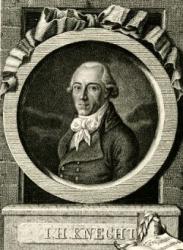
Justin Heinrich Knecht

1752 - 1817 Person Name: Justin H. Knecht, 1752-1817 Composer (melody) of "VIENNA" in Pilgrim Hymnal Justin Heinrich Knecht Germany 1752-1817. Born at Biberach Baden-Wurttemberg, Germany, he attended a Lutheran college in Esslingen am Neckar from 1768-1771. Having learned the organ, keyboard, violin and oratory, he became a Lutheran preceptor (professor of literature) and music director in Biberach. It was a free imperial city until 1803 and had a rich cultural life. He became organist of St. Martin’s Church in 1792, used by both Lutherans and Catholics, and was there for many years. He led an energetic, busy musical life, composing for both the theatre and church, organizing subscription concerts, teaching music theory, acoustics, aesthetics, composition, and instruments at the Gymnasium, affiliated to the Musikschule in 1806. He went to Stuttgart in 1806 in hopes of a post there as Kapellmeister, serving two years as Konzertmeister, but he was appointed Direktor Beim Orchester by the King of Wurttemberg in 1807. However, he returned to his former life in 1808 and remained there the rest of his life. He died at Biberach. He wrote 10 vocals, 11 opera and stage works, one symphony, 3 chamber music instrumentals, 7 organ works, 4 piano works, and 6 music theories. He was an author composer, editor, contributor, musician, compiler, and lyricist. John Perry

Pages


Export as CSV
It looks like you are using an ad-blocker. Ad revenue helps keep us running. Please consider white-listing Hymnary.org or getting Hymnary Pro to eliminate ads entirely and help support Hymnary.org.