

 My Starred Hymns
 My FlexScores
 My Hymnals
 My Purchased Files
Planning worship?
Check out our sister site, ZeteoSearch.org,
for 20+ additional resources related to your search.
- |
User Links
Person Results
Louis F. Benson
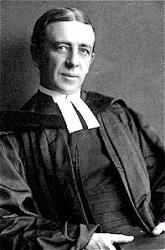
1855 - 1930 Topics: Kingdom of God on Earth, The Brotherhood Author of "The Light of God is Falling" in The Hymnbook Benson, Louis FitzGerald, D.D., was born at Philadelphia, Penn., July 22, 1855, and educated at the University of Penn. He was admitted to the Bar in 1877, and practised until 1884. After a course of theological studies he was ordained by the Presbytery of Philadelphia North, in 1888. His pastorate of the Church of the Redeemer, Germantown, Phila., extended from his ordination in 1888 to 1894, when he resigned and devoted himself to literary and Church work at Philadelphia. He edited the series of Hymnals authorised for use by the General Assembly of the Presbyterian Church in the U.S.A., as follows:—
(1) The Hymnal, Phila., 1895; (2) The Chapel Hymnal, 1898; and (3) The School Hymnal, 1899.
Dr. Benson's hymnological writings are somewhat extensive. They include:—
(1) Hymns and Verses (original and translations), 1897; (2) The Best Church Hymns, 1898; (3) The Best Hymns, 1898; (4) Studies of Familiar Hymns, 1903, &c.
Of his original hymns the following have come into American common use:—
I. In The Hymnal, 1895:—
1. O Christ, Who didst our tasks fulfil. For Schools and Colleges. Written in 1894.
2. O risen Christ, Who from Thy throne. For Installation of a Pastor. Written in 1894.
II. In The School Hymnal, 1899:—
3. A glory lit the wintry sky. Loneliness of Jesus. Written in 1897.
4. Happy town of Salem. Heaven.
5. Now the wintry days are o'er. Easter.
6. O sing a song of Bethlehem. Early Life of Jesus.
7. Open the door to the Saviour. Invitation.
8. Out of the skies, like angel eyes. Lullaby.
9. Who will teach me how to pray? Prayer. In Carey Bonner's Sunday School Hymnary, 1905:—
10. The sun is on the land and sea. Morning.
11. Our wilful hearts have gone astray. Penitence.
12. When I awake from slumber. Morning.
Of the above, Nos. 1-4, 10-12 are from Hymns and Verses, 1897. In the above collection by C. Bonner, Nos. 1, 4, and 6 are also found. Of Dr. Benson's translations from the Latin one only is in common use. See "Plaudite coeli, Rideat aether."
As a hymn writer Dr. Benson is not widely known, mainly through the recent publication of his verse. His hymns deserve attention, and will, no doubt, gain the public ear in due time; whilst his hymnological researches and publications are thorough and praiseworthy.
--John Julian, Dictionary of Hymnology, New Supplement (1907)
Louis F. Benson
Thomas Haweis
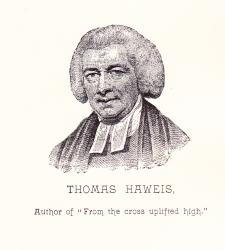
1734 - 1820 Person Name: Rev. Thomas Haweis Topics: The Kingdom of God on Earth Discipleship and Service Composer of "CHESTERFIELD" in The Hymnal Thomas Haweis (b. Redruth, Cornwall, England, 1734; d. Bath, England, 1820) Initially apprenticed to a surgeon and pharmacist, Haweis decided to study for the ministry at Oxford and was ordained in the Church of England in 1757. He served as curate of St. Mary Magdalen Church, Oxford, but was removed by the bishop from that position because of his Methodist leanings. He also was an assistant to Martin Madan at Locke Hospital, London. In 1764 he became rector of All Saints Church in Aldwinkle, Northamptonshire, and later served as administrator at Trevecca College, Wales, a school founded by the Countess of Huntingdon, whom Haweis served as chaplain. After completing advanced studies at Cambridge, he published a Bible commentary and a volume on church history. Haweis was strongly interested in missions and helped to found the London Mission Society. His hymn texts and tunes were published in Carmino Christo, or Hymns to the Savior (1792, expanded 1808).
Bert Polman
============================
Haweis, Thomas, LL.B., M.D., born at Truro, Cornwall, 1732. After practising for a time as a Physician, he entered Christ's College, Cambridge, where he graduated. Taking Holy Orders, he became Assistant Preacher to M. Madan at the Lock Hospital, London, and subsequently Rector of All Saints, Aldwincle, Northamptonshire. He was also Chaplain to Lady Huntingdon, and for several years officiated at her Chapel in Bath. He died at Bath, Feb. 11, 1820. He published several prose works, including A History of the Church, A Translation of the New Testament, and A Commentary on the Holy Bible. His hymns, a few of which are of more than ordinary merit, were published in his
Carmina Christo; or, Hymns to the Saviour. Designed for the Use and Comfort of Those who worship the Lamb that was slain. Bath, S. Hayward, 1792 (139 hymns), enlarged. London, 1808 (256 hymns). In 1794, or sometime after, but before the enlarged edition was published, two hymns "For the Fast-day, Feb. 28, 1794," were added to the first edition. These were, "Big with events, another year," and "Still o'er the deep the cannon's roar."
The most popular and widely used of his hymns are, "Behold the Lamb of God, Who bore," &c.; "Enthroned on high, Almighty Lord"; and “O Thou from Whom all goodness flows." The rest, all being from Carmina Christo, first edition 1792, are:—
1. Dark was the night and cold the ground. Gethsemane.
2. From the cross uplifted high. Christ in Glory.
3. Great Spirit, by Whose mighty power. Whitsuntide.
4. Submissive to Thy will, my God. Resignation.
5. The happy morn is come. Easter.
6. Thou Lamb of God, that on the tree. Good Friday. The hymn, "Thy Head, the crown of thorns that wears," in Stryker & Main's Church Praise Book, N. Y., 1882, begins with st. ii. of this hymn.
7. To Thee, my God and Saviour, My heart, &c. Praise for Redemption.
--John Julian, Dictionary of Hymnology (1907)
Thomas Haweis
Henry Carey
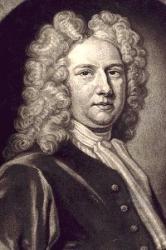
1687 - 1743 Person Name: Henry Carey, c. 1690-1743 Topics: The Kingdom of God on Earth The Nation, Peace Composer of "AMERICA" in The Hymnal Henry Carey, b. 1685 (?); d. London, 1743
Evangelical Lutheran Hymnal, 1908
Henry Carey
Louis Bourgeois
1510 - 1561 Topics: Kingdom of God on Earth, The Missions Composer (melody) of "ST. MICHAEL" in The Hymnbook Louis Bourgeois (b. Paris, France, c. 1510; d. Paris, 1561). In both his early and later years Bourgeois wrote French songs to entertain the rich, but in the history of church music he is known especially for his contribution to the Genevan Psalter. Apparently moving to Geneva in 1541, the same year John Calvin returned to Geneva from Strasbourg, Bourgeois served as cantor and master of the choristers at both St. Pierre and St. Gervais, which is to say he was music director there under the pastoral leadership of Calvin. Bourgeois used the choristers to teach the new psalm tunes to the congregation.
The extent of Bourgeois's involvement in the Genevan Psalter is a matter of scholarly debate. Calvin had published several partial psalters, including one in Strasbourg in 1539 and another in Geneva in 1542, with melodies by unknown composers. In 1551 another French psalter appeared in Geneva, Eighty-three Psalms of David, with texts by Marot and de Beze, and with most of the melodies by Bourgeois, who supplied thirty four original tunes and thirty-six revisions of older tunes. This edition was republished repeatedly, and later Bourgeois's tunes were incorporated into the complete Genevan Psalter (1562). However, his revision of some older tunes was not uniformly appreciated by those who were familiar with the original versions; he was actually imprisoned overnight for some of his musical arrangements but freed after Calvin's intervention. In addition to his contribution to the 1551 Psalter, Bourgeois produced a four-part harmonization of fifty psalms, published in Lyons (1547, enlarged 1554), and wrote a textbook on singing and sight-reading, La Droit Chemin de Musique (1550). He left Geneva in 1552 and lived in Lyons and Paris for the remainder of his life.
Bert Polman
Louis Bourgeois
Isaac Watts
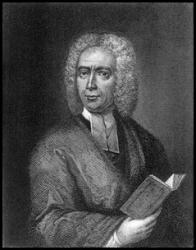
1674 - 1748 Topics: Kingdom of God on Earth, The Missions Author of "Jesus Shall Reign Where'er the Sun" in The Hymnbook Isaac Watts was the son of a schoolmaster, and was born in Southampton, July 17, 1674. He is said to have shown remarkable precocity in childhood, beginning the study of Latin, in his fourth year, and writing respectable verses at the age of seven. At the age of sixteen, he went to London to study in the Academy of the Rev. Thomas Rowe, an Independent minister. In 1698, he became assistant minister of the Independent Church, Berry St., London. In 1702, he became pastor. In 1712, he accepted an invitation to visit Sir Thomas Abney, at his residence of Abney Park, and at Sir Thomas' pressing request, made it his home for the remainder of his life. It was a residence most favourable for his health, and for the prosecution of his literary labours. He did not retire from ministerial duties, but preached as often as his delicate health would permit.
The number of Watts' publications is very large. His collected works, first published in 1720, embrace sermons, treatises, poems and hymns. His "Horae Lyricae" was published in December, 1705. His "Hymns" appeared in July, 1707. The first hymn he is said to have composed for religious worship, is "Behold the glories of the Lamb," written at the age of twenty. It is as a writer of psalms and hymns that he is everywhere known. Some of his hymns were written to be sung after his sermons, giving expression to the meaning of the text upon which he had preached. Montgomery calls Watts "the greatest name among hymn-writers," and the honour can hardly be disputed. His published hymns number more than eight hundred.
Watts died November 25, 1748, and was buried at Bunhill Fields. A monumental statue was erected in Southampton, his native place, and there is also a monument to his memory in the South Choir of Westminster Abbey. "Happy," says the great contemporary champion of Anglican orthodoxy, "will be that reader whose mind is disposed, by his verses or his prose, to imitate him in all but his non-conformity, to copy his benevolence to men, and his reverence to God." ("Memorials of Westminster Abbey," p. 325.)
--Annotations of the Hymnal, Charles Hutchins, M.A., 1872.
=================================
Watts, Isaac, D.D. The father of Dr. Watts was a respected Nonconformist, and at the birth of the child, and during its infancy, twice suffered imprisonment for his religious convictions. In his later years he kept a flourishing boarding school at Southampton. Isaac, the eldest of his nine children, was born in that town July 17, 1674. His taste for verse showed itself in early childhood. He was taught Greek, Latin, and Hebrew by Mr. Pinhorn, rector of All Saints, and headmaster of the Grammar School, in Southampton. The splendid promise of the boy induced a physician of the town and other friends to offer him an education at one of the Universities for eventual ordination in the Church of England: but this he refused; and entered a Nonconformist Academy at Stoke Newington in 1690, under the care of Mr. Thomas Rowe, the pastor of the Independent congregation at Girdlers' Hall. Of this congregation he became a member in 1693.
Leaving the Academy at the age of twenty, he spent two years at home; and it was then that the bulk of the Hymns and Spiritual Songs (published 1707-9) were written, and sung from manuscripts in the Southampton Chapel. The hymn "Behold the glories of the Lamb" is said to have been the first he composed, and written as an attempt to raise the standard of praise. In answer to requests, others succeeded. The hymn "There is a land of pure delight" is said to have been suggested by the view across Southampton Water. The next six years of Watts's life were again spent at Stoke Newington, in the post of tutor to the son of an eminent Puritan, Sir John Hartopp; and to the intense study of these years must be traced the accumulation of the theological and philosophical materials which he published subsequently, and also the life-long enfeeblement of his constitution.
Watts preached his first sermon when he was twenty-four years old. In the next three years he preached frequently; and in 1702 was ordained pastor of the eminent Independent congregation in Mark Lane, over which Caryl and Dr. John Owen had presided, and which numbered Mrs. Bendish, Cromwell's granddaughter, Charles Fleetwood, Charles Desborough, Sir John Hartopp, Lady Haversham, and other distinguished Independents among its members. In this year he removed to the house of Mr. Hollis in the Minories. His health began to fail in the following year, and Mr. Samuel Price was appointed as his assistant in the ministry. In 1712 a fever shattered his constitution, and Mr. Price was then appointed co-pastor of the congregation which had in the meantime removed to a new chapel in Bury Street. It was at this period that he became the guest of Sir Thomas Abney, under whose roof, and after his death (1722) that of his widow, he remained for the rest of his suffering life; residing for the longer portion of these thirty-six years principally at the beautiful country seat of Theobalds in Herts, and for the last thirteen years at Stoke Newington. His degree of D.D. was bestowed on him in 1728, unsolicited, by the University of Edinburgh. His infirmities increased on him up to the peaceful close of his sufferings, Nov. 25, 1748. He was buried in the Puritan restingplace at Bunhill Fields, but a monument was erected to him in Westminster Abbey.
His learning and piety, gentleness and largeness of heart have earned him the title of the Melanchthon of his day. Among his friends, churchmen like Bishop Gibson are ranked with Nonconformists such as Doddridge. His theological as well as philosophical fame was considerable. His Speculations on the Human Nature of the Logos, as a contribution to the great controversy on the Holy Trinity, brought on him a charge of Arian opinions. His work on The Improvement of the Mind, published in 1741, is eulogised by Johnson. His Logic was still a valued textbook at Oxford within living memory. The World to Come, published in 1745, was once a favourite devotional work, parts of it being translated into several languages. His Catechisms, Scripture History (1732), as well as The Divine and Moral Songs (1715), were the most popular text-books for religious education fifty years ago. The Hymns and Spiritual Songs were published in 1707-9, though written earlier. The Horae Lyricae, which contains hymns interspersed among the poems, appeared in 1706-9. Some hymns were also appended at the close of the several Sermons preached in London, published in 1721-24. The Psalms were published in 1719. The earliest life of Watts is that by his friend Dr. Gibbons. Johnson has included him in his Lives of the Poets; and Southey has echoed Johnson's warm eulogy. The most interesting modern life is Isaac Watts: his Life and Writings, by E. Paxton Hood. [Rev. H. Leigh Bennett, M.A.]
A large mass of Dr. Watts's hymns and paraphrases of the Psalms have no personal history beyond the date of their publication. These we have grouped together here and shall preface the list with the books from which they are taken.
(l) Horae Lyricae. Poems chiefly of the Lyric kind. In Three Books Sacred: i.To Devotion and Piety; ii. To Virtue, Honour, and Friendship; iii. To the Memory of the Dead. By I. Watts, 1706. Second edition, 1709. (2) Hymns and Spiritual Songs. In Three Books: i. Collected from the Scriptures; ii. Composed on Divine Subjects; iii. Prepared for the Lord's Supper. By I. Watts, 1707. This contained in Bk i. 78 hymns; Bk. ii. 110; Bk. iii. 22, and 12 doxologies. In the 2nd edition published in 1709, Bk. i. was increased to 150; Bk. ii. to 170; Bk. iii. to 25 and 15 doxologies. (3) Divine and Moral Songs for the Use of Children. By I. Watts, London, 1715. (4) The Psalms of David Imitated in the Language of the New Testament, And apply'd to the Christian State and Worship. By I. Watts. London: Printed by J. Clark, at the Bible and Crown in the Poultry, &c, 1719. (5) Sermons with hymns appended thereto, vol. i., 1721; ii., 1723; iii. 1727. In the 5th ed. of the Sermons the three volumes, in duodecimo, were reduced to two, in octavo. (6) Reliquiae Juveniles: Miscellaneous Thoughts in Prose and Verse, on Natural, Moral, and Divine Subjects; Written chiefly in Younger Years. By I. Watts, D.D., London, 1734. (7) Remnants of Time. London, 1736.
454 Hymns and Versions of the Psalms, in addition to the centos are all in common use at the present time.
--Excerpts from John Julian, Dictionary of Hymnology (1907)
==================================
Watts, I. , p. 1241, ii. Nearly 100 hymns, additional to those already annotated, are given in some minor hymn-books.
--John Julian, Dictionary of Hymnology, Appendix, Part II (1907)
=================
Watts, I. , p. 1236, i. At the time of the publication of this Dictionary in 1892, every copy of the 1707 edition of Watts's Hymns and Spiritual Songs was supposed to have perished, and all notes thereon were based upon references which were found in magazines and old collections of hymns and versions of the Psalms. Recently three copies have been recovered, and by a careful examination of one of these we have been able to give some of the results in the revision of pp. 1-1597, and the rest we now subjoin.
i. Hymns in the 1709 ed. of Hymns and Spiritual Songs which previously appeared in the 1707 edition of the same book, but are not so noted in the 1st ed. of this Dictionary:—
On pp. 1237, L-1239, ii., Nos. 18, 33, 42, 43, 47, 48, 60, 56, 58, 59, 63, 75, 82, 83, 84, 85, 93, 96, 99, 102, 104, 105, 113, 115, 116, 123, 124, 134, 137, 139, 146, 147, 148, 149, 162, 166, 174, 180, 181, 182, 188, 190, 192, 193, 194, 195, 197, 200, 202.
ii. Versions of the Psalms in his Psalms of David, 1719, which previously appeared in his Hymns and Spiritual Songs, 1707:—
On pp. 1239, U.-1241, i., Nos. 241, 288, 304, 313, 314, 317, 410, 441.
iii. Additional not noted in the revision:—
1. My soul, how lovely is the place; p. 1240, ii. 332. This version of Ps. lxiv. first appeared in the 1707 edition of Hymns & Spiritual Songs, as "Ye saints, how lovely is the place."
2. Shine, mighty God, on Britain shine; p. 1055, ii. In the 1707 edition of Hymns & Spiritual Songs, Bk. i., No. 35, and again in his Psalms of David, 1719.
3. Sing to the Lord with [cheerful] joyful voice, p. 1059, ii. This version of Ps. c. is No. 43 in the Hymns & Spiritual Songs, 1707, Bk. i., from which it passed into the Ps. of David, 1719.
A careful collation of the earliest editions of Watts's Horae Lyricae shows that Nos. 1, 7, 9, 10, 11, 12, 14, 16, p. 1237, i., are in the 1706 ed., and that the rest were added in 1709. Of the remaining hymns, Nos. 91 appeared in his Sermons, vol. ii., 1723, and No. 196 in Sermons, vol. i., 1721. No. 199 was added after Watts's death. It must be noted also that the original title of what is usually known as Divine and Moral Songs was Divine Songs only.
--John Julian, Dictionary of Hymnology, New Supplement (1907)
===========
See also in:
Hymn Writers of the Church
Isaac Watts
John Warrington Hatton
1710 - 1793 Person Name: John Hatton, d. 1793 Topics: Kingdom of God on Earth, The Missions Composer of "DUKE STREET" in The Hymnbook John Warrington Hatton (b. Warrington, England, c. 1710; d, St. Helen's, Lancaster, England, 1793) was christened in Warrington, Lancashire, England. He supposedly lived on Duke Street in Lancashire, from where his famous tune name comes. Very little is known about Hatton, but he was most likely a Presbyterian, and the story goes that he was killed in a stagecoach accident.
Bert Polman
John Warrington Hatton
Horatius Bonar
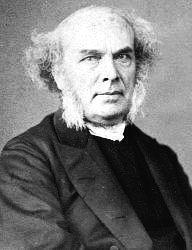
1808 - 1889 Person Name: Rev. Horatius Bonar Topics: The Kingdom of God on Earth Missions Author of "Go, labor on: spend and be spent" in The Hymnal Horatius Bonar was born at Edinburgh, in 1808. His education was obtained at the High School, and the University of his native city. He was ordained to the ministry, in 1837, and since then has been pastor at Kelso. In 1843, he joined the Free Church of Scotland. His reputation as a religious writer was first gained on the publication of the "Kelso Tracts," of which he was the author. He has also written many other prose works, some of which have had a very large circulation. Nor is he less favorably known as a religious poet and hymn-writer. The three series of "Hymns of Faith and Hope," have passed through several editions.
--Annotations of the Hymnal, Charles Hutchins, M.A. 1872
================================
Bonar, Horatius, D.D. Dr. Bonar's family has had representatives among the clergy of the Church of Scotland during two centuries and more. His father, James Bonar, second Solicitor of Excise in Edinburgh, was a man of intellectual power, varied learning, and deop piety.
Horatius Bonar was born in Edinburgh, Dec. 19th, 1808; and educated at the High School and the University of Edinburgh. After completing his studies, he was "licensed" to preach, and became assistant to the Rev. John Lewis, minister of St. James's, Leith. He was ordained minister of the North Parish, Kelso, on the 30th November, 1837, but left the Established Church at the "Disruption," in May, 1848, remaining in Kelso as a minister of the Free Church of Scotland. The University of Aberdeen conferred on him the doctorate of divinity in 1853. In 1866 he was translated to the Chalmers Memorial Church, the Grange, Edinburgh; and in 1883 he was chosen Moderator of the General Assembly of of the Free Church of Scotland.
Dr. Bonar's hymns and poems were, he tells us, composed amid a great variety of circumstances; in many cases he cannot himself recall these circumstances; they also appeared in several publications, but nearly all have boen published or republished in the following:— (i) Songs for the Wilderness, 1843-4. (2) The Bible Hymn Book, 1845. (3) Hymns, Original and Selected, 1846. (4) Hymns of Faith and Hope, First Series, 1857; Second Series, 1861; Third Series, 1866. (5) The Song of the New Creation, 1872. (6) My Old Letters, a long poem, 1877. (7) Hymns of the Nativity, 1879. (8) Communion Hymns, 1881. In addition to numerous prose works, he has also edited The New Jerusalem; a Hymn of the Olden Time, 1852, &c.
Dr. Bonar's poems—-including many beautiful lyrics, several psalm versions, and translations from the Greek and Latin, a large number of hymns, and a long meditative poem—-are very numerous, too numerous, perhaps, for their permanent fame as a whole.
Dr. Bonar's scholarship is thorough and extensive; and his poems display the grace of style and wealth of allusion which are the fruit of ripe culture. Affected very slightly by current literary moods, still less by the influence of other religious poetry, they reveal extreme susceptibility to the emotional power which the phases of natural and of spiritual life exercise; the phases of natural life being recognised chiefly as conveying and fashioning spiritual life, used chiefly for depicting spiritual life, and handled for this purpose with greater delicacy of touch than in the Olney Hymns, and with less conscious purpose than in the Christian Year. As a result of this susceptibility, and from habitual contemplation of the Second Advent as the era of this world's true bliss, his hymns and poems are distinguished by a tone of pensive reflection, which some might call pessimism. But they are more than the record of emotion; another element is supplied by his intellectual and personal grasp of Divine truth, these truths particularly:—The gift of a Substitute, our Blessed Saviour; Divine grace, righteous, yet free and universal in offer; the duty of immediate reliance upon the privilege of immediate assurance through that grace; communion with God, especially in the Lord's Supper, respecting which he insists on the privilege of cherishing the highest conceptions which Scripture warrants; and finally, the Second Advent of our Lord: by his vigorous celebration of these and other truths as the source and strength of spiritual life, his hymns are protected from the blight of unhealthy, sentimental introspection.
To sum up: Dr. Bonar's hymns satisfy the fastidious by their instinctive good taste; they mirror the life of Christ in the soul, partially, perhaps, but with vivid accuracy; they win the heart by their tone of tender sympathy; they sing the truth of God in ringing notes; and although, when taken as a whole, they are not perfect ; although, in reading them, we meet with feeble stanzas, halting rhythm, defective rhyme, meaningless Iteration; yet a singularly large number have been stamped with approval, both in literary circles and by the Church.
In Great Britain and America nearly 100 of Dr. Bonar's hymns are in common use. They are found in almost all modern hymnals from four in Hymns Ancient & Modern to more than twenty in the American Songs for the Sanctuary, N. Y., 1865-72. The most widely known are, "A few more years shall roll;" "Come, Lord, and tarry not;" "Here, O my Lord, I see Thee face to face;" "I heard the Voice of Jesus say;" "The Church has waited long;" and "Thy way, not mine, O Lord."
In addition to these and others which are annotated under their respective first lines, the following are also in common use:—
From Songs for the Wilderness, No. 1, 1843.
1. For Thee we long and pray. Sunday Morning.
2. Holy Father, hear my cry. A Child's Prayer.
3. I thought upon my sins and I was sad. Christ our Peace.
4. Peace to the world, our Lord is come. A Millennial Song.
5. Spirit of everlasting grace. The Vision of Dry Bones.
ii. From Songs for the Wilderness, No. 2,1844.
6. Ho, ye thirsty, parched and fainting. Invitation.
7. 0 'tis not what we fancied it. The world renounced.
8. Sing them, my children, sing them still. Children exhorted to Praise.
9. Time's sun is fast setting. Advent.
10. Weep, pilgrim, weep, yet 'tis not for the sorrow. Faith.
11. Yes, for me, for me He careth. Christ the Elder Brother .
iii. From The Bible Hymn Book, 1845.
12. Jesus, my sorrow lies too deep. Jesus, the Great High Priest.
13. There is a Morning Star, my soul. The Morning Star.
14. This is not my place of resting. Pressing towards heaven.
iv. From Hymns, Original and Selected, 1845.
15. Let there be light, Jehovah said. Creation.
v. From Hymns of Faith and Hope, 1st series, 1857.
16. Be brave, my brother. The Fight of Faith.
17. Blessed be God, our God. Good Friday.
18. Everlasting praises. Doxology.
19. Go up, go up, my heart. Heavenly aspirations desired.
20. I close my heavy eye. Evening. Sometimes given as "We close our heavy eyes."
21. I see the crowd in Pilate's hall. Good Friday.
22. Jesus, while this rongh desert soil. Strength by the Way.
23. Jesus, Whom angel-hosts adore. The Word made Flesh. From "The Son of God, in mighty love."
24. Make haste, 0 man, to live. Exhortation to lay hold of Life.
25. No seas again shall sever. Heaven.
26. Oppressed with noonday's scorching heat. Shadow of the Cross.
27. Rest for the toiling hand. Burial. From "Lie down, frail body, here."
28. Shall this life of mine be wasted? Exhortation to Duty.
29. These are the crowns that we shall wear. Heaven.
30. Thy works, not mine, O Christ [Lord]. The Sin-bearer.
31. Where the faded flower shall freshen. Heaven.
vi. From Hymns of Faith and Hope. 2nd series, 1861.
32. Be still, my soul, Jehovah loveth Thee. Rest in the Love of God.
33. Christ has done the mighty work. Good Friday.
34. Come, mighty Spirit, penetrate. Whitsuntide.
35. Deep down beneath the unresting surge. Burial at Sea.
36. Fear not the foe, thou flock of God [thou little flock]. Battle-Song of the Church.
37. For lack of love I languish. Lent.
38. From this bleak hill of storms. Eternal Rest desired.
39. He liveth long who liveth well. The True Life.
40. Here shall death's triumph end: the rock-barred door. Easter. From "The tomb is empty: wouldst thou have it full."
41. Jesus, Sun and Shield art Thou. Jesus the First and Last.
42. Jesus, the Christ of God. Praise to Christ.
43. Light of the world, for ever, ever shining. Christ the Light of the World. From "Why walk in darkness? Has the dear light vanished?"
44. Make use of me, my God. Duty desired.
45. Not what I am, 0 Lord, but what Thou art. The Love of God.
46. 0 Light of Light, shine in. Cry of the Weary.
47. 0 love of God, how strong and true. Love of God.
48. 0 love that casts out fear. Love of God.
49. 0 strong to save and bless. Lent.
50. 0 this soul, how dark and blind. Lent.
51. Safe across the waters. Thanksgiving at end of a journey.
52. Silent, like men in solemn haste. Pressing onwards.
53. Speak, lips of mine. Exhortation to Praise.
54. The Bridegroom comes. Advent.
vii. From Hymns of Faith and Hope. 3rd series, 1866.
55. Bear Thou my burden, Thou Who bar'st my sin. Lent or Passiontide.
56. Done is the work that saves. Easter.
57. Father, our children keep. Prayer on behalf of Children.
58. Fill Thou my life, 0 Lord my God. Life's Praise.
59. Finish Thy work, the time is short. Earnest labour to the end.
60. From the Cross the blood is falling. Good Friday.
61. He called them, and they left. Obedience.
62. Help me, my [0] God to speak. Truth desired.
63. Holy Father, Mighty God. Holy Trinity.
64. How are my troubles multiplied. Ps. iii.
65. How sweetly doth He show His face Flower Service.
66. Light hath arisen, we walk in its brightness. Sustaining power of Faith.
67. Lo, God, our God has come. Christmas.
68. Lord, give me light to do Thy work. Divine guidance desired.
69. No, not despairingly. Lent.
70. Not to ourselves again. Life in Christ, or, Living unto God.
71. Now in parting, Father, bless us. Post Communion.
72. Sounds the trumpet from afar. Battle-Song of the Church.
73. Thee in the loving bloom of morn. God in all.
74. Through good report and evil, Lord. Faithfulness.
75. To Jehovah, God of might. Praise to the Father.
76. To the name of God on high. Doxology.
77. Upward, where the stars are burning. Heavenward Aspirations.
78. We take the peace which He hath won. The Gift of Peace.
79. When the weary, seeking rest. Intercession for all Conditions of Men.
viii. From The Song of the New Creation,1872.
80. For the Bread and for the Wine. Holy Communion.
81. Light of life so softly shining. Light of Life.
82. Yet there is room. The Lamb's bright hall of song. Home Missions.
ix. From Hymns of the Nativity, 1879.
83. Great Ruler of the land and sea. Sailors' Liturgy. From Communion Hymns, 1881.
84. Beloved, let us love. Brotherly Love.
In several instances these hymns are given in an abbreviated form, and sometimes alterations are also introduced. In this latter respect however Dr. Bonar has suffered less than most modern hymn-writers. [Rev. James Mearns, M.A.]
-- John Julian, Dictionary of Hymnology (1907)
====================
Bonar, Horatius, p. 161, i. He died at Edinburgh, July 31, 1889. In 1890 his son published a posthumous volume of his poetical pieces as Until the Day Break and other Hymns and Poems left behind. The following additional hymns are in common use:—
1. Almighty Comforter and Friend. (1866.) Whitsuntide.
2. Father, make use of me. An altered form of No. 44, p. 162, ii.
3. I ask a perfect creed. (1861.) Creed not Opinions. From this is also taken "O True One, give me truth."
4. Long, long deferred, now come at last. Marriage of the Lamb. Part of "Ascend, Beloved, to the joy." (1861.)
5. Nay 'tis not what we fancied it. (1857.) Vanity of the World.
6. No blood, no altar now. (1861.) The Finished Sacrifice.
7. No shadows yonder. (1857.) Heaven Anticipated.
8. Not with the light and vain. (1857.) Godly Companionship.
9. O Love invisible, yet infinite. (1866.) Divine Love.
10. On the great love of God I lean. (1866.) Love of God our Resting-place.
11. On Thee, O Jesus, strongly leaning. (1866.) Fellowship with Christ.
12. Peace upon peace, like wave on wave. (1866.) Divine Peace.
13. Sower divine, sow the good seed in me. (1857.) Heavenly Sowing.
14. Speaketh the sinner's sin within my heart. (1866.) Ps. xxxvi.
15. Still one in life and one in death. (1857.) Communion of Saints. Part of "'Tis thus they press the hand and part."
16. Surely, yon heaven, where angels see God's face. (1857.) Heaven Anticipated.
17. That city with the jewelled crest. (1857.) Heaven. Part of "These are the crowns that we shall wear." Another cento from the same is "Yon city, with the jewelled crest."
18. That clime is not like this dull clime of ours. (1843.) Heaven.
19. The Free One makes you free: He breaks the rod. (1857.) Freedom in Christ. From "Of old they sang the song of liberty."
20. There is a Morning-star, my soul. (1357.) Christ the Morning Star.
21. This is the day of toil. (1866.) Pressing Onwards.
22. Thy thoughts are here, my God. (1866.) Holy Scripture.
23. Till the day dawn. (1857.) Life's Journey.
24. To Him Who spread the skies. (1866.) Creation's Song.
25. Trustingly, trustingly. (1866.) Trust.
26. Unto th' eternal hills. (1866.) Ps. cxxi.
The above dates are: 1843, Songs in the Wilderness; 1857, Hymns of Faith and Hope, 1st Series; 1861, same, 2nd Ser. (not 1864); 1866, same, 3rd Ser. (not 1867), The dates 1857, 1864,1867, were given by Dr. Bonar, but the British Museum copies are 1857, 1861, 1866 respectively.
--John Julian, Dictionary of Hymnology, Appendix, Part II (1907)
==============
Bonar, H., pp. 161, i.; 1554, i. The Rev. H. N. Bonar, Dr. Bonar's son, published in 1904, Hymns by Horatius Bonar, Selected and Arranged by his Son H. N. Bonar, With a brief History of some of the Hymns, &c. (London: H. Frowde). From this work we must correct the date of his Song of the New Creation to 1872. We have also enriched our pages by additional and expanded notes on several of Dr. Bonar's most widely used hymns. In his biographical notes, Mr. Bonar refers to Dr. Bonar's work as editor of the Quarterly Journal of Prophecy, begun in 1848, to which he contributed a hymn for each number. We find that the number of hymns contributed thereto is 101.
With Dr. Bonar's poetical productions great difficulty has been encountered by the historian and annotator because of his absolute indifference to dates and details. It was enough for him that he had written, and that the Church of Christ approved and gladly used what, out of the fulness of his heart, he had given her.
--Excerpt from John Julian, Dictionary of Hymnology, New Supplement (1907)
Horatius Bonar
Mary Ann Thomson
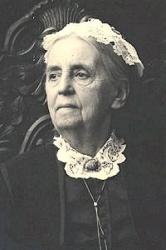
1834 - 1923 Topics: Kingdom of God on Earth, The Missions Author of "O Zion, Haste, Thy Mission High Fulfilling" in The Hymnbook Thomson, Mary Ann, wife of Mr. John Thomson, Librarian of the Free Library, Philadelphia, was born in London, England, December 5, 1834. She has written about forty hymns, which have appeared mostly in the Churchman, New York, and in the Living Church, Chicago. Four of her hymns are found in the Protestant Episcopal Hymnal, 1892. Of the origin of the missionary hymn by Mrs. Thomson which is found in our Hymnal she writes as follows:
I wrote the greater part of the hymn, "O Zion, haste," in the year 1868. I had written many hymns before, and one night, while I was sitting up with one of my children who was ill of typhoid fever, I thought I should like to write a missionary hymn to the tune of the hymn beginning "Hark, hark, my soul, angelic songs are swelling," as I was fond of that tune; but as I could not then get a refrain I liked, I left the hymn unfinished, and about three years later I finished it by writing the refrain which now forms part of it. By some mistake 1891 is given instead of 1871 as the date of the hymn in the (Episcopal) Hymnal. I do not think it is ever sung to the tune for which I wrote it. Rev. John Anketell told me, and I am sure he is right, that it is better for a hymn to have a tune of its own, and I feel much indebted to the composer of the tune "Tidings" for writing so inspiring a tune to my words.
Hymn Writers of the Church by Wilber F. Tillett and Charles S. Nutter, 1915
==================
Thomson, Mary Ann, wife of John Thomson, Librarian of the Free Library, Phila., was born in London, England, Dec. 5, 1834. She has written several hymns and poems. To 1895, eight of these appeared in The Churchman (New York); and thirty-four in The Living Church (Chicago). Of her hymns the following were included in The Hymnal, Revised and Enlarged .. . The P. E. Church, U.S.A., 1892 :—
1. Now the blessed Dayspring. [Annunciation B. V. M.] Begins with stanza ii. of "Through the sins and sorrows," which appeared in The Living Church, March 29, 1890.
2. O King of saints, we give Thee praise and glory. [All Saints.] First published in The Living Church, Nov. 8, 1890. In the first ed. of The Book of Praise, N.Y., 1894, it was attributed to Bp. W. W. How in error.
3. O Sion, haste, thy mission high fulfilling. [Missions.] No. 249 in The Hymnal, &c., 1892.
4. Saviour, for the little one. [Burial of a Child.] The Hymnal, &c., 1892, No. 247.
Mrs. Thomson's Christmas Carol, "Lo! amid the shades of night," appeared, with music by B. Cecil Klein, in The Churchman, N.Y., Dec. 19, 1891, and separately at Phila. in 1892.
--John Julian, Dictionary of Hymnology, New Supplement (1907)
Mary Ann Thomson
Henry Thomas Smart

1813 - 1879 Person Name: Henry Smart Topics: The Kingdom of God on Earth Discipleship and Service Composer of "LANCASHIRE" in The Hymnal Henry Smart (b. Marylebone, London, England, 1813; d. Hampstead, London, 1879), a capable composer of church music who wrote some very fine hymn tunes (REGENT SQUARE, 354, is the best-known).
Smart gave up a career in the legal profession for one in music. Although largely self taught, he became proficient in organ playing and composition, and he was a music teacher and critic. Organist in a number of London churches, including St. Luke's, Old Street (1844-1864), and St. Pancras (1864-1869), Smart was famous for his extemporizations and for his accompaniment of congregational singing. He became completely blind at the age of fifty-two, but his remarkable memory enabled him to continue playing the organ. Fascinated by organs as a youth, Smart designed organs for important places such as St. Andrew Hall in Glasgow and the Town Hall in Leeds. He composed an opera, oratorios, part-songs, some instrumental music, and many hymn tunes, as well as a large number of works for organ and choir. He edited the Choralebook (1858), the English Presbyterian Psalms and Hymns for Divine Worship (1867), and the Scottish Presbyterian Hymnal (1875). Some of his hymn tunes were first published in Hymns Ancient and Modern (1861).
Bert Polman
Henry Thomas Smart
Karl Johann Philipp Spitta
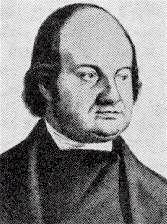
1801 - 1859 Person Name: Karl J. P. Spitta, 1801-1859 Topics: The Kingdom of God on Earth Home, Marriage, Parents Author of "O happy home, where thou art loved the dearest" in The Hymnal Spitta, Carl Johann Philipp, D.D., was born Aug. 1, 1801, at Hannover, where his father, Lebrecht Wilhelm Gottfried Spitta, was then living, as bookkeeper and teacher of the French language. In his eleventh year Spitta fell into a severe illness, which lasted for four years, and so threw him back that his mother (the father died in 1805) abandoned the idea of a professional career, and apprenticed him to a watchmaker. This occupation did not prove at all congenial to him, but he would not confess his dislike, and his family were ignorant of it till an old friend, who was trying to comfort him after the death of a younger brother, discovered his true feelings. The younger brother had been preparing for ordination, and so Carl was now invited by the family to adopt this career. He joyfully accepted the offer, left the workshop in the autumn of 1818, and succeeded, by dint of hard study during the winter, in gaining admission to the highest class in the Gymnasium (Lyceum) at Hannover, which he entered at Easter, 1819. He was thus able, at Easter, 1821, to proceed to the University of Göttingen, where he completed his theological course, under professors of pronounced Rationalistic opinions, at Easter, 1824 (D.D. from Gottingen, 1855).
He then became, in the beginning of May, a tutor in the family of Judge (Oberamlmann) Jochnius, at Lüine, near Lüneburg. Here he remained till his ordination on Dec. 10, 1828, as assistant pastor at Sudwalde, near Hoya. In Nov., 1830, he became assistant chaplain to the garrison and to the prison at Hameln on the Weser, and would have succeeded as permanent chaplain there, in the beginning of 1837, had not the military authorities, alarmed by reports which described him as a Pietist and a Mystic, refused to sanction the arrangement. As a compensation, he was appointed pastor at Wechold, near Hoya, in Oct., 1837, and married just before settling there. On his birthday, Aug. 1, 1847, he was instituted as Lutheran superintendent at Wittingen; in Oct., 1853, at Peine; and in July, 1859, at Burgdorf—all his appointments having been in the kingdom of Hannover.
A few weeks after removing to Burgdorf he was seized with gastric fever, but had apparently recovered, when, on Sept. 28, 1859, while sitting at his writing table, he was seized with cramp of the heart, and died in a quarter of an hour.
Spitta had begun to write in verse when he was eight years old, along with his brother Heinrich. During his university course he continued to write songs and secular poems, and published a collection of songs anonymously as a Sangbüchlein der Liebe für Handwerksleute. At Göttingen he formed a life-long friendship with Adolf Peters. He was also on intimate terms with Heinrich Heine, who was a fellow member with them of the Burschenschaft, or student's patriotic union (see K. Goedeke'sGrundriss, vol. iii., 1881, p. 259); and this friendship continued till Heine, while visiting him at Ltine, so jested at things sacred, even in the presence of Spitta's pupils, that their friendship came to an end. After the spiritual change, which began about the end of his university course, Spitta ceased to write secular pieces. His hymnwriting proper seems to have begun in 1821. In writing to a friend on May 5, 1826, he says, "In the manner in which I formerly sang I sing no more. To the Lord I consecrate my life and my love, and likewise my song. His love is the one great theme of all my songs; to praise and exalt it worthily is the desire of the Christian singer. He gave to me song and melody; I give it back to Him." The most fruitful period of his hymnwriting was at Lüne, where many of his most popular hymns were composed in the quiet evenings, in his own room, often after fasting, and when, sitting at the piano or at his harp, he had tuned his spirit to song. Many others were inspired by the beautiful scenery of the valley of the Weser, and by the intercourse with friends during his residence at Hameln. In his later years his ecclesiastical duties absorbed his attention, and hardly any of his hymns were written after 1847. A number of them were first printed in the Christliche Monatsschrift zur häuslichen Erbauung für alle Stände, which appeared from Jan. to June, 1826, and was edited by Spitta and by Pastor Deichmann, of Lüneburg.
Various causes doubtless contributed to the popularity of Spitta's Psalter und Harfe. The hymns therein are, as a rule, of moderate length, are clear and simple in style, refined in diction, sweet, flowing and melodious. Their quiet beauty, their tone of earnest, sincere, and childlike piety, of glowing devotion to the Saviour, and of calm resting on, what to Spitta were, the eternal verities, endeared them to all ranks and classes. They form a faithful mirror of his inner life and Chritian experience. They at once met and ministered to the revival of Evangelical religion in Germany, and thus enjoyed somewhat of the same good fortune and popularity which the renewed churchly life in England brought to Keble's Christian Year. As the title adopted shows Spitta meant them for family and private use, and for this they are best fitted, being, for the most part, subjective and individnal. They speedily, however, passed into the German hymnbooks for church use, both at home and abroad, and translations of them are found in almost all recent English and American collections.
Another element of Spitta's popularity in Germany has been contributed by the very numerous musical settings which have appeared to his hymns. Koch, vii., 246, gives a list of the more important of the collective editions, but, besides these, many of the separate pieces have been set to music by various composers, the "Angel of Patience" being one of the greatest favourites.
A number of Spitta's hymns are annotated under their original first lines. Of the rest we may note here the following:—
I. From his Psalter und Harfe. 1st Series, Pirna, 1833, and the 2nd ed. Leipzig, 1834; 2nd Series, Leipzig, 1843.
i. Allen ist ein Heil beschieden. Communion of Saints. First published at Pirna, 1833, as above, p. 27, in 5 stanzas of 7 lines, entitled "Unity in spirit." Another translation is:—“Salvation is a boon." By Miss Fry, 1859, p. 75.
ii. Es wird mein Herz mit Freuden wach. Sunday Morning. First published at Leipzig, 1843, p. 61, in 7 st. of 4 1., entitled "Sunday Morning." Translated as:—
My heart wakes with a joyful lay. This is a good and full tr. by Mrs. Findlater, in Hymns from the Land of Luther, 4th Ser. 1862, p. 82. Repeated, abridged and beginning "Awake! all hearts and joyful say," in G. S. Jellicoe's Collection, 1867, No. 26.
Other trs. are: (1) "My heart awakes with holy glee." By Miss Manington, 1863, p. 143. (2) "Awake, my heart, this day of rest." By R. Massie, 1864, p. 51. (3) "My heart is bright with joy." By Lady Durand, 1873, p. 25.
iii. Gottes Stadt steht festgegründet. Christian Church. First published at Leipzig, 1843, p. 97, in 6 stanzas of 12 lines, entitled "The City of God," and founded on Ps. lxxxvii. Tr. as:—
By the holy hills surrounded, In full, by R.. Massie, in his Lyra Domestica, 1864, p. 82, repeated in the Wesleyan Hymn Book1875, No. 595.
iv. Hochgesegnet seid ihr Boten. Foreign Missions. First pub. at Pirna, 1833, as above, p. 24, in 6 stanzas of 8 lines, entitled "The Missionaries to the Heathen." Tr. as:—
Blest are ye, ye chosen bearers. In full, by R. Massie, in his Lyra Domestica, 1860, p. 95.
Other trs. are: (1) "Ye messengers of Christ, By Him commissioned forth." By Miss Fry, 1859, p. 147. (2) "0 blessed are ye messengers, sent forth." By Lady Durand, 1873, p. 52.
v. Ich glaube, darum rede ich. Faith. First published at Pirna, 1833, as above, p. 56, in 5 st. of 8 1., entitled " I believe." Tr. as:—
I believe, and so have spoken. By R. Massie, in his Lyra Domestica, 1860, p. 55.
vi. Ich höre deine Stimme. Ps. xxiii. First pub. at Pirna, 1833, as above, p. 44, in 7 st. of 8 1., entitled "The Lord is my Shepherd." Tr. as:—
1. I hear my Shepherd calling. This is a good and full tr. by R. Massie, in his Lyra Domestic, 1860, p. 44
2. Jesu, my Lord, my Shepherd. This is a very good translation, omitting st. vi., in the Catholic Apostolic Hymns for the Use of the Churches, n.d. [1868], marked as tr. by "M. E. A. 1867."
Other trs. are: (1) "Shepherd of souls. Thy voice I hear, As stage." By Dr. R. Maguire, 1872, p. 166. (2) “I know Thy voice, my Shepherd.” By Lady Durand, 1873, p. 11.
vii. Ich und mein Haus, wir sind bereit. Family Use. A fine hymn, founded on Joshua xxiv., 15. First pub. at Pirna, 1833, as above, p. 110, in 6 st. of 10 1., entitled “I and my house will serve the Lord." Tr. as:—
I and my house are ready, Lord. In full, by R. Massie, in his Lyra Domestica, 1860, p. 103.
viii. Im Osten flammt empor der gol'dne Morgen. Morning. First published at Pirna, 1833, as above, p. 91, in 7 st. of 6 1., entitled "At Morning." Tr. as:—
The golden morn flames up the Eastern sky. This is a good and full tr. by Miss Winkworth, in the Lyra Germanica, 2nd Ser., 1858, p. 74. Other trs. are: (1) “The golden morn is in the East arisen." By the Hon. S. R. Maxwell in his Sacred Poems, 1857, p. 114. (2) "On the far East now flames the golden Morning." By S. A. Storrs, in her Thoughts and Sketches, 1857, p. 74. (3) "Lo! in the East the golden morn appearing." By Miss Fry, 1859, p. 1. (4) “The purple morning gilds the Eastern skies." By R. Massie, 1860, p. 6. (5) "Out from the East, the golden morn is riding." By Miss Manington. 1863, p. 113. (6) “See from the East the golden morn." By Dr. R. Maguire, 1883, p. 27.
ix. Kehre wieder, kehre wieder. Lent. Founded on Jer. iii. 12, 13. First pub. at Pirna, 1833, as above, p. 29, in 5 st. of 10 l., entitled " Turn again." Translated as:—
1. Return, return! Poor long-lost wanderer, home. This is a free tr. by Miss Borthwick in Hymns from the Land of Luther, 2nd Ser., 1855, p. 25.
2. Turn, poor wanderer, ere the sentence. In full, by R. Massie, in his Lyra Domestic, 1860, p. 69.
Other trs. are: (1) "Turn, O turn, no more delaying." By the Hon. S. R. Maxwell, in his Sacred Poems, 1857, p. 101. (2) "Return, return, thou lost one." By Lady Durand, 1873, p. 59. (3) "Return again! return again." By J. Kelly, in his Hymns of the Present Century, 1885, p. 60.
x. Meine Stund' ist noch nicht kommen. Cross and Consolation. First published at Pirna, 1833, as above, p. 37, in 7 st. of 6 1., entitled "The Lord's Hour.” Tr. as:—
Jesus' hour is not yet come. This is a free tr., omitting st. v., by Miss Borthwick, in Hymns from the Land of Luther, 2nd ser. 1855, p.43.
Other trs. are:—(1) "'Tis not yet the time appointed." By R. Massie, 1860, p. 47, and in Reid's Praise Book, 1872. (2) " My times, O Lord, are in Thy hand." By Dr. R. Maguire, 1883, p. 99.
xi. Kimm hin, was dein ist, Gott, nimms hin. Surrender to God. This beautiful hymn was first pub. at Leipzig, 1843, as above, p. 58, in 5 st. of 10 1., entitled "Resignation." Translated as:—
I give Thee back Thine own again. A good and full tr. by R. Massie, in hisLyra Domestica, 1864, p. 49.
xii. 0 du, der uns begegnet. Christian Service. First pub. at Leipzig, 1843, as above, p. 92, in 4 st. of 4 1., entitled "The Blessing of the Blest." Tr. as:—
0 Thou Whose grace first found us, Whose love. In full, by R. Massie, in his Lyra Domestica, 1864.
xiii. O komm, du Geist der Wahrheit. Whitsuntide. First pub. at Pirna, 1833, as above, p. 12, in 7 st. of 8 1., entitled "Whitsunday." Tr. as:—
1. Draw, Holy Spirit, nearer. In full, by R. Massie, in his Lyra Domestica, 1860, p. 27.
2. 0 come, Eternal Spirit, Of truth, diffuse Thou light.
xiv. 0 Vaterhand, die mich so treu geführet. Holy Trinity. A fine hymn, first pub. at Pirna, 1833, as above, p. 128, in 3 st. of 8 1., entitled "Father, Son, and Spirit.” Tr. as:—
1. O Father-Eye, that hath so truly watch'd. By Miss Winkworth, in her Lyra Germanica, 2nd Ser., 1858, p. 63.
2. Father whose hand hath led me so securely.
xv. 0 welche fromme schöne Sitte. Spiritual Conversation. First pub. at Pirna, 1833, as above, p. 101, in 6 st. of 8 1., entitled "The Blessing of Christian fellowship." Tr. as:—
It is a practice greatly blest. In full, by R. Massie, in his Lyra Domestica, 1860, p. 89.
xvi. 0 wie freun wir uns der Stunde. Fellowship with Christ. First pub. at Leipzig, 1843, as above, p. 3, in 6 st. of 8 1., entitled "Thou hast the words of Eternal Life". Tr. as:—
Oh J how blest the hour, Lord Jesus. In full, by R. Massie, in his Lyra Domestica, 1864, p. 5. Another tr. is: "How great the joy, how blest the hour." By Dr. R. Maguire, 1872, p. 182.
xvii. 0 wie manche schone Stunde. Cross and Consolation. First published at Pirna, 1833, as above, p. 130, in 10 st. of 4 1., entitled "Comfort." Tr. as:—
1. O how many hours of gladness, Hath the Lord. In full, by R. Massie, in his Lyra Domestica, 1860, p. 126, repeated, abridged, in the Book of Common Praise, 1863.
2. O how many hours of beauty. This is a good and full tr., by Mrs. Findlater, in Hymns from the Land of Luther, 4th Ser., 1862, p. 11.
Another tr. is: "O how many an hour of gladness." By Lady Durand, 1873, p. 16.
xviii. Sehet, sehet, welche Liebe. The Love of the Holy Trinity. First pub. at Pirna, 1833, as above, p. 19, in 3 st. of 8 1., entitled " See what Love." Tr. as:—
See, O see, what love the Father. In full, by R. Massie, in his Lyra Domestica, 1860, p. 50.
Other trs. are : (1) "Behold the Father's love." By Miss Fry, 1859, p. 9. (2) "See! what wondrous love, how matchless." By Miss Manington, 1863, p. 33. (3) “Behold what love the Father hath—how great." By Dr. R. Maguire, 1872, p. 68.
xix. Unser Wandel ist im Himmel! Wie ein Mensch in sich versenkt. The Christian Life. First pub. at Pirna, 1833, as above, p. 75, in 7 st. of 8 1., entitled "Our Conversation is in Heaven," and suggested by Philipp. iii. 20. Tr. as:—
As a traveller returning. In full, by R. Massie, in his Lyra Domestica, 1860, p. 73. This is found in two centos :—
1. Jesus, like the magnet, raises (st. iii., v., vi.) in the Methodist New Congregational Hymn Book 1863.
2. Can we have our hearts in heaven (st. v., vii.) in Adams's Church Pastorals, Boston, U.S., 1864.
Another tr. is: "We are citizens of heaven." In the British Herald, January, 1866, p. 205.
xx. Wandle leuchtender und schöner. Easter. First published at Pirna, 1833, as above, p. 8, in 9 st. of 8 1., entitled "Easter Festival." Tr. as:—
Sun, shine forth in all thy splendour. This is a full and good tr. by R. Massie, in his Lyra Domestica, 1860, p. 24. Another tr. is: "With brighter glory, Easter Sun." By Lady Durand, 1873, p. 4.
xxi. Wir sind des Herrn, wir leben, oder sterben. Life in Christ. A fine hymn founded on Rom. xiv. 8. Tr. as:—
1. We are the Lord's; His all-sufficient merit. This is a good and full tr. by C. T. Astley, in his Songs in the Night, 1860, p. 32.
2. We are the Lord's, whether we live or die. Also a good and full tr. by R. Massie, in his Lyra Domestica, 1864, p. 81.
Hymns not in English common use:—
xxii. Ach, welche Marter, welche Flagen. Christ's Mercy. Tr. as "O Lord, what sorrows past expression."
xxiii. Das Leben wird oft trübe. Spiritual Dryness. The trs. are: (1) "How weary and how worthless this life at times appears." (2) “Our life is often dark." (3) "This life is ofttimes gloomy." (4) "Life often seems so dreary.”
xxiv. Der du in der Nacht des Todes. Epiphany. The trs. are: (1) "Thou Who in the night of death." (2) "Christ whose first appearance lighted." (3) "Thou who in death's night of terror." (4) "Christ, who in Death's night of darkness."
xxv. Des Christen Schmuck und Ordensband. Rejoicing in Tribulation. The trs. are: (1) "The Christian's badge of honour here." (2) "The badge the Christian wears on earth." (3) "The Christian's star of honour here." (4) "The sign of faith, and love's true token
xxvi. Du schöne Lilie auf dem Feld. Trust in God. The trs. are: (1) "Thou beauteous lily of the field, Who robed." (2) "Thou beauteous lily of the field! Who hath." (3) "Thou beauteous lily of the field, Thou child to Nature dear." (4) "Sweet lily of the field, declare." (5) "Thou pretty lily of the field." (6) "Thou lovely lily of the field."
xxvii. Ein lieblich Loos ist uns gefallen. The Christian's Portion.
xxviii. Ein Pilger schickt sich an zur Fahrt. For the Dying. Tr. as (1) "A pilgrim stands on Jordan's brink." (2) "A pilgrim for his new abode."
xxix. Erhalt' in mir den Lebenstrieb, das Sehnen. The Plant of Grace. The trs. are (1) "Maintain in me the sap of life, the yearning." (2) "Excite in me, 0 Lord, an ardent thirst.” (3) "Uphold in me a living wish and longing."
xxx. Es giebt ein Lied der Lieder. The Lord's Song. The trs. are: (1) "A Song of songs there is." (2) "There is a song so thrilling." (3) "There is a song now singing." (4) "One song of songs —the sweetest." (5) "A blessed Song of songs there is."
xxxi. Freuet euch der schonen Erde. Joy in the Beauties of Nature. The trs. are: (1) "0 rejoice in Nature's beauties." (2) "In the beauteous earth rejoice ye." (3) "Rejoice in the beautiful earth! For well may." (4) "Rejoice in the beautiful earth For well she," &c. (5) "Joy ye o'er this earth so lovely." (6) "Rejoice in Earth's fair beauty."
xxxii. Gehe hin in Gottes Namen. Before Work. The trs. are: (1) "Cheerfully to work proceed.” (2) "In the name of God advancing." (3) "In the Name of God go forward."
xxxiii. Ich nehme, was du mir bestimmst. Submission to God's Will. The trs. are: (1) "What Thou appointest I receive." (2) "Give what Thou wilt oh Lord! my grateful heart." (3) "Thy will I cheerfully obey.”
xxxiv. Ich steh' in xneines Herren Hand. Trust in God. Tr. as "I place myself in Jesus' hands."
xxxv. In der Angst der Welt will ich nicht klagen. Christian Life. The trs. are: (1) "Amid the world's vexations." (2) "Uncomplaining, though with care grown hoary." (3) "In this earth—life's bitter anguish.”
xxxvi. 0 du, den meine Seele liebt. Holy Communion. The trs. are: (1) "0 Thou, Who holdest in my heart." (2) "Oh Thou, my loving thoughts employ.”
xxxvii. Still an deinem liebevollen Herzen. The Love of Christ. The trs. are: (1) "Safe on thy paternal breast." (2) "With calm repose, Oh let me lie." (3) "Still on Thy loving heart let me repose."
xxxviii. Stimm' an das Lied vom Sterben. For the Dying. Sung at hisown funeral on Sunday, Oct. 1, 1859. The trs. are: (1) "I sing of death and dying." (2) "Sing now the Song of Dying."
xxxix. Vom Oelberg' wogt es nieder. Christ weeping over Jerusalem. The trs. are: (1) "Hark! for loud notes of joy." (2) "Where yonder mount, with olives clad." (3) “From Olivet the surging crowd."
xl. Was macht ihr dass ihr weinet. Communion of Saints. Founded on Acts xxi. 13. The trs. are: (1) "What mean ye by this wailing." (2) "What mean ye, dearly loved ones." (3) " What mean ye thus those tears to weep." (4) "How mean ye thus by weeping." (5) "Why is it that ye're weeping."
xli. Weint nicht uber Jesu Schmerzen. Repentance. The trs. are: (1) "For Jesu's agony and death." (2) "Wherefore weep we over Jesus." (3) "Weep not over Jesu's sorrow."
xlii. Wie wird uns sein, wenn endlich nach dent
schweren. Eternal Life. The trs. are: (1) "How shall it be with us, when we, frail mortals." (2) "O what will be the day, when won at last." (3) "What shall we be, and whither shall we go?" (4) "How will it be? when past the conflict heavy.” (5) "O what shall we be, when the conflict o'er."
xliii. Winter ist es. In dem weiten Reich. Winter. The trs. are: (1) "Winter is here, and none may dare intrude." (2) "It is winter. All seems dead or dying." (3) "Winter it is! o'er the mighty kingdom." (4) "It is Winter. The wide realm of Nature.” (5) "Winter is here. In Nature's wide domain." (6) "It is winter; and the wide domain.”
xliv. Wohl uns, der Vater hat uns lieb. The Love of God. Founded on Rom. viii. 32. This was, according to Koch vii. 243, one of the hymns which Spitta wrote between Easter and July, 1824, while studying the Epistle to the Romans, and which on July 7, 1824, he sent to his brother Heinrich Spitta, professor of medicine at Rostock, but Ludwig Spitta dates it "Autumn, 1833." It is tr. as "How blest are we! that God of us."
xlv. Wo ist göttliches Erbarmen. The Grace of Christ. The trs. are:— (1) "Oh where doth mercy dwell." (2) "Where is mercy and compassion." (3) "Where is Divine compassion, that."
xlvi. Wort des Lebens, lautre Quelle. Holy Scripture. The trs. are: (1) "Word of Life! unsullied fountain." (2) "Thou word of Life, unsullied spring!"
(3) "Word of Life, eternal Fountain." (4) "Word of Life, thou fountain bright.”
II. From his Nachgelassene geistliche Lieder. Leipzig, 1861.
Hardly any of these have come into use in Germany; and they have either remained unknown to or have been almost entirely ignored by translators into English. We need only note two, viz.:—
xlvii. Die erste Ruhestatte die die Welt. Christmas. It is tr. as "The cradle which the world has drest."
xlviii. 0 Herbst, du Abendstunde. Autumn. It is tr. as “0 autumn, fair pensive evening." By Miss Borthwick, in the Family Treasury, 1864, p. 191, dated September 1864, and included Thoughtful Hour, 1867, p. 181. [Rev. James Mearns, M.A.]
--Excerpts from John Julian, Dictionary of Hymnology (1907)
===================
Spitta, C. J. P. , p. 1076, ii. A new edition of the Psalter und Harfe (both parts), with biographical Introduction, was published at Gotha in 1890.
--John Julian, Dictionary of Hymnology, Appendix, Part II (1907)
Karl Johann Philipp Spitta
Pages




