

 My Starred Hymns
 My FlexScores
 My Hymnals
 My Purchased Files
Planning worship?
Check out our sister site, ZeteoSearch.org,
for 20+ additional resources related to your search.
- |
User Links
Person Results
B. B. McKinney
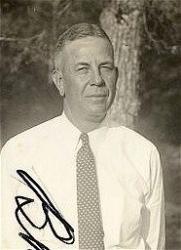
1886 - 1952 Composer of "[Standing by a purpose true]" in Service Songs Pseudonyms--
Martha Annis (his mother’s maiden name was Martha Annis Heflin)
Otto Nellen
Gene Routh (his wife’s maiden name was Leila Irene Routh)
-----
Son of James Calvin McKinney and Martha Annis Heflin McKinney, B . B. attended Mount Lebanon Academy, Louisiana; Louisiana College, Pineville, Louisiana; the Southwestern Baptist Seminary in Fort Worth, Texas; the Siegel-Myers Correspondence School of Music, Chicago, Illinois (BM.1922); and the Bush Conservatory of Music, Chicago. Oklahoma Baptist University awarded him an honorary MusD degree in 1942.
McKinney served as music editor at the Robert H. Coleman company in Dallas, Texas (1918–35). In 1919, after several months in the army, McKinney returned to Fort Worth, where Isham E. Reynolds asked him to join the faculty of the School of Sacred Music at Southwestern Baptist Theological Seminary. He taught at the seminary until 1932, then pastored in at the Travis Avenue Baptist Church in Fort Worth (1931–35). In 1935, McKinney became music editor for the Baptist Sunday School Board in Nashville, Tennessee.
McKinney wrote words and music for about 150 songs, and music for 115 more.
--© Cyber Hymnal™ (www.hymntime.com/tch)
B. B. McKinney
F. A. Blackmer
1855 - 1930 Arranger of "[At the feast of Belshazzar and a thousand of his lords]" in The Gospel Awakening Blackmer, Francis Augustus. (Ware, Massachusetts, February 17, 1855--October 8, 1930, Somerville, Massachusetts). Advent Christian musician. His parents, Augustus and Jane Blackmer, were among those caught up in the excitement of the Millerite Movement. One son, Fred, became an Advent Christian minister. Francis, with a talent recognized at an early age, consecrated his own life to Christian service as a musician. He was immersed in baptism at the Adventist campmeeting in Springfield, Massachusetts, by Elder Miles Grant.
His early years were spend in central Massachusetts, his schooling at Wilbraham Academy. He was largely self-taught in harmony and musical composition. He wrote the words and music to his first gospel song, "Out on the fathomless sea," at the age of sixteen. Altogether he wrote over 300 gospel songs about the Second Coming, witnessing and working for the Lord, and praises to God's Holy Name. A few of these have circulated widely outside his own denomination. His final text, "I shall see him, And be like him," came when he was so weak that his friend, Clarence M. Seamans, had to supply the music. He used the pseudonym, A. Francis, with some of his early songs.
Blackmer's first anthology was The Gospel Awakening, (1888). Subsequent gospel songbooks with which he was associated were: Singing by the Way (1895), Carols of Hope (1906), The Golden Sheaf, No. 2 (1916), and Songs of Coming Glory (1926).
Most of his adult life was spent in Somerville, Massachusetts, a suburb of Boston, where he had a prosperous piano business. In the 1890s, his "Francis A. Blackmer Pianos" were made for him by the Washington Hall Piano Company of Boston. Later, his "Good as Gold Pianos" were manufactured by the Christman Piano Company of New York City and shipped directly to his customers throughout New England.
In Somerville, Blackmer served as choirmaster and song-leader in the Advent Christian Church for many years. He was also an elder of the church until his death. From 1914 until his death, he was songleader at the mid-summer Alton Bay Campmeeting on Lake Winnepesaukee, New Hapshire. There his High Rock Hill was both a salesroom and a summer cottage over the years. He was a member of the board of directors of the campmeeting association for several years. Very popular were his singing sessions on the campground square between suppertim and evening services, and a final sing into the small hours of the night following the final service of the campmeeting.
--Leonard Ellinwood, DNAH Archives
F. A. Blackmer
P. P. Bliss
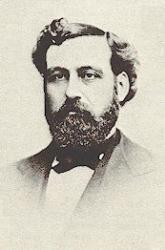
1838 - 1876 Person Name: Philip P. Bliss Author of "Dare to Be a Daniel!" in Trinity Hymnal (Rev. ed.) Philip P. Bliss (b. Clearfield County, PA, 1838; d. Ashtabula, OH, 1876) left home as a young boy to make a living by working on farms and in lumber camps, all while trying to continue his schooling. He was converted at a revival meeting at age twelve. Bliss became an itinerant music teacher, making house calls on horseback during the winter, and during the summer attending the Normal Academy of Music in Genesco, New York. His first song was published in 1864, and in 1868 Dwight L. Moody advised him to become a singing evangelist. For the last two years of his life Bliss traveled with Major D. W. Whittle and led the music at revival meetings in the Midwest and Southern United States. Bliss and Ira D. Sankey published a popular series of hymn collections entitled Gospel Hymns. The first book of the series, Gospel Songs, was published in 1874. Bliss's tragic death at the age of thirty-eight happened near the end of 1876. Philip P. Bliss and his wife were traveling to Chicago to sing for the evangelistic services led by Daniel W. Whittle at Dwight L. Moody's Tabernacle. But a train wreck and fire en route claimed their lives.
Bert Polman
=================
Bliss, Philip, b. at Clearfield County, Pennsylvania, July 9, 1838. In 1864 he went to Chicago in the employ of Dr. George F. Root, the musician, where he was engaged in conducting musical Institutes, and in composing Sunday School melodies. Originally a Methodist, he became, about 1871, a choirman of the First Congregational Church, Chicago, and the Superintendent of its Sunday Schools. In 1874 he joined D. W. Whittle in evangelical work. To this cause he gave (although a poor man) the royalty of his Gospel Songs, which was worth some thirty thousand dollars. His death was sudden. It occurred in the railway disaster at Ashtabula, Ohio, Dec. 30, 1876. ... Some of his verses have obtained wide popularity in most English-speaking countries. The more widely known, and specially those which are found in collections in use in G. Britain, are in the following American works:—
i. The Prize, 1870.
1. I should like to die. Death anticipated. This is one of his earliest compositions, and is unworthy of the position it holds.
2. Through the valley of the shadow I must go. Death anticipated.
3. Whosoever heareth, shout, shout the sound. Jesus the Way. Written during the winter of 1869-70 after hearing Mr. H. Moorhouse (from England) preach on St. John iii. 16.
ii. The Charm, 1871.
4. Almost persuaded now to believe. Procrastination. This was suggested by the following passage in a sermon by the Rev. Mr. Brundnge, Bliss being present at its delivery:—" He who is almost persuaded is almost saved, but to be almost saved is to be entirely lost."
5. Ho! my comrades! see the signal. Faithfulness.
6. O! Jerusalem, the golden city, bright, &c. Heaven.
7. On what Foundation do [did] you build? Christ the Foundation.
iii. The Song Tree, 1872.
8. Light in the darkness, sailor, day is at hand. Safety. This hymn, “The Life-Boat," has attained to great popularity. The incident upon which it is based, that of the rescue of a ship's crew by a life-boat, is given in detail by Mr. Sankey in his Sacred Songs, &c, No. 99 (large ed.). It is sometimes known by its refrain, "Pull for the shore," &c.
iv. The Joy, 1873.
9. In me ye may have peace. Peace.
10. To die is gain. Death anticipated.
v. Sunshine, 1873.
11. Down life's dark vale we wander. Death anticipated.
12. More holiness give me. For Holiness.
13. Only an armour-bearer. Soldiers of the Cross.
14. Standing by a purpose true. Faithfulness.
15. This loving Saviour stands patiently. Invitation.
vi. Gospel Songs, 1874.
16. A long time I wandered. Peace and Joy.
17. Brightly beams our Father's mercy. Mercy.
18. Come, brethren, as we march along. Praise.
19. Free from the law, O happy condition. Redemption.
20. Have you on the Lord believed? Fullness of Grace. This hymn arose out of the following circumstances :—" A vast fortune was left in the hands of a minister for one of his poor parishioners. Fearing that it might be sqmandered if suddenly bestowed upon him, the wise minister sent him a little at a time, with a note saying, “This is thine; use it wisely; there is more to follow.” Hence also the refrain ‘More to follow,’ by which the hymn is known."
21. How much owest thou? Divine Claims.
22. I know not the hour when my Lord will come. Death anticipated. Suggested by reading the book, The Gates Ajar.
23. See the gentle Shepherd standing. The Good Shepherd.
24. Though the way be sometimes dreary. Divine Leading.
25. Will you meet me at the fountain? Fountain of Living Water. The incident out of which this hymn arose is thus stated in The Christian, No. 365, "At the Industrial Exposition at Chicago it was an everyday appointment to meet at the Central Fountain. Mr. P. P. Bliss, whose mind seemed always set on things above, caught up the words, and wrote this hymn, 'Meet me at the Fountain.'"
vii. Gospel Hymns, No. 1, 1875.
26. One offer of salvation. The Name of Jesus.
27. Wandering afar from the dwellings of men. The Lepers.
viii. The International Lesson Monthly, 1875.
28. Weary gleaner, whence comest thou? Duty.
29. The whole world was lost in the darkness of Sin. Light of the world.
30. Man of sorrows! what a name. Redemption.
31. The Spirit, O sinner, in mercy doth move. Holy Spirit.
ix. Gospel Hymns, No. 2, 1876.
32. At the feet of Jesus. The good choice.
33. Come, sing the Gospel's joyful sound. Salvation.
34. Cut it down, cut it down. Justice and Mercy.
35. Do you see the Hebrew captive? Prayer.
36. Hallelujah, He is risen. Easier. Written in the spring of 1876 and first sung by Bliss on Easter afternoon, 1876, in the Court House Square, Augusta, Georgia, to 5900 people.
37. In Zion's rock abiding. Safety.
38. Repeat the story o'er and o'er. Grace and Peace.
39. Tenderly the Shepherd. The Good Shepherd.
x. Gospel Hymns, No. 3, 1878.
40. Hear ye the glad good news from heaven. Faith and Salvation.
41. I will sing of my Redeemer. Praise.
xi. Gospel Hymns, No. 4, 1881.
42. 'Tis known on earth and heaven too. More about Jesus.
xii. Various.
43. Sing over again to me. Words of Life. This appeared in a paper entitled Words of Life, 1874, The following are undated:—
44. March to the battle-field. Duty and Victory.
45. There is sin in the camp. Hinderances.
46. 'Tis the promise of God. Praise.
47. While the silvery moon-beams, fall, New Birth.
48. God is always near me. Omnipresence.
Two hymns," I am so glad that our Father in heaven," and " Sowing the seed by the daylight [dawnlight] fair," (sometimes given as " Sowing our seed in the morning fair ") are usually attributed to Mr. Bliss. In his Gospel Songs, Cincinnati, 1874, however, he lays claim to the music only. Mr. Sankey attributes this last to "E. A. Oakey." With the exception of No. 48, these hymns are given in Mr. Sankey's Sacred Songs & Solos, Pts. i. and ii. Their popularity is far beyond their literary merits, and is mainly due to the simple melodies to which they are wedded. As a writer of hymns of this class Mr. Bliss is second only to Mrs. Van Alstyne. Many anecdotes concerning hymns of this class are given in American Evangelists; an Account of their work in England and America, by the Rev. Elias Nason, Boston, U.S., Lathrop & Co., 1877.
Mr. Bliss is usually known as "P. P. Bliss." This is found on the title-pages of his collections. On his own authority, however, we are enabled to say that his name originally stood thus : “Philipp Bliss.” Early in life he separated the final p from his Christian name, constituted it a capital P, and thus produced "P. P. Bliss." (For this article we are mainly indebted to Professor F. M. Bird, and Mr. H. P. Main.)
-John Julian, Dictionary of Hymnology (1907)
========================
Bliss, Philip , p. 151, i. "Sowing the seed by the daylight fair" is in the Family Treasury , Edinburgh, 1861, pt. i., p. 84. It is said to be by Miss Emily Sullivan Oakey; born at Albany, N. York, Oct. 8, 1829, died May 11, 1883. Note also that Bliss's hymn, No. 43. on p. 150, ii., should read, "Sing them over again to me."
--John Julian, Dictionary of Hymnology, Appendix, Part II (1907)
=====================
Bliss, P., p. 150, i. Two works have been brought to our notice, since the issue of our first edition of this Dictionary, which concern this author, viz.:—
1. Memoirs of Philip P. Bliss. Edited by D. W. Whittle. Contributions by Rev. E. P. Goodwin, Ira D. Sankey, and Geo. F. Root. Introduction by D. L. Moody. New York, &c.: A. S. Barnes & Co., 1877.
2. My Life and Sacred Songs. By Ira D. Sankey. With an Introduction by Theodore L. Cuyler, D.D). London: Hodder & Stoughton, and Morgan & Scott, 1906.
These works have a special interest for those who use I. D. Sankey's Sacred Songs & Solos, and all of P. Bliss's publications. To Mr. Sankey's My Life, &c, we direct special attention for P. Bliss's hymns:—
“Do you see the Hebrew captive kneeling?" p. 294.
"Down life's dark vale we wander." p. 285.
"Ho! my comrades, see the signal." p. 105.
"'Tis the promise of God full salvation to give." p. 99.
--John Julian, Dictionary of Hymnology, New Supplement (1907)
P. P. Bliss
Mrs. J. M. Hunter

1860 - 1942 Author of "Be a Daniel" in The Ganus Hymnal Laura Bell Ogilvie Hunter. Married John Madison Hunter.
Mrs. J. M. Hunter
J. B. Vaughan

1862 - 1918 Person Name: J. B. Vauhan Composer of "["Dare to be a Daniel" in this world below]" in The Ganus Hymnal John B. Vaughan (sometimes misspelled Vaughn), 1862-1918
Born: June 16, 1862, Elbert County, Georgia.
Died: July 18, 1918, Athens, Georgia.
Buried: Oconee Hill Cemetery, Athens, Georgia.
Vaughan was a Gospel song writer and music publisher. At one time he taught at the Southern Development Normal music school in Waco, Texas.
Lyrics--
Beautiful Home Somewhere
There’ll Be Room Enough
’Twill Be Glory By and By
We Shall See the King
--http://www.hymntime.com
--http://www.findagrave.com/cgi-bin/fg.cgi?page=gr&GRid=23551328
J. B. Vaughan
J. D. Patton
1868 - 1932 Composer of "[See the brave young Daniel passing nobly by]" in The New Revival Glory John Daniel Patton
J. D. Patton
Daniel Read
1757 - 1836 Composer of "WINDHAM" in The Seventh-Day Adventist Hymn and Tune Book Daniel Read; b. 1757, Rehoboth, Mass.; d. 1837, New Haven, Conn.An American composer and a primary figure in early American classical music. He was one of the “Yankee Tunesmiths” (1st New England School of Music) when classical music was popular in Europe. Read was a private in Massachusetts militia and later a comb maker and owner of a general store in New Haven, CN. He was only the 3rd composer in the U. S. to put out a collection of his own music. His work, “The American Singing Book” went through 5 editions, making him the most popular composer in the nation. Others often plagarized his tunes in those days. Tunebook sales supplemented his general store income, including “The Columbian Harmonist” (3 volumnes) with 3 revisions, and “The New Haven Collection of Sacred Music” 1818. Read also published “The American Musical magazine” in 12 annual issues in 1786 and 1787. In later years he came to appreciate European music more and imitated that styling in devotional music. Some of Read's music is still being performed, and selections have been published in “The Sacred Harp”, 1991 Edition, and the “Stoughton Music Society” (Centennial Collection 1980).
John Perry
Daniel Read
Adoniram J. Gordon
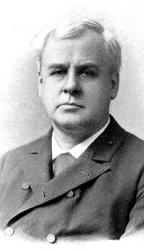
1836 - 1895 Author of "Help Me to Be Holy" in The Cyber Hymnal Gordon, Adoniram Judson, D.D., born at New Hampton, N.H., Apr. 19, 1836. Graduated at Brown University, 1860; entered the Baptist ministry; Pastor of Clarendon Street Baptist Church, Boston, 1869; and died in 1895. He published The Vestry Hymn and Tune Book, 1872; and was one of the editors of the Service of Song for Baptist Churches, 1871. His hymns in common use include:—
1. O blessed Paraclete. [Holy Spirit .] Given in Sursum Corda, 1898, as having been written in 1890.
2. O Spirit's anointing, for service appointing . [Foreign Missions.] This hymn was "written in the summer of 1886, at Northfield School for Bible Study, organised by Mr. Moody. More than one hundred college students connected with this school gave themselves to the work of foreign missions during their stay at Northfield. Four of their number were chosen to visit the colleges in different parts of the country, and endeavour to awaken a deeper interest in missions during the succeeding academic year. At their request Dr. Gordon” wrote this hymn. Baptist Hymns and Hymn Writers.
3. Where art thou, soul! I hear God say. [Divine Chiding.] Published in social meeting edition of The Service of Song, 1881.
--John Julian, Dictionary of Hymnology, New Supplement (1907)
Adoniram J. Gordon
Charlotte G. Homer
1856 - 1932 Author of "Be a Hero " in Awakening Songs for the Church, Sunday School and Evangelistic Services Pseudonym. See also Gabriel, Chas. Hutchinson, 1856-1932
Charlotte G. Homer
Jon Drevits
b. 1928 Person Name: Jon Drevits, 1928- Arranger of "[Standing by a purpose true]" in Revival Hymns and Choruses
Jon Drevits
Pages