

 My Starred Hymns
 My FlexScores
 My Hymnals
 My Purchased Files
Planning worship?
Check out our sister site, ZeteoSearch.org,
for 20+ additional resources related to your search.
- |
User Links
Search Results

Courage, my sorely-tempted heart!
Author: Justus Henning Böhmer; Catherine Winkworth Appears in 7 hymnals First Line: Courage, my sorely tempted heart
Courage, my sorely-tempted heart!


GREGOR'S 54TH METRE
Appears in 1 hymnal Tune Sources: Bohemian Brethren, before 1566 Tune Key: g minor Incipit: 11231 23455 55754 Used With Text: Courage, My Sorely Tempted Heart!
GREGOR'S 54TH METRE


Courage, My Sorely Tempted Heart!
Author: Justus H. Böhmer; Catherine Winkworth Hymnal: The Cyber Hymnal #13709 Lyrics: 1 Courage, my sorely tempted heart!
Break through thy woes, forget their smart;
Come forth, and on thy Bridegroom gaze,
The Lamb of God, the Fount of grace;
Here is Thy place!
2 His arms are open, thither flee!
There rest and peace are waiting thee,
The deathless crown of righteousness,
The entrance to eternal bliss;
He gives thee this!
3 Then combat well, of naught afraid,
For this His follower thou art made:
Each battle teaches thee to fight,
Each foe to be a braver knight,
Armed with His might.
4 If storms of fierce temptation rise,
Unmoved we’ll face the frowning skies;
If but the heart is true indeed,
Christ will be with us in our need,
His own could bleed.
5 I flee away to Thy dear cross,
For hope is there for every loss,
Healing for every wound and woe,
There all the strength of love I know
And feel its glow.
6 Before the Holy One I fall,
The eternal Sacrifice for all;
His death has freed us from our load,
Peace on the anguished soul bestowed,
Brought us to God.
7 Thy word hath still its glorious powers,
The noblest chivalry is ours;
O Thou, for whom to die is gain,
I bring Thee here all; oh, deign to
Accept and reign.
8 How then should I go mourning on?
I look to Thee—my fears are gone,
With Thee is rest that cannot cease,
For Thou has wrought us full release,
And made our peace. Languages: English Tune Title: GREGOR'S 54TH METRE
Courage, My Sorely Tempted Heart!

Courage, my sorely-tempted heart!
Author: Böhmer Hymnal: Chorale Book for England, The #126 (1863) Lyrics:
Courage, my sorely-tempted heart!
Break through thy woes, forget their smart;
Come forth and on thy Bridegroom gaze,
The Lamb of God, the Fount of grace;
Here is thy place!
His arms are open, thither flee!
There rest and peace are waiting thee,
The deathless crown of righteousness,
The entrance to eternal bliss;
He gives thee this!
Then combat well, of nought afraid,
For thus His follower thou art made,
Each battle teaches thee to fight,
Each foe to be a braver knight,
Arm'd with His might.
If storms of fierce temptation rise,
Unmoved I'll face the frowning skies;
If but the heart is true indeed,
Christ will be with me in my need,--
His own could bleed.
I flee away to Thy dear Cross,
For hope is there for every loss,
Healing for every wound and woe,
There all the strength of love I know,
And feel its glow.
Before the Holy One I fall,
The Eternal Sacrifice for all;
His death has freed us from our load,
Peace on the anguish'd soul bestow'd,
Brought us to God.
How then thould I go mourning on?
I look to Thee,--my fears are gone,
With Thee is rest that cannot cease,
For Thou hast wrought us full release,
And made our peace.
Thy word hath still its glorious powers,
The noblest cbivalry is ours;
O Thou, for whom to die is gain,
Bring Thee here my all, oh deign
T'accept and reign!
Languages: English
Courage, my sorely-tempted heart!
Courage, my sorely tempted heart
Author: Catherine Winkworth, 1827-1878; Justus Henning Boehmer Hymnal: Christ in Song #455 (1871)
Courage, my sorely tempted heart


Catherine Winkworth
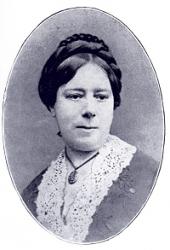
1827 - 1878 Translator of "Courage, My Sorely Tempted Heart!" in The Cyber Hymnal Catherine Winkworth (b. Holborn, London, England, 1827; d. Monnetier, Savoy, France, 1878) is well known for her English translations of German hymns; her translations were polished and yet remained close to the original. Educated initially by her mother, she lived with relatives in Dresden, Germany, in 1845, where she acquired her knowledge of German and interest in German hymnody. After residing near Manchester until 1862, she moved to Clifton, near Bristol. A pioneer in promoting women's rights, Winkworth put much of her energy into the encouragement of higher education for women. She translated a large number of German hymn texts from hymnals owned by a friend, Baron Bunsen. Though often altered, these translations continue to be used in many modern hymnals. Her work was published in two series of Lyra Germanica (1855, 1858) and in The Chorale Book for England (1863), which included the appropriate German tune with each text as provided by Sterndale Bennett and Otto Goldschmidt. Winkworth also translated biographies of German Christians who promoted ministries to the poor and sick and compiled a handbook of biographies of German hymn authors, Christian Singers of Germany (1869).
Bert Polman
========================
Winkworth, Catherine, daughter of Henry Winkworth, of Alderley Edge, Cheshire, was born in London, Sep. 13, 1829. Most of her early life was spent in the neighbourhood of Manchester. Subsequently she removed with the family to Clifton, near Bristol. She died suddenly of heart disease, at Monnetier, in Savoy, in July, 1878. Miss Winkworth published:—
Translations from the German of the Life of Pastor Fliedner, the Founder of the Sisterhood of Protestant Deaconesses at Kaiserworth, 1861; and of the Life of Amelia Sieveking, 1863.
Her sympathy with practical efforts for the benefit of women, and with a pure devotional life, as seen in these translations, received from her the most practical illustration possible in the deep and active interest which she took in educational work in connection with the Clifton Association for the Higher Education of Women, and kindred societies there and elsewhere. Our interest, however, is mainly centred in her hymnological work as embodied in her:—
(1) Lyra Germanica, 1st Ser., 1855. (2) Lyra Germanica, 2nd Ser., 1858. (3) The Chorale Book for England (containing translations from the German, together with music), 1863; and (4) her charming biographical work, the Christian Singers of Germany, 1869.
In a sympathetic article on Miss Winkworth in the Inquirer of July 20, 1878, Dr. Martineau says:—
"The translations contained in these volumes are invariably faithful, and for the most part both terse and delicate; and an admirable art is applied to the management of complex and difficult versification. They have not quite the fire of John Wesley's versions of Moravian hymns, or the wonderful fusion and reproduction of thought which may be found in Coleridge. But if less flowing they are more conscientious than either, and attain a result as poetical as severe exactitude admits, being only a little short of ‘native music'"
Dr. Percival, then Principal of Clifton College, also wrote concerning her (in the Bristol Times and Mirror), in July, 1878:—
"She was a person of remarkable intellectual and social gifts, and very unusual attainments; but what specially distinguished her was her combination of rare ability and great knowledge with a certain tender and sympathetic refinement which constitutes the special charm of the true womanly character."
Dr. Martineau (as above) says her religious life afforded "a happy example of the piety which the Church of England discipline may implant.....The fast hold she retained of her discipleship of Christ was no example of ‘feminine simplicity,' carrying on the childish mind into maturer years, but the clear allegiance of a firm mind, familiar with the pretensions of non-Christian schools, well able to test them, and undiverted by them from her first love."
Miss Winkworth, although not the earliest of modern translators from the German into English, is certainly the foremost in rank and popularity. Her translations are the most widely used of any from that language, and have had more to do with the modern revival of the English use of German hymns than the versions of any other writer.
-- John Julian, Dictionary of Hymnology (1907)
============================
See also in:
Hymn Writers of the Church
Catherine Winkworth
Justus Henning Böhmer

1674 - 1749 Person Name: Justus H. Böhmer Author of "Courage, My Sorely Tempted Heart!" in The Cyber Hymnal Bohmer, Just Henning, s. of Valentin Bohmer, advocate of Hannover, b. at Hannover, Jan. 29, 1674. After studying Law at the Universities at Jena, Rinteln, and Halle, he graduated at Halle in 1698, and began to lecture in 1699. In 1701 he was appointed Professor extraordinary, in 1702 Doctor, and and in 1711 ordinary Professor of Law, at Halle. He subsequently received many honour?, being appointed in 1731 Director of the University of Halle, in 1743 Chaucellor of the Duciiy of Magdeburg, &c, and was reckoned a very high authority especially in ecclesiastical law. While lecturing to his students, Aug. 8, 1749, he suddenly became ill, and after a stroke of palsy, d. Aug. 23, 1749. (Koch, iv. 373-375; Allg. Deutsche Biog. f iii. 79-81, the latter dating his death Aug. 29.) Of his 21 hymns, 3 appeared in Freylinghausen's Geistretches G. B. 1704-5. Two have been tr. into English, viz.:—
i. Brick durch, mein angefochtnes Herz. [Passiontide.] 1st pub. 1704, as above, No. 646, in 14 st. of 5 1., repeated as No. 218 in the Berlin G. L. S., ed. 1863. Tr. as :—
Courage, my sorely tempted heart! A good tr. by Miss Winkworth of st. i.-iii., vi., ix., xii.-xiv. in the 2nd Series of her Lyra Ger. 1858, p. 143, repeated as No. 126 in her C. B. for England, 1863. In Schaff’s Christ in Song, ed. 1879, p. 356.
ii. O auferstandner Siegesfurst. [Easter.] 1704, as above, No. 650, in 14 st. of 8 1., included as No. 314 in the Berlin G. L. S., ed. 1863. Tr. as:—
O risen Lord.' O conquering King! A good tr. by Miss Winkworth of st. i., iv.-vi., xiii., xiv., in the 2nd Series of her Lyra Ger., 1858, p. 41. In full in Schaff’s Christ in Song, ed. 1879, p. 208,4 and, with alterations and the omission of st. iv., in Allon's Supp. Hys. No. 325 ; N. Cong., No. 1041; and J. L. Porter's Coll., 1876, No. 757. In her C. B. for England, 1863, No. 62, altered, with the trs. of st. iv., xiv. omitted.
-John Julian, Dictionary of Hymnology (1907)
Justus Henning Böhmer