You help make Hymnary.org possible. More than 10 million people from 200+ countries found hymns, liturgical resources and encouragement on Hymnary.org in 2025, including you. Every visit affirms the global impact of this ministry.

If Hymnary has been meaningful to you this year, would you take a moment today to help sustain it? A gift of any size—paired with a note of encouragement if you wish—directly supports the server costs, research work and curation that keep this resource freely available to the world.

Give securely online today, or mail a check to:
Hymnary.org
Calvin University
3201 Burton Street SE
Grand Rapids, MI 49546

Thank you for your partnership, and may the hope of Advent fill your heart.

Search Results

Text Identifier:"^traveling_to_the_better_land$"

Planning worship? Check out our sister site, ZeteoSearch.org, for 20+ additional resources related to your search.

Texts

text icon
Text authorities
TextAudio

Lead Me On

Author: Anonymous Meter: 7.7.7.6 Appears in 59 hymnals First Line: Traveling to the better land Lyrics: 1 Traveling to the better land, O’er the desert’s scorching sand, Father! let me grasp Thy hand; Lead me on, lead me on! 2 When at Marah, parched with heat, I the sparkling fountain greet, Make the bitter waters sweet; Lead me on, lead me on! 3 When the wilderness is drear, Show me Elim’s palm grove near, And her wells, as crystal clear, Lead me on, lead me on! 4 When with Amalec I fight, Brave to battle for the right, Give me courage, give me might: Lead me on, lead me on! 5 In temptation, when the foe Sorely thrusts to lay me low, Father! conquering grace bestow, Lead me on, lead me on! 6 Through the water, through the fire, Never let me fail or tire, Every step brings Canaan nigher: Lead me on, lead me on! 7 Bid me stand on Nebo’s height, Gaze upon the land of light, Then, transported with the sight, Lead me on, lead me on! 8 When I stand on Jordan’s brink, Never let me fear or shrink; Hold me, Father, lest I sink: Lead me on, lead me on! 9 When the victory is won, And eternal life begun, Up to glory lead me on! Lead me on, lead me on! Used With Tune: LEAD ME ON Text Sources: Silver Wings by Charles C. Converse (New York: C. H. Ditson/Oliver Ditson, 1870)

Tunes

tune icon
Tune authorities
Audio

LEAD ME ON

Meter: 7.7.7.6 Appears in 36 hymnals Composer and/or Arranger: Charles Crozat Converse Tune Key: F Major Incipit: 55531 61555 32225 Used With Text: Lead Me On
Page scansAudio

[Trav’ling to the better land]

Appears in 1 hymnal Composer and/or Arranger: Ira Evans Hicks Used With Text: Lead Me
Page scans

[Trav'ling to the better land]

Appears in 1 hymnal Composer and/or Arranger: S. Morrison Incipit: 35511 23355 17124 Used With Text: Traveling to the Better Land

Instances

instance icon
Published text-tune combinations (hymns) from specific hymnals
Page scan

Traveling to the Better Land

Hymnal: Carmina Centum #47 (1882) First Line: Trav'ling to the better land Refrain First Line: Lead me, lead me on Languages: English Tune Title: [Trav'ling to the better land]
Page scan

Traveling to the better land

Hymnal: The Standard Hymnal #36a (1896) Languages: English Tune Title: [Traveling to the better land]
Page scan

Traveling to the better land

Hymnal: A Selection of Spiritual Songs #74 (1881) Topics: Activity; Work Languages: English Tune Title: [Traveling to the better land]

People

person icon
Authors, composers, editors, etc.

Charles C. Converse

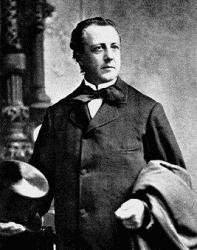
1832 - 1918 Person Name: C. C. Converse Composer of "[Traveling to the better land]" in The Standard Hymnal Pseudonyms: Clare, Lester Vesé, Nevers, Karl Re­den, Revons ================================= Charles Crozat Converse LLD USA 1832-1918. Born in Warren, MA, he went to Leipzig, Germany to study law and philosophy, as well as music theory and composition under Moritz Hauptmann, Friedrich Richter, and Louis Plaidy at the Leipzig Conservatory. He also met Franz Liszt and Louis Spohr. He became an author, composer, arranger and editor. He returned to the states in 1859 and graduated from the Albany, NY, Law School two years later. He married Lida Lewis. From 1875 he practiced law in Erie, PA, and also was put in charge of the Burdetta Organ Company. He composed hymn tunes and other works. He was offered a DM degree for his Psalm 126 cantata, but he declined the offer. In 1895 Rutherford College honored him with a LLD degree. He spent his last years in Highwood, NJ, where he died. He published “New method for the guitar”, “Musical bouquet”, “The 126th Psalm”, “Sweet singer”, “Church singer”, “Sayings of Sages” between 1855 and 1863. he also wrote the “Turkish battle polka” and “Rock beside the sea” ballad, and “The anthem book of the Episcopal Methodist Church”. John Perry

Anonymous

Person Name: Anon. Author of "Traveling to the better land" in Association Hymn Book In some hymnals, the editors noted that a hymn's author is unknown to them, and so this artificial "person" entry is used to reflect that fact. Obviously, the hymns attributed to "Author Unknown" "Unknown" or "Anonymous" could have been written by many people over a span of many centuries.

Ira David Sankey

1840 - 1908 Person Name: Ira D. Sankey Composer of "[Trav’ling to the better land]" in Gospel Hymns No. 6 Sankey, Ira David, was born in Edinburgh, Pennsylvania, in 1840, of Methodist parents. About 1856 he removed with his parents to New Castle, Pennsylvania, where he became a member of the Methodist Episcopal Church. Four years afterwards he became the Superintendent of a large Sunday School in which he commenced his career of singing sacred songs and solos. Mr. Moody met with him and heard him sing at the International Convention of the Young Men's Christian Association, at Indianapolis, and through Mr. Moody's persuasion he joined him in his work at Chicago. After some two or three years' work in Chicago, they sailed for England on June 7, 1872, and held their first meeting at York a short time afterwards, only eight persons being present. Their subsequent work in Great Britain and America is well known. Mr. Sankey's special duty was the singing of sacred songs and solos at religious gatherings, a practice which was in use in America for some time before he adopted it. His volume of Sacred Songs and Solos is a compilation from various sources, mainly American and mostly in use before. Although known as Sankey and Moody’s Songs, only one song, "Home at last, thy labour done" is by Mr. Sankey, and not one is by Mr. Moody. Mr. Sankey supplied several of the melodies. The English edition of the Sacred Songs & Solos has had an enormous sale; and the work as a whole is very popular for Home Mission services. The Songs have been translated into several languages. --John Julian, Dictionary of Hymnology (1907) Pseudonymns: Harry S. Low­er Rian A. Dykes ==================== Sankey, I. D., p. 994, i. During the past fifteen years Mr. Sankey's Sacred Songs and Solos have had a very large sale, which has justified him in increasing the number of songs and hymns, including " New Hymns and Solos," to 1200. In 1906 he published My Life and Sacred Songs (London : Morgan & Scott). In addition to the "Story of his Own Life," the work contains an account of the most popular of his solos, with interesting reminiscences of the spiritual awakening of many who were influenced through his singing of them in public. In this respect it corresponds in some measure with G. J. Stevenson's Methodist Hymn Book, &c, 1883 (p. 1094, i.). It is an addition to the Sacred Songs and Solos, which will be held in esteem by many. In addition to his hymn, noted on p. 994, ii., Mr. Sankey gives details of the following:— 1. Out of the shadow-land into the sunshine. [Heaven Anticipated.] Mr. Sankey's account of this hymn is:— "I wrote this hymn specially for the memorial service held for Mr. Moody in Carnegie Hall, where 1 also sang it as a solo. It is the last sacred song of which I wrote both the words and music. The idea was suggested by Mr. Moody's last words, 'Earth recedes; heaven opens before me . . . God is calling me, and I must go.' On account of its peculiar association with my fellow-labourer in the Gospel for so many years, the words are here given in full." The hymn follows on p. 185, in 3 stanzas of 4 lines and a chorus. 2. Rejoice! Rejoice! our King is coming, [Advent.] Mr. Sankey writes concerning this hymn:— "During one of my trips to Great Britain on the SS. City of Rome a storm raged on the sea. The wind was howling through the rigging, and waves like mountains of foam were breaking over the bow of the vessel. A great fear had fallen upon the passengers. When the storm was at its worst, we all thought we might soon go to the bottom of the sea. The conviction came to me that the Lord would be with us iu the trying hour, and sitting down in the reading room, I composed this hymn. Before reaching England the tune had formed itself in my mind, and on arriving in London I wrote it out, and had it published in Sacred Songs and Solos, where it is No. 524 in the edition. of 1888. From Mr. Sankey's autobiographical sketch we gather that he was born at Edinburgh, in Western Pennsylvania, Aug. 28, 1840, joined Mr. Moody in 1871, and visited England for the first time in 1873. The original of the Sacred Songs, &c, of 23 pieces only, was offered as a gift to the London publishers of P. Phillips's Hallowed Song, and declined by them. It was subsequently accepted by Mr. K. O. Morgan, of Morgan & Scott, and is now a volume of 1200 hymns. From a return kindly sent us by Messrs. Morgan & Scott, we find that the various issues of the Sacred Songs and Solos were:— In 1873, 24 pp.; 1874, 72 pp. ; 1876, 153 hymns; 1877, 271 hymns; 1881, 441 hymns; 1888, 750 hymns; 1903, 1200 hymns. In addition, The Christian Choir, which is generally associated with the Sacred Songs and Solos, was issued in 1884 with 75 hymns, and in 1896 with 281. The New Hymns & Solos, by the same firm, were published in 1888. --John Julian, Dictionary of Hymnology, New Supplement (1907)
It looks like you are using an ad-blocker. Ad revenue helps keep us running. Please consider white-listing Hymnary.org or getting Hymnary Pro to eliminate ads entirely and help support Hymnary.org.