You help make Hymnary.org possible. More than 10 million people from 200+ countries found hymns, liturgical resources and encouragement on Hymnary.org in 2025, including you. Every visit affirms the global impact of this ministry.

If Hymnary has been meaningful to you this year, would you take a moment today to help sustain it? A gift of any size—paired with a note of encouragement if you wish—directly supports the server costs, research work and curation that keep this resource freely available to the world.

Give securely online today, or mail a check to:
Hymnary.org
Calvin University
3201 Burton Street SE
Grand Rapids, MI 49546

Thank you for your partnership, and may the hope of Advent fill your heart.

Person Results

Tune Identifier:"^galilee_jude$"
In:people

Planning worship? Check out our sister site, ZeteoSearch.org, for 20+ additional resources related to your search.
Showing 11 - 20 of 45Results Per Page: 102050

Richard Mant

1776 - 1848 Author of "God, my King, thy might confessing" in The Pilgrim Hymnal Mant, Richard D.D., son of the Rev. Richard Mant, Master of the Grammar School, Southampton, was born at Southampton, Feb. 12, 1776. He was educated at Winchester and Trinity, Oxford (B.A. 1797, M.A., 1799). At Oxford he won the Chancellor's prize for an English essay: was a Fellow of Oriel, and for some time College Tutor. On taking Holy Orders he was successively curate to his father, then of one or two other places, Vicar of Coggeshall, Essex, 1810; Domestic Chaplain to the Archbishop of Canterbury, 1813, Rector of St. Botolph, Bishopsgate, London. 1816, and East Horsley, 1818, Bishop of Killaloe, 1820, of Down and Connor, 1823, and of Dromore, 1842. He was also Bampton Lecturer in 1811. He died Nov. 2, 1848. His prose works were numerous, and although now somewhat obsolete, they were useful and popular in their day. His poetical works, and other works which contain poetical pieces, are:— (1) The Country Curate, 1804; (2) Poems in three Parts, 1806; (3) The Slave, 1807; (4) The Book of Psalms in an English Metrical Version, &c, 1824; (5) The Holydays of the Church; or Scripture Narratives of Our Blessed Lord's Life and Ministry, and Biographical Notices of the Apostles, Evangelists, and Other Saints, with Reflections, Collects, and Metrical Sketches, vol. i., 1828; vol. ii., 1831; (6) The Gospel Miracles in a series of Poetical Sketches, &c., 1832; (7) The British Months, 2 vols., 1836; (8) Ancient Hymns from the Roman Breviary, for Domestick Use. . . .To which are added Original Hymns, principally of Commemoration and Thanksgiving for Christ's Holy Ordinances, 1837: new ed., 1871. (9) The Happiness of the Blessed Dead, 1847. Bishop Mant is known chiefly through his translations from the Latin. He was one of the earliest of the later translators, I. Williams and J. Chandler being his contemporaries. Concerning his translations, Mr. Ellerton, in his Notes on Church Hymns, 1881, p. xlviii. (folio ed.), says justly that:— "Mant had little knowledge of hymns, and merely took those of the existing Roman Breviary as he found them: consequently he had to omit many, and so to alter others that they have in fact become different hymns: nor was he always happy in his manipulation of them. But his book has much good taste and devout feeling, and has fallen into undeserved neglect." His metrical version of the Psalms has yielded very few pieces to the hymnals, the larger portion of his original compositions being from his work of 1837. The most popular of these is "Come Holy Ghost, my soul inspire, Spirit of," &c, and its altered forms; "Bright the vision that delighted," and its altered form of "Round the Lord in glory seated;" and "For all Thy saints, O Lord." His hymns in common use which are not annotated under their respective first lines are:— i. From his Metrical Version of the Psalms, 1824. 1. God, my King, Thy might confessing. Ps. cxlv. 2. Lord, to Thee I make my vows. Ps. xxvii. 3. Blessed be the Lord most High. Ps. xxviii. Pt. ii. 4. My trust is in the highest Name. Ps. xi. 5. Reign, Jehovah, King supreme. Ps. xcix. 6. Thy listening ear, O Lord, incline. Ps. Ixxxvi. 7. To God my earnest voice I raise. Ps. cxlii. 8. To Jehovah hymn the lay. Ps. cxviii. Two centos in Spurgeon's Our Own Hymn Book, 1866. (1) st. i., ii., v.; and (2) "Thee, Jehovah, will I bless" from st. vii.-x. ii. From his Holydays of the Church, &c, 1828-31. 9. Lo, the day the Lord hath made. Easter. 10. There is a dwelling place above. All Saints. iii. From his Ancient Hymns, &c, 1837. 11. Before Thy mercy's throne. Lent. 12. Father of all, from Whom we trace. Unity. 13. For these who first proclaimed Thy word. Apostles. 14. No! when He bids me seek His face. Holy Communion. 15. Oft as in God's own house we sit. Divine Worship. 16. Put off thy shoes, 'tis holy ground. The House of God . 17. Saviour of men, our Hope [Life] and Rest. The Greater Festivals. 18. Thy House each day of hallowed rest. Holy Communion. 19. We bless Thee for Thy Church, 0 Lord. Thanksgiving for the Church. 26. We deem and own it, Lord, a proof. Divine Grace. When all Bishop Mant's translations of original hymns, and versions of the Psalms in common use are taken into account, it is found that he is somewhat strongly represented in modern hymnody. -- John Julian, Dictionary of Hymnology (1907) ==================== http://en.wikipedia.org/wiki/Richard_Mant

Jessie Brown Pounds

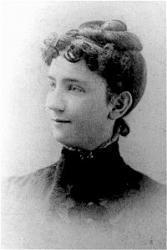
1861 - 1921 Person Name: Jessie H. Brown Author of "Out of Self and into Thee" in Christian Hymnal Jessie Brown Pounds was born in Hiram, Ohio, a suburb of Cleveland on 31 August 1861. She was not in good health when she was a child so she was taught at home. She began to write verses for the Cleveland newspapers and religious weeklies when she was fifteen. After an editor of a collection of her verses noted that some of them would be well suited for church or Sunday School hymns, J. H. Fillmore wrote to her asking her to write some hymns for a book he was publishing. She then regularly wrote hymns for Fillmore Brothers. She worked as an editor with Standard Publishing Company in Cincinnati from 1885 to 1896, when she married Rev. John E. Pounds, who at that time was a pastor of the Central Christian Church in Indianapolis. A memorable phrase would come to her, she would write it down in her notebook. Maybe a couple months later she would write out the entire hymn. She is the author of nine books, about fifty librettos for cantatas and operettas and of nearly four hundred hymns. Her hymn "Beautiful Isle of Somewhere" was sung at President McKinley's funeral. Dianne Shapiro, from "The Singers and Their Songs: sketches of living gospel hymn writers" by Charles Hutchinson Gabriel (Chicago: The Rodeheaver Company, 1916)

Juan Bautista Cabrera Ivars

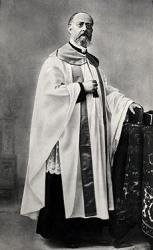
1837 - 1916 Person Name: Juan Bautista Cabrera, 1837-1916 Author of "Amoroso Nos Convida" in Cántico Nuevo Juan Bautista Cabrera Ivars was born in Benisa, Spain, April 23, 1837. He attended seminary in Valencia, studying Hebrew and Greek, and was ordained as a priest. He fled to Gibraltar in 1863 due to religious persecution where he abandoned Catholicism. He worked as a teacher and as a translator. One of the works he translated was E.H. Brown's work on the thirty-nine articles of the Anglican Church, which was his introduction to Protestantism. He was a leader of a Spanish Reformed Church in Gibraltar. He continued as a leader in this church when he returned to Spain after the government of Isabel II fell, but continued to face legal difficulties. He then organized the Spanish Reformed Episcopal Church and was consecrated as bishop in 1894. He recognized the influence of music and literature on evangelism which led him to write and translate hymns. Dianne Shapiro, from Real Academia de la Historia (https://dbe.rah.es/biografias/39825/juan-bautista-cabrera-ivars) and Himnos Cristanos (https://www.himnos-cristianos.com/biografia-juan-bautista-cabrera/) (accessed 7/30/2021)

Bernhard Severin Ingemann

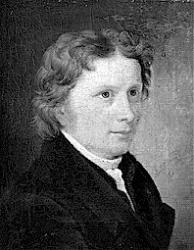
1789 - 1862 Person Name: Bernhardt Severin Ingemann, 1789-1862 Author of "Through the night of doubt and sorrow" in The Book of Praise Ingemann, Bernhardt Severin, was born at Thor Kildstrup, Island of Falster, May 28, 1789. From 1822 to his death in 1862, he was Professor of the Danish Language and Literature at the Academy of Sorö, Zealand, Denmark. He was a poet of some eminence. His collected works were pub, in 1851, in 34 volumes. Seven of his hymns translated into English are given in Gilbert Tait's Hymns of Denmark, 1868. The only hymn by him in English common use is:— Igjennem Nat og Traengael. Unity and Progress. It is dated 1825, and is given in the Nyt Tillaeg til Evangelisk-christelig. Psalmebog, Copenhagen, 1859, No. 502. In its translated form as "Through the night of doubt and sorrow," by the Rev. S. Baring-Gould, it has become widely known in most English-speaking countries. The translation was published in the People's Hymnal, 1861. It was greatly improved in Hymns Ancient & Modern, 1875, and has been specially set to music by several composers. --John Julian, Dictionary of Hymnology (1907)

W. H. Jude

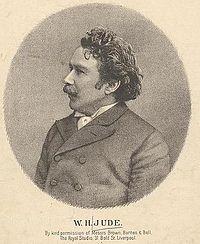
1851 - 1922 Person Name: William H. Jude Composer of "GALILEE (JUDE)" in Psalter Hymnal (Blue) William Herbert Jude United Kingdom 1851-1922. Born at Westleton, Suffolk, England, his family moved to Norfolk. A precocious child, by age eight he was composing music for school plays. Educated at the Liverpool Organ School and East Liverpool College of Music, he became college principal for awhile. He married Catherine Helena Haigh. They had no children. He became a composer, editor, and organist. He was organist for the Blue Coat Hospital & School and Stretford Town Hall near Manchester, while teaching and lecturing. After 20 years there he was appointed organist at the Exeter Hall in London, a primary venue and Christian Centre owned by the YMCA on the Strand in London. As a recitalist, he was asked to “open” over 1000 new organs across the UK, Ireland, and Australia. He was considered the most brilliant organist of his day. He wrote at least two operettas: “Innocents abroad” (1882) and “The mighty deep” (1917). His compositions were frequently religious. He admired British evangelist, Rodney “Gipsy” Smith and published a collection of Smith’s favorite solos in 1903. He also supported the temperance movement. He toured Australia and New Zealand 1890-1894. In 1904 he served as editor for several musical periodicals, including “Monthly Hymnal”, “Minister of music”, and “The Higher life”. He also compiled several hymnbooks, including “Mission hymns” (1911”), and “Festival hymns” (1916). He wrote a number of works on music. He died in London. John Perry

W. G. Tarrant

1853 - 1928 Person Name: William G. Tarrant Author of "Long ago the lilies faded" in The Beacon Hymnal Tarrant, William George, B.A., b. 1853. Since 1883 Minister of the Wandsworth Unitarian Christian Church. Editor of The Inquirer, 1888-97. One of the editors of the Essex Hall Hymnal. 1890, and of the Revised ed., 1902. 1. Come, let us Join with faithful souls. The Faithful. 2. Draw nigh to God; He will draw nigh to you. The Divine Helper. 3. Long ago the lilies faded. The Constant Presence. 4. The Light along the ages. Easter. 5. With happy voices ringing. Children's Praise. --John Julian, Dictionary of Hymnology, New Supplement (1907)

Anonymous

Person Name: Anónimo Author of "Jesucristo Desde el Cielo" in El Himnario In some hymnals, the editors noted that a hymn's author is unknown to them, and so this artificial "person" entry is used to reflect that fact. Obviously, the hymns attributed to "Author Unknown" "Unknown" or "Anonymous" could have been written by many people over a span of many centuries.

Godfrey Thring

1823 - 1903 Author of "Hallelujah! Song of Triumph" in The Cyber Hymnal Godfrey Thring (b. Alford, Somersetshire, England, 1823; d. Shamley Green, Guilford, Surrey, England, 1903) was born in the parsonage of Alford, where his father was rector. Educated at Balliol College, Oxford, England, he was ordained a priest in the Church of England in 1847. After serving in several other parishes, Thring re­turned to Alford and Hornblotten in 1858 to succeed his father as rector, a position he retained until his own retirement in 1893. He was also associated with Wells Cathedral (1867-1893). After 1861 Thring wrote many hymns and published several hymnals, including Hymns Congregational (1866), Hymns and Sacred Lyrics (1874), and the respect­ed A Church of England Hymn Book Adapted to the Daily Services of the Church Throughout the Year (1880), which was enlarged as The Church of England Hymn Book (1882). Bert Polman ================ Thring, Godfrey, B.A., son of the Rev. J. G. D. Thring, of Alford, Somerset, was born at Alford, March 25, 1823, and educated at Shrewsbury School, and at Balliol College, Oxford, B.A. in 1845. On taking Holy Orders he was curate of Stratfield-Turgis, 1846-50; of Strathfieldsaye, 1850-53; and of other parishes to 1858, when he became rector of Alford-with-Hornblotton, Somerset. R.D. 1867-76. In 1876 he was preferred as prebend of East Harptree in Wells cathedral. Prebendary Thring's poetical works are:— Hymns Congregational and Others, 1866; Hymns and Verses, 1866; and Hymns and Sacred Lyrics, 1874. In 1880 he published A Church of England Hymnbook Adapted to the Daily Services of the Church throughout the Year; and in 1882, a revised and much improved edition of the same as The Church of England Hymn Book, &c. A great many of Prebendary Thring's hymns are annotated under their respective first lines; the rest in common use include:— 1. Beneath the Church's hallowed shade. Consecration of a Burial Ground. Written in 1870. This is one of four hymns set to music by Dr. Dykes, and first published by Novello & Co., 1873. It was also included (but without music) in the author's Hymns & Sacred Lyrics, 1874, p. 170, and in his Collection, 1882. 2. Blessed Saviour, Thou hast taught us. Quinquagesima. Written in 1866, and first published in the author's Hymns Congregational and Others, 1866. It was republished in his Hymns & Sacred Lyrics, 1874; and his Collection, 1882. It is based upon the Epistle for Quinquagesima. 3. Blot out our sins of old. Lent. Written in 1862, and first published in Hymns Congregational and Others

George P. Simmonds

1890 - 1991 Person Name: Geo. P. Simmonds Author of "Cantaré, Oh Madre Mía" in El Himnario Used pseudonyms G Paul S., J. Paul Simon, and J. Pablo Símon

Gracia Grindal

b. 1943 Author of "May the Grace of Our Lord Jesus" in Celebrating Grace Hymnal Gracia Grindal (b. Powers Lake, ND, 1943). Grindal was educated at Augsburg College, Minneapolis, Minnesota; the University of Arkansas; and Luther-Northwestern Seminary, St. Paul, Minnesota, where she has served since 1984 as a professor of pastoral theology and communications. From 1968 to 1984 she was a professor of English and poet-in-residence at Luther College, Decorah, Iowa. Included in her publications are Sketches Against the Dark (1981), Scandinavian Folksongs (1983), Lessons in Hymnwriting (1986, 1991), We Are One in Christ: Hymns, Paraphrases, and Translations (1996), Good News of Great Joy: Advent Devotions for the Home (1994 with Karen E. Hong), Lina Sandell, the Story of Her Hymns (2001 with John Jansen), and A Revelry of Harvest: New and Selected Poems (2002). She was instrumental in producing the Lutheran Book of Worship (1978) and The United Methodist Hymnal (1989). Bert Polman

Pages


Export as CSV
It looks like you are using an ad-blocker. Ad revenue helps keep us running. Please consider white-listing Hymnary.org or getting Hymnary Pro to eliminate ads entirely and help support Hymnary.org.