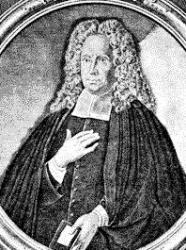
1670 - 1739 Meter: 8.7.8.7.8.7 with refrain Composer of "DEN DES VATERS SINN GEBOREN" Freylinghausen, Johann Anastasius, son of Dietrich Freylinghausen, merchant and burgomaster at Gandersheim, Brunswick, was born at Gandersheim, Dec. 2, 1670. He entered the University of Jena at Easter, 1689. Attracted by the preaching of A. H. Francke and J. J. Breithaupt, he removed to Erfurt in 1691, and at Easter, 1692, followed them to Halle. About the end of 1693 he returned to Gandersheim, and employed himself as a private tutor. In 1695 he went to Glaucha as assistant to Francke; and when Francke became pastor of St. Ulrich's, in Halle,1715, Freylinghausen became his colleague, and in the same year married his only daughter. In 1723 he became also sub-director of the Paedagogium and the Orphanage; and after Francke's death in 1727, succeeded him as pastor of St. Ulrich's and director of the Francke Institutions. Under his fostering care these Institutions attained their highest development. From a stroke of paralysis in 1728, and a second in 1730, he recovered in great measure, but a third in 1737 crippled his right side, while the last, in Nov., 1738, left him almost helpless. He died on Feb. 12, 1739, and was buried beside Francke (Koch, vi. 322-334; Allgemine Deutsche Biographie, vii. 370-71; Bode, pp. 69-70; Grote's Introduction, &c.)
Almost all Freylinghausen's hymns appeared in his own hymnbook, which was the standard collection of the Halle school, uniting the best productions of Pietism with a good representation of the older "classical" hymns. This work, which greatly influenced later collections, and was the source from which many editors drew not only the hymns of Pietism, but also the current forms of the earlier hymns (as well as the new "Halle" melodies, a number of which are ascribed to Freylinghausen himself) appeared in two parts, viz.:—
i. Geistreiches Gesang-Buch, den Kern alter und neuer Lieder...in sich haltend &c, Halle. Gedrucktund verlegt im Waysen-Hause, 1704 [Hamburg], with 683 hymns and 173 melodies. To the second edition, 1705 [Rostock University], an Appendix was added with Hymns 684-758, and 21 melodies. Editions 3-18 are practically the same so far as the hymns are concerned, save that in ed. 11, 1719 [Berlin], and later issues, four hymns, written by J. J. Rambach at Freylinghausen's request, replaced four of those in eds. 1-10.
ii. Neues Geistreiches Gesangbuch,&c, Halle . . . 1714 [Berlin], with 815 hymns and 154 melodies. In the 2nd edition, 1719 [Rostock University], Hymns 816-818, with one melody, were added.
In 1741 these two parts were combined by G. A. Francke, seven hymns being added, all but one taken from the first edition, 1718, of the so-called Auszug, which was compiled for congregational use mainly from the original two parts: and this reached a second, and last, edition in 1771. So far as the melodies are concerned, the edition of 1771 is the most complete, containing some 600 to 1582 hymns. (Further details of these editions in the Blätter für Hymnologie, 1883, pp. 44-46, 106-109; 1885, pp. 13-14.) A little volume of notes on the hymns and hymnwriters of the 1771 edition, compiled by J. H. Grischow and completed by J. G. Kirchner, and occasionally referred to in these pages, appeared as Kurzgefasste Nachricht von ältern und ncuern Liederverfassern at Halle, 1771.
As a hymnwriter Freylinghausen ranks not only as the best of the Pietistic school, but as the first among his contemporaries. His finest productions are distinguished by a sound and robust piety, warmth of feeling depth of Christian experience, scripturalness, clearness and variety of style, which gained for them wide acceptance, and have kept them still in popular use. A complete edition of his 44 hymns, with a biographical introduction by Ludwig Grote, appeared as his Geistliche Lieder, at Halle, 1855. A number of them, including No. v., are said to have been written during severe attacks of toothache. Two (“Auf, auf, weil der Tag erschienen"; "Der Tag ist hin") are noted under their own first lines.
i. Hymns in English common use: --
i. Monarche aller Ding. God's Majesty. 1714, as above, No. 139, in 11 stanzas of 6 lines, repeated in Grote, 1855, p. 88, and as No. 38 in the Berlin Geistliche Lieder, ed. 1863. A fine hymn of Praise, on the majesty and love of God. Translated as:—
Monarch of all, with lowly fear, by J. Wesley, in Hymns & Sacred Poems, 1739 (P. Works, 1868-1872, vol. i. p. 104), in 8 stanzas of 4 lines, from st. i., ii., v.-vii., ix.-xi. Repeated in full in the Moravian Hymnbook, 1754, pt. i., No. 456 (1886, No. 176); and in J. A. Latrobe's Collection, 1841. The following forms of this translation are also in common use:--
(1) To Thee, 0 Lord, with humble fear, being Wesley's st. i., iii.-v., vii., viii. altered as No. 156 in Dr. Martineau's Hymns for Christian Church & Home, 1840, and repeated in Miss Courtauld's Psalms, Hymns & Anthems, 1860, and in America in the Cheshire Association Unitarian Collection, 1844.
(2) Thou, Lord, of all the parent art, Wesley's, st. iii.-v., vii. altered in the College Hymnal, N. Y., 1876.
(3) Thou, Lord, art Light; Thy native ray, Wesley's st. iv., v., vii., in Hymns of the Spirit, 1864.
ii. 0 reines Wesen, lautre Quelle. Penitence. Founded on Psalm li. 12, 1714, as above, No. 321, in 7 stanzas of 8 lines, repeated in Grote, 1855, p. 41, and in Bunsen's Versuch, 1833, No. 777 (ed. 1881, No. 435). The only translation in common use is:—
Pure Essence: Spotless Fount of Light. A good and full translation by Miss Winkworth in the first series of her Lyra Germanica, 1855, p. 43, and in her Chorale Book for England, 1863, No. 113.
iii. Wer ist wohl wie du. Names and offices of Christ. One of his noblest and most beautiful hymns, a mirror of his inner life, and one of the finest of the German "Jesus Hymns." 1704, as above, No. 66, in 14 st. of 6 l., repeated in Grote, 1855, p. 33, and is No. 96 in the Berlin Geistliche Lieder, ed. 1863. The translations in common use are:
1. 0 Jesu, source of calm repose, by J. Wesley, being a free translation of st. i., iii., v., viii., xiii. First published in his Psalms & Hymns, Charlestown, 1737 (Poetical Works, 1868-1872, vol. i. p. 161). Repeated in full as No. 462 in pt. i. of the Moravian Hymnbook, 1754. In the 1826 and later editions (1886, No. 233) it begins, "Jesus, Thou source." The original form was included as No. 49 in the Wesley Hymns & Spiritual Songs , 1753, and, as No. 343, in the Wesley Hymnbook, 1780 (1875, No. 353). Varying centos under the original first line are found in Mercer's Church Psalter & Hymn Book, 1855-1864; Kennedy , 1863; Irish Church Hymnal, 1869-1873; J. L. Porter's Collection, 1876, &c. It has also furnished the following centos:—
(1) Messiah! Lord! rejoicing still, being Wesley's st. iv.-vi. altered in Dr. Martineau's Collection of Hymns for Christian Worship, 1840.
(2) Lord over all, sent to fulfil, Wesley's st. iv., iii., v., vi. in the American Methodist Episcopal Hymnbook, 1849.
2. Who is like Thee, Who? a translation of st. i., ii., v., vii., x., xiii., as No. 687, in pt. i. of the Moravian Hymnbook, 1754. Translations of st. xi., xiv. were added in 1789, and the first line altered in 1801(1886, No. 234), to "Jesus, who with Thee." The translations of st. i., ii., x., xiv., from the 1801, altered and beginning, "Jesus, who can be," are included in America in the Dutch Reformed Hymns of the Church, 1869; Hymns & Songs of Praise, N. Y., 1874; and Richards's Collection, N.Y., 1881.
3. Who is there like Thee, a good translation of st. i., ii., viii., xiv., by J. S. Stallybrass, as No. 234 in Curwen's Sabbath Hymnbook, 1859, repeated in the Irish Church Hymnal, 1873, and in W. F. Stevenson's Hymns for Church & Home, 1873.
4. Who is, Jesus blest, a translation of stanzas i., ii., v., vi., xii., xiv., by M. Loy, in the Ohio Lutheran Hymnal, 1880.
5. Who, as Thou, makes blest, a good translation, omitting st. vii., ix., x., contributed by Dr. F. W Gotch to the Baptist Magazine, 1857. Repeated in the 1880 Supplement to the Baptist Psalms & Hymns, 1858.
The translations not in common use are: —
(1) "Whither shall we flee," by Miss Dunn, 1857, p. 55. (2) "Who has worth like Thine," in the U. P. Juvenile Miss. Magazine, 1857, p. 217. (3) "Thou art First and Best," by Miss Winkworth, 1869, p. 267.
ii. Hymns translated into English but not in common use:—
iv. Herr und Gott der Tag und Nächte. Evening. 1705, as above, No. 755, in 6 stanzas, Grote, p. 105. Translated by H. J. Buckoll, 1842, p. 106, beginning with stanza. ii.
v. Mein Herz, gieb dioh rufrieden. Cross and Consolation. First in the Halle Stadt Gesangbuch, 1711, No. 503, in 11 stanzas; repeated 1714, No. 450, and in Grote, p. 71. Translated by Dr. G. Walker, 1860, p. 86.
vi. 0 Lamm, das keine Sünde je beflecket. Passiontide. 1714, No. 85, in 19 stanzas, Grote, p. 14. Translated as, (1) "Lamb, for Thy boundless love I praises offer," of st. xii. as stanza i. of No. 1023 in the Supplement of 1808 to the Moravian Hymn Book, 1801 (1849, No. 121). (2) "O Lamb, whom never spot of sin defiled," in the British Magazine, June, 1838, p. 625.
vii. 0 Lamm, das meine Sündenlast getragen. Easter Eve. 1714, No. 95, in 8 stanzas; Grote, p. 23. Translated as "Christ Jesus is that precious grain," a translation of st. v. by F. W. Foster, as No. 71 in the Moravian Hymnbook, 1789 (1886, No. 921).
viii. Zu dir, Herr Jesu, komme ich. Penitence. Founded on St. Matthew xi. 28-30. 1714, as above, No. 306, in 4 stanzas; Grote, p. 39. Translated by Dr. H. Mills, 1845 (1856, p. 80). [Rev. James Mearns, M.A.]
--John Julian, Dictionary of Hymnology (1907)
Johann Anastasius Freylinghausen


 My Starred Hymns
 My FlexScores
 My Hymnals
 My Purchased Files