

 My Starred Hymns
 My FlexScores
 My Hymnals
 My Purchased Files
Planning worship?
Check out our sister site, ZeteoSearch.org,
for 20+ additional resources related to your search.
- |
User Links
Person Results
Salomon Liscovius
1640 - 1689 Person Name: Salomon Liscovius, 1640-1689 Author of "Tesoro incomparable" in Culto Cristiano Liscovius, Salomo, son of Johann Liscovius, or Lischkow, pastor at Niemitsch, near Guben, was born at Niemitsch, Oct. 25, 1640. He entered the University of Leipzig in 1660, and then went to Wittenberg, where he graduated M.A., and was crowned as a poet. Shortly thereafter he was appointed pastor at Otterwisch with Stockheim, near Lausigk, and ordained to this post April 21, 1664. He was then, on March 29, 1685, appointed second pastor of St. Wenceslaus's church, at Wurzen. He died at Wurzen, Dec. 5, 1689. (Koch, iii. 385; Rotermund's continuation of Jöcher's Gelehrten-Lexikon, iii. 1950, &c.)
Liscovius was one of the best German hymn-writers of the second rank in the 17th century. That is, though his hymns are not lacking in intensity, in depth, or in beauty of form, yet neither by their intrinsic value nor by their adoption into German common use are they worthy to be ranked with the hymns of Gerhardt, Franck, Scheffler and others of this period. They appeared mostly in his Christlicher Frauenzimmers Geistlicher Tugend-Spiegel. The preface to this book is dated April 14, 1672, and it was probably published at Leipzig in 1672; but the earliest ed. extant is that at Leipzig, 1703. Dr. J. L. Pasig pub. 51 of his Geistliche Lieder, with a short biographical notice, at Halle, 1855.
One of his hymns is translated:—
Schatz über alle Schatze. Love to Christ. His finest hymn. 1672 as above, and Pasig, 1855, p. 53. In the Nürnberg Gesang-Buch 1676, No. 509, and the Berlin Geistlicher Lieder Schatz, ed. 1863, No. 826. It is in 7 stanzas of 8 lines, the initial letters of the stanzas forming his Christian name Salomon. The translations are:—
(1) "Treasure above all treasure," as No. 441 in pt. i. of the
Salomon Liscovius
Alfred Barratt
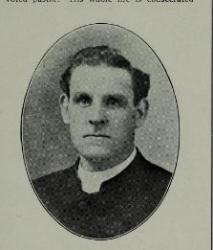
1879 - 1968 Person Name: Rev. Alfred Barratt Author of "A Newborn Feeling In My Heart" in Christian Choruses Barratt, Alfred. (New Springs, Wigan, Lancashire, England, October 25, 1879--December, 1968). Coming to the United States as a young man, he studied at Gordon College, Massachusetts, and Newton Theological Seminary, Mass. He was ordained in December, 1913, by the Baptists in Connecticut, then by the Wheeling WV Presbytery, Presbyterian Church in the USA, in 1924. He was pastor of Dallas, West Virginia, then of a series of churches in the Presbytery of Clarion, Pennsylvania. In 1937 he was awarded the Doctor of Literature degree by Bob Jones College.
On November 26, 1962, he wrote the undersigned: "For 39 long years I have labored hard and steady writing sermons, children's story sermons, and hymns. Up to the present day I have written 4,477 hymns. 80 percent of my sermons are published in books and magazines."
--William J. Reynolds, DNAH Archives
Alfred Barratt
Arthur Penrhyn Stanley
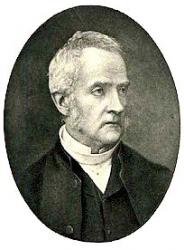
1815 - 1881 Person Name: Rev. Arthur Penrhyn Stanley, 1815-1881 Author of "O Master, it is good to be" in Hymnal and Liturgies of the Moravian Church Stanley, Arthur Penrhyn, Dean of Westminster, one of the most distinguished English Churchmen of the nineteenth century, was the son of Rev. Edward Stanley, Bishop of Norwich, and was born at Alderly, in Cheshire, December 13, 1815. At the age of fourteen he became a pupil of Dr. Arnold, of Rugby, in whose famous school he displayed a strength of moral character which was a prophecy of the frank and courageous man that was to be. He took well-nigh all the honors at Oxford, where he graduated in 1837. Entering the ministry of the Church of England, he filled successively various positions of honor and responsibility until in 1855 he was appointed Regius Professor of Ecclesiastical History at Oxford. In 1864 he became Dean of Westminster. His marriage that same year to Lady Augusta Bruce, a personal friend and attendant of Queen Victoria, increased the freedom and intimacy of his already cordial relations with the royal family. He died July 18, 1881. He was a Churchman of broad and liberal views. His catholicity of spirit was one of his most notable characteristics. His contributions to theological literature are numerous and well known. His Life of Dr. Arnold, of Rugby, 1844, is one of the most successful volumes of biography in the English language. Among his historical writings his lectures on the Eastern Church, 1861, Jewish Church (two volumes), 1863-65, and the Church of Scotland, 1868, are accounted as of highest value. He is the author of about a dozen hymns, and of several translations. These, although of a high order of excellence, do not take rank with his prose writings, which for choice English diction, scholarly erudition, and Christian catholicity are not surpassed, perhaps, by anything in the religious literature of England in the nineteenth century.
Day of wrath, O dreadful day 599
He is gone; a cloud of light 170
O Master, it is good to be 131
From Hymn Writers of the Church by Charles S. Nutter, 1915
============================
Stanley, Arthur Penrhyn, D.D., was born at Alderley, in Cheshire, Dec. 13, 1815. His father, Edward Stanley, was the son of Sir Edward Stanley of Alderley, and younger brother of the first Lord Stanley of Alderley, and was rector of the parish until 1837, when he became Bishop of Norwich. His mother, Catherine Stanley, was daughter of tho Rev. Oswald Leycester, Rector of Stoke-upon-Tern, Shropshire. Arthur Stanley received his early education under the superintendence of his father; but in 1829 he was sent to Rugby to be under the direct charge of Dr. Arnold, who bad been appointed to the head-mastership the year before, and of whom Mr. Stanley had been an early friend and admirer. Arthur Stanley bore the stamp of Rugby and of its great headmaster to the end of his life. In 1834 he went up to Oxford, having won a Balliol scholarship, the "blue ribbon of undergraduate life," and commenced a career of unusual brilliancy at the University. He gained the Newdigate prize for English Verse (the subject being The Gypsies); the Ireland scholarship (the highest test of Greek scholarship), and a First Class in Classical Honours, all in 1837. He won the Prize for the Latin Essay in 1839, the Prize for the English Essay, and the Ellerton Prize for the Theological Essay in 1840, and was in the same year elected to a Fellowship at University College.
He was then appointed College Tutor, and held that office for twelve years. In 1845-6 he was Select Preacher for the University. From 1850 to 1852 he was Secretary to the Oxford University Commissioners. In 1851 he was appointed Canon of Canterbury, and held that post until 1855, when he was elected Regius Professor of Ecclesiastical History at Oxford, to which a Canonry at Christ Church was attached. He was also chosen in 1858 Examining Chaplain to the Bishop of London, his fellow Rugbeian, Dr. Tait. These offices he held until 1863, when, on the elevation of Dean Trench to the Archbishopric of Dublin, he was appointed to the Deanery of Westminster. In the same year he married Lady Augusta Bruce, a sister of the Earl of Elgin, and a personal friend and attendant of Queen Victoria. This marriage brought him into still closer relation with the Court, at which he had before been so highly valued, that he had been twice chosen to accompany the Prinoe of Wales in his travels in the East. He was singularly happy in his married life, and felt the death of Lady Augusta, which occurred in 1876, as an irreparable loss. In 1872, he took part in the Old Catholic Congress at Cologne; and at the close of the same year he was again appointed Select Preacher, not, however, without considerable opposition being made to the appointment on account of the Dean's theological views; the vote, however, was carried by 349 against 287. In 1875 he was installed Lord Rector of the University of St. Andrews, having received the degree of LL.D. from that University four years previously. He died at the Deanery, Westminster, on July 18, 1881, after a short illness.
Dr. Stanley was a voluminous and very popular writer, his pure and picturesque style being singularly fascinating. The first work by which he became known to the literary world was the Life and Correspondence of Dr. Arnold, published in 1844. This is an almost perfect model of biography. Though the writer is distinctly a hero-worshipper, he never allows his worship to violate the rules of good taste, while he brings out all the points in his hero's character most vividly, and exercises a most wise discretion in permitting him, as far as possible, to tell his own tale. This was followed in 1850 by Memoirs of Edward Stanley, Bishop of Norwich, and Catherine Stanley, which is very interesting both for its intrinsic merits, and also as a pious tribute of filial affection; but it does not reach the level of the Life of Arnold. In 1854 appeared the Epistles to the Corinthians, the value of which will be variously estimated according to the theological standpoint of the reader. But his next two works will command the admiration of all persons who are competent to judge. In his Historical Memorials of Canterbury, published in 1854, and Sinai and Palestine in connexion with their History, published in 1856, Dr. Stanley was again on his own proper ground where his almost unique powers of description had their full scope. The former was a very popular work, reaching a 6th edition in 1872; but Sinai and Palestine was still more warmly welcomed, and may be con¬sidered, with the Life of Dr. Arnold, as Dr. Stanley's chef-d'oeuvre.
Passing over for the present his sermons, we next come to his Lectures on the History of the Eastern Church, pub. in 1861; this also was very popular, reaching a 5th ed. in 1869. Then followed a series of Lectures on the History of the Jewish Church, in 2 volumes (1863-5). His next publication again showed him at his best. The Historical Memorials of Westminster Abbey, pub. in 1867, may be regarded as a companion volume to the Historical Memorials of Canterbury, and is, at least, worthy of its predecessor.
Dr. Stanley attained great eminence as a preacher, especially in his own Abbey. His manner was most solemn and impressive, and his style of composition was exactly suited for a sermon. It is fair to add that sermons would also, of course, be the species of composition in which what many considered the most unsatisfactory features of Dr. Stanley's intellectual character, his vagueness of doctrine and extreme breadth of statement, were most conspicuous. He published several volumes of sermons and single sermons. The chief are: Sermons and Essays on the Apostolical Age (1846), Sermons preached in Canterbury Cathedral (1857), Sermons on the Unity of Evangelical and Apostolical Teaching (1859), Sermons in the East preached before the Prince of Wales (1863), Address and Sermons at St. Andrews, 1877.
The point of view from which this sketch naturally regards Dean Stanley as a writer is that from which he appears at the least advantage. Thirteen of his hymns which had been published singly have been incorporated in the Westminster Abbey Hymn Book, but none of them have attained any extensive popularity; and, to tell the truth, they do not deserve it. That exquisite taste and felicity of diction which distinguish more or less all his prose writings seem to desert him when he is writing verse. This is all the more strange because one would have said that he regarded outward nature, as well as the works and history of man, with a poet's eye. Like another great writer, Jeremy Taylor, his prose is poetical, but his poetry is prosaic. The divine afflatus is wanting. Of course he always writes as a scholar; hence his translations are more successful than his original hymns; but in neither department has he produced anything that can at all be termed classical; and it is from his general eminence rather than from his contributions to hymnology that he requires even the small space which has been devoted to him in this article. [Rev. J. H. Overton, D.D.]
In addition to Dean Stanley's trsanslations from the Latin, and his popular hymns, "He is gone! beyond the skies,'' and "Master, it is good to be," the following are also in common use:—
1. Let us with a gladsome mind. National Hymn. The Accession. This hymn is called "Hymn for the Accession (June 20
2. 0 frail spirit, vital spark. Easter. Given in Macmillan's Magazine, May 1878, and headed "Our Future Hope."
3. Spirit unseen, our spirits' home. Whitsuntide.
This hymn was published in Macmillan's Magazine, May, 1879, in 7 stanzas of 8 lines, and 1 stanza of 9 lines, with the following note:—"Manzoni's Hymn for Whitsuntide.”
4. The Lord is come! On Syrian soil. Advent. This hymn appeared in Macmillan's Magazine, Dec. 1872, in 6 stanzas of 8 lines, with the following introduction:— “Hymn for Advent.”
5. When the Paschal evening fell. Holy Communion. This appeared in Macmillan's Magazine, Nov. 1874, in 5 st. of 8 1., 1 st. of 12 1., and 1 st. of 8 1., with this introduction:—" This do in Remembrance of Me. It is intended in the following lines to furnish a sacred hymn founded on the one common idea of commemoration which lies at the basis of all views of the Eucharist, whether material or spiritual, and to express this undoubted intention of the original institution apart from the metaphorical language by which the ordinance is often described."
6. Where is the Christian's Fatherland? The Christian's Fatherland. This poem (it cannot be called a hymn) was given in Macmillan's Magazine, Nov. 1872, in 7 st. of 8 1., with the following introduction:—"The Traveller's Hymn for All Saints' Day. Being an adaptation of Arndt's Poem, 'Was ist des Deutschen Vaterland.'"
7. Where shall we find the Lord? Epiphany. Given in Macmillan's Magazine, March 1880, in 7 st. of 8 1., and introduced thus: —"The Divine Life
8. Where shall we learn to die? Good Friday. This was published in Macmillan's Magazine, March 1880, in 7 st. of 8 1., with the simple heading, "The Perfect Death. Disce mori."
9. Who shall be the last great Seer? St. John Baptist. Appeared in Macmillan's Magazine, July 1879, in 4 st. of 8 1., as a "Hymn for St. John the Baptist Day, June 24."
All these hymns were given in full, and without alteration, in the Westminster Abbey Hymn Book, 1883. Their use is mainly confined to that collection.
--Excerpts from John Julian, Dictionary of Hymnology (1907)
Arthur Penrhyn Stanley
F. Richard Garland
Author of "Come to the Mountain Peak (A Hymn for Transfiguration Sunday)" in Discipleship Ministries Collection The Reverend F. Richard Garland is a retired United Methodist pastor. He and his wife, Catherine Sprigg, a Certified Registered Nurse Anesthetist, live in North Kingstown, RI.
Dick was born and raised in Fort Wayne, Indiana, and is a lifelong Methodist. A graduate of Garrett Theological Seminary, he interned in Chicago and then served churches in Indiana, Rhode Island, Massachusetts, and Connecticut. He continues to preach on occasion, provide coverage in emergency pastoral situations, and write a monthly essay, "From Where I Sit" for the newsletter of the North Kingstown UMC. He has been a contributor to The Upper Room.
Dick is a lifelong hiker who still climbs in the mountains of New Hampshire. At home, he spends a great deal of time in his flower gardens. He has sung with the Rhode Island Civic Chorale and Orchestra and is a member of the Fellowship of United Methodists in Music and Worship Arts.
Dick wrote his first hymn, a children's song, in a seminary music class with Austin C. Lovelace, and he has written poetry for many years. He began writing hymns for use in his churches about twenty years ago, but did not submit them for publication until 2006, after being encouraged to do so by a classmate and friend.
Many of his texts are inspired by the seasons of the church year, particularly Christmas and Easter, and by Scriptures from the Lectionary. In April of 2007, an appeal from a clergy colleague for a memorial hymn in response to the shootings at Virginia Tech University resulted in the creation of his hymn, In Grief and Aching Sorrow, set to the tune, Passion Chorale by J.S. Bach. Once, his pastor, frustrated in trying to find enough hymns to go with the Good Samaritan story in Luke 10:25-37, asked him to write a new hymn for a service. The result was his hymn, "When We Would Neighbor Be." On a dare from a colleague, he revealed a whimsical side by writing a hymn for Groundhog Day, "Praise the Lord for Woodland Creatures." His hymn, "I Have a Dream," was written to celebrate the 50th Anniversary of the address by The Rev. Dr. Martin Luther King, Jr. He has written a series of texts based on the selections from the Letters to the Ephesians and to the Philippians found in the New Revised Common Lectionary.
F. Richard Garland
F. Richard Garland
David Hamilton
b. 1964 Arranger (last st. setting and choral ending) of "BATTLE HYMN" in Baptist Hymnal 2008
David Hamilton
Angel E. Fuster
Person Name: Ángel E. Fúster Translator of "Tesoro incomparable" in Culto Cristiano Angél E. Fuster, poet, published a volume of hymns in France about 1870.
Dianne Shapiro from Himnario para uso de las Iglesias Evangélicas by Juan B. Cabrera, Seville, 1871 (preface) and “Suenen Dulces Himnos”: Orígenes de los himarios evangelicos en España" by Josué Aguiar Rogríguez (doctoral thesis for Universidad de las Palmas de Gran Canaria, 2015)
Angel E. Fuster
Walter Henry Hall
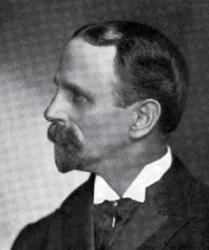
1862 - 1935 Composer of "ONEONTA" in The Cyber Hymnal Born: April 25, 1862, London, England.
Died: 1938, New York City.
Buried: Boothbay Harbor, Maine, the location of his summer home.
Hall studied at the Royal Academy of Music for four years under George Macfarren, H. C. Bannister, Charles Steggall, and others. He emigrated to America in 1883, where he was organist and choirmaster at St. Luke’s Church, Germantown, Pennsylvania; St. Peter’s Church, Albany, New York; Church of the Heavenly Rest, New York City; St. James’ Church, New York City; and Cathedral of St. John the Divine, New York City. He founded and conducted the Brooklyn Oratorio Society, and founded the Cathedral Festival Choir. His works include:
Essentials of Choir Boy Training
--www.hymntime.com/tch/
Walter Henry Hall
F. A. Blackmer
1855 - 1930 Author of "The Transfiguration" Blackmer, Francis Augustus. (Ware, Massachusetts, February 17, 1855--October 8, 1930, Somerville, Massachusetts). Advent Christian musician. His parents, Augustus and Jane Blackmer, were among those caught up in the excitement of the Millerite Movement. One son, Fred, became an Advent Christian minister. Francis, with a talent recognized at an early age, consecrated his own life to Christian service as a musician. He was immersed in baptism at the Adventist campmeeting in Springfield, Massachusetts, by Elder Miles Grant.
His early years were spend in central Massachusetts, his schooling at Wilbraham Academy. He was largely self-taught in harmony and musical composition. He wrote the words and music to his first gospel song, "Out on the fathomless sea," at the age of sixteen. Altogether he wrote over 300 gospel songs about the Second Coming, witnessing and working for the Lord, and praises to God's Holy Name. A few of these have circulated widely outside his own denomination. His final text, "I shall see him, And be like him," came when he was so weak that his friend, Clarence M. Seamans, had to supply the music. He used the pseudonym, A. Francis, with some of his early songs.
Blackmer's first anthology was The Gospel Awakening, (1888). Subsequent gospel songbooks with which he was associated were: Singing by the Way (1895), Carols of Hope (1906), The Golden Sheaf, No. 2 (1916), and Songs of Coming Glory (1926).
Most of his adult life was spent in Somerville, Massachusetts, a suburb of Boston, where he had a prosperous piano business. In the 1890s, his "Francis A. Blackmer Pianos" were made for him by the Washington Hall Piano Company of Boston. Later, his "Good as Gold Pianos" were manufactured by the Christman Piano Company of New York City and shipped directly to his customers throughout New England.
In Somerville, Blackmer served as choirmaster and song-leader in the Advent Christian Church for many years. He was also an elder of the church until his death. From 1914 until his death, he was songleader at the mid-summer Alton Bay Campmeeting on Lake Winnepesaukee, New Hapshire. There his High Rock Hill was both a salesroom and a summer cottage over the years. He was a member of the board of directors of the campmeeting association for several years. Very popular were his singing sessions on the campground square between suppertim and evening services, and a final sing into the small hours of the night following the final service of the campmeeting.
--Leonard Ellinwood, DNAH Archives
F. A. Blackmer
Johann Hermann Schein
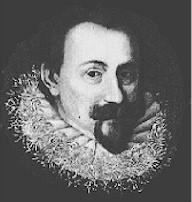
1586 - 1630 Person Name: Johann Hermann Schein 1580-1630 Composer of "EISENACH" in Praise! psalms hymns and songs for Christian worship Schein, Johann Hermann, son of Hieronymus Schein, pastor at Griinhain, near Annaberg, in Saxony, was born at Grünhain, Jan. 20,1586. He matriculated at the University of Leipzig in 1607, and studied there for four years. Thereafter he acted for some time as a private tutor, including two years with a family at Weissenfels. On May 21, 1615, he was appointed Capellmeister, at the court of Duke Johann Ernst, of Sachse-Weimar; and in 1616 he became cantor of I3t. Thomas's Church, and music director at Leipzig, in succession to Seth Calvisius (d. Nov. 24, 1615). This post he held till his death, at Leipzig, Nov. 19, 1630.
Schein was one of the most distinguished musicians of his time, both as an original composer, and as a harmoniser of the works of others. As a hymnwriter he was not so prolific, or so noteworthy. Most of his hymns were written on the deaths of his children or friends, e.g. on seven of his children, and on his first wife. They appeared mostly in broadsheet form, and were included, along with his original melodies, in his Cantional oder Gesang-Buch Augspurgischer Confession, Leipzig, 1627; 2nd ed., 1645. [Both in Wernigerode Library.]
Those of Schein's hymns which have passed into English are:—
i. Machs mit mir, Gott, nach deiner Güt. For the Dying. First published, as a broadsheet, at Leipzig, 1628, as a Trost-Liedlein á 5 (i.e. for 5 voices), &c. [Berlin Library.] The words, the melody, and the five-part setting, are all by Schein. It was written for, and first used at, the funeral, on Dec. 15, 1628, of Margarita, wife of Caspar Werner, a builder and town councillor at Leipzig, and a churchwarden of St. Thomas's. It is in 6 stanzas of 6 lines; the initial letters of 11. 1, 3, in st. i.-iv., forming the name Margarita; and the W of st. v. 1. 1 standing for Werner. In Schein's Cantional, 1645, No. 303 (marked as Trost-Liedlein, Joh. Herm. Scheins, á 5), and later hymn-books, as e.g. the Unverfäschter Liedersegen, 1851, No. 830, st. vi. was omitted. It is Schein's finest production, and one of the best German hymns for the sick and dying. Translated as:—
Deal with me, God, in mercy now. This is a good and full translation by Miss Winkworth, in her Chorale Book for England, 1863, No. 191, set to Schein's melody of 1628.
ii. Mein Gott und Herr, ach sei nicht fern. For the Dying. First published, with his name, in his Cantional, 1627, No. 262, in 9 stanzas of 6 lines. The initial letters of the stanzas give the name Margarita, probably one of the daughters who predeceased him. It is included, in 5 st., in the 164-8, and later eds., of Crüger's Praxis. The translation in common use is:—
My Lord and God, go not away. A good tr. of st. i., ii., iv., v., vii., by A. T. Russell, as No. 254, in his Psalms & Hymns, 1851. [Rev. James Mearns, M.A.]
--Excerpts from John Julian, Dictionary of Hymnology (1907)
Johann Hermann Schein
Pages