
1. Give me the wings of faith to rise
Within the veil, and see
The saints above, how great their joys,
How bright their glories be.
2. Once they were mourning here below
And wet their cheeks with tears;
They wrestled hard, as we do now,
With sins, and doubts and fears.
3. I ask them whence their vic'try came;
They, with united breath,
Ascribe their conquest to the Lamb,
Their triumph to his death.
4. Our glorious Leader claims our praise
For his own pattern giv'n,
While the long cloud of witnesses
Show the same path to Heav'n.
Source: Hymns and Devotions for Daily Worship #262
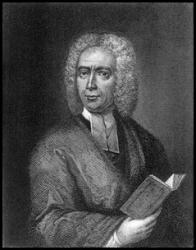
Isaac Watts was the son of a schoolmaster, and was born in Southampton, July 17, 1674. He is said to have shown remarkable precocity in childhood, beginning the study of Latin, in his fourth year, and writing respectable verses at the age of seven. At the age of sixteen, he went to London to study in the Academy of the Rev. Thomas Rowe, an Independent minister. In 1698, he became assistant minister of the Independent Church, Berry St., London. In 1702, he became pastor. In 1712, he accepted an invitation to visit Sir Thomas Abney, at his residence of Abney Park, and at Sir Thomas' pressing request, made it his home for the remainder of his life. It was a residence most favourable for his health, and for the prosecution of his literary… Go to person page >| First Line: | Give me the wings of faith to rise |
| Title: | The Saints In Glory |
| Author: | Isaac Watts (1709) |
| Meter: | 8.6.8.6 |
| Language: | English |
| Notes: | altered |
| Copyright: | Public Domain |
Give me the wings of faith to rise. I. Watts. [Heaven: All Saints.] First published in his Hymns & Spiritual Songs, 2nd edition, 1709, Bk. ii., No. 140, in 5 stanzas of 4 lines, and entitled, "The Examples of Christ and the Saints." It is in extensive use in all English-speaking countries, and generally in its original form as in the Hymnal Companion, No. 357. In Kennedy, 1863, the opening line reads:—"Be mine the wings of faith to rise," No. 1379. There are also other slight alterations in the text.
--John Julian, Dictionary of Hymnology (1907)
My Starred Hymns