

 My Starred Hymns
 My FlexScores
 My Hymnals
 My Purchased Files
Planning worship?
Check out our sister site, ZeteoSearch.org,
for 20+ additional resources related to your search.
- |
User Links
Person Results
Timothy T'ingfang Lew
1891 - 1947 Person Name: Timothy Ting Fang Lew Topics: Occasional Services Dedication / Consecration / Anniversary Translator (into Chinese) of "All People That on Earth Do Dwell" in Psalms for All Seasons T'ingfang Lew was a leading Chinese educator, author, and editor. He was educated in China and at Columbia University in New York City (M.A.; Ph.D.). His Bachelor of Divinity degree was from Yale and he studied at Union Theological Seminary, New York City, where he also taught Christian education. Lew lectured throughout America at schools and colleges from 1926 to 1938 and received an S.T.D. degree from Oberlin College.
In 1932, Lew began to chair the commission to prepare a Chinese Union hymnal. The resulting Hymns of Universal Praise was published in 1936. Its music editor was Bliss Wiant, a colleague of Lews's at Yenching University in Peking. Lew also edited the Union Book of Common Prayer which was used by four Protestant Chinese groups having approximately one-half million members. He represented China at the World Council of Churches meetings (1927-1939). He served as a member of the Chinese government's legislative body (1936-1941).
Lew is remembered for his work with Chinese Christian organizations in China and America where he resided from 1941 to 1947. He died while teaching at the University of New Mexico.
--The Presbyterian Hymnal Companion, 1993
Timothy T'ingfang Lew
Francis Pott
1832 - 1909 Topics: Church Building and Consecration Author of "Angel voices, ever singing" in The Hymnal Francis Pott studied at Brasenose College, Oxford, where he graduated B.A. in 1854, and M.A. in 1857. He was ordained Deacon in 1856, and Priest in 1857. He was Curate of Bishopsworth, Bristol, 1856; of Ardingley, Sussex, 1858; was appointed to Ticehurst in 1861; and is now incumbent of Northill, Bedfordshire. Mr. Pott has made many acceptable translations, and has edited "Hymns Fitted to the Order of Common Prayer, etc.;" a compilation of real merit.
--Annotations of the Hymnal, Charles Hutchins, M.A., 1872
============
Pott, Francis, M.A., was born Dec. 29, 1832, and educated at Brasenose, College, Oxford, B.A. 1854; M.A. 1857. Taking Holy Orders in 1856 he was curate of Bishopsworth, Gloucestershire, 1856-8; Ardingly, Berks, 1858-61; Ticehurst, Sussex, 1861-66; and Rector of Norhill, Ely, 1866. His
Hymns fitted to the Order of Common Prayer, and Administration of the Sacraments, and other Rites and Ceremonies of the Church, According to the Use of the Church of England, To which are added Hymns for Certain Local Festivals,
was published in 1861, and reprinted from time to time with a few additions. Mr. Pott contributed translations from the Latin and Syriac, and original hymns, including “Angel voices ever singing" (p. 68, ii.), and "Lift up your heads, eternal gates" (Ascension). These original hymns, together with his translations, have been received with much favour and are widely used. In several.…works, several translations from the Latin, and other hymnological work, are attributed to Archdeacon Alfred Pott. We are authorized to state that this ascription of authorship is an error.
--John Julian, Dictionary of Hymnology (1907)
Francis Pott
James Walch
1837 - 1901 Person Name: James Walch, 1837-1901 Topics: Consecration To Ministry; Ministry Consecration to Composer of "ANGELIC SONGS" in Methodist Hymn and Tune Book James Walch was a musician and composer, born near Bolton, Lancashire, England in 1837. He spent his early life in the town and was organist in several churches there, including the parish church of St George’s. From 1870-1877, he was conductor for the Bolton Philharmonic Society. He also composed at least four published hymn tunes, the best known of which is called “Tidings”. Written in 1875, it’s usually used as the tune to a hymn called “O Zion Haste”.
James Walch was a musical instrument dealer by trade, and moved to Barrow-in-Furness in 1877. He later moved to Llandudno Junction in North Wales, where he died in August 1901 and was buried locally. His wife later donated money to pay for the organs in two local churches, St Paul's Llandudno and All Saints Deganwy, in his memory.
Three decades later, an article in the London Gazette reported on a dispute arising from his will, and mentioned that he had a son, Harry West Walch, who was a pianist and lived in Hereford.
St Paul's Church, Llandudno newsletter; used by permission of Christ Dearden (Walch's wife paid for the organ at St. Paul's Church)
James Walch
W. P. Mackay
1839 - 1885 Person Name: William P. Mackay, 1839-1885 Topics: The Christian Way of Life Aspiration and Consecration Author of "Revive Us Again" in Worship and Service Hymnal Mackay, William Paton, M.D., was born at Montrose, May 13, 1839, and educated at the University of Edinburgh. After following his medical profession for a time, he became minister of Prospect Street Presbyterian Church, Hull, in 1868, and died from an accident, at Portree, Aug. 22, 1885. Seventeen of his hymns are in W. Reid's Praise Book, 1872. Of these the best known is "We praise Thee, O God, for the Son of Thy love" (Praise to God), written 1863, recast 1867. [Rev. James Mearns, M.A.]
--John Julian, Dictionary of Hymnology, Appendix II (1907)
======================
Born: May 13, 1839, Montrose, Scotland.
Died: August 22, 1885, Portree, Scotland, of an accident.
Mackay graduated from the University of Edinburgh and initially worked as a doctor. However, he was ordained, and in 1868 became pastor of the Prospect Street Presbyterian Church in Hull. He married Mary Loughton Livingstone 1868 in Kingston Upon Hull, Yorkshire; they were living in Sculcoates, Yorkshire, as of 1881. Seventeen of his hymns appeared in W. Reid’s Praise Book in 1872.
Sources:
Hustad, p. 278
Julian, p. 1667
Reynolds, p. 365
http://www.hymntime.com/tch/bio/m/a/c/mackay_wp.htm
W. P. Mackay
George William Warren

1828 - 1902 Person Name: George W. Warren Topics: Church Building and Consecration Composer of "NATIONAL HYMN" in The Hymnal George W. Warren (b. Albany, NY, 1828; d. New York, 1902) received his general education at Racine College in Wisconsin, but as a musician he was largely self-trained. An organist in a number of Episcopal churches, he played the organ for thirty years (1870-1900) at St. Thomas Church in New York City. Warren composed anthems and liturgical service music; his hymn tunes were collected in Warren's Hymns and Tunes as Sung in St. Thomas Church (1888).
Bert Polman
George William Warren
Charles Albert Tindley
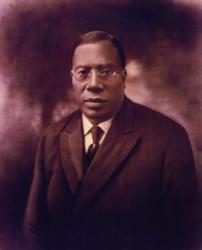
1851 - 1933 Person Name: Charles A. Tindley, 1851-1933 Topics: The Christian Way of Life Aspiration and Consecration Author of "Nothing Between" in Worship and Service Hymnal
Charles Albert Tindley
Samuel Sebastian Wesley
1810 - 1876 Person Name: Samuel Sebastian Wesley, 1810-1876 Topics: The Christian Life Discipleship and Consecration; Hymns for the Young Discipleship and Consecration Composer of "EPWORTH" in The Book of Praise Samuel Sebastian Wesley (b. London, England, 1810; d. Gloucester, England, 1876) was an English organist and composer. The grandson of Charles Wesley, he was born in London, and sang in the choir of the Chapel Royal as a boy. He learned composition and organ from his father, Samuel, completed a doctorate in music at Oxford, and composed for piano, organ, and choir. He was organist at Hereford Cathedral (1832-1835), Exeter Cathedral (1835-1842), Leeds Parish Church (1842-1849), Winchester Cathedral (1849-1865), and Gloucester Cathedral (1865-1876). Wesley strove to improve the standards of church music and the status of church musicians; his observations and plans for reform were published as A Few Words on Cathedral Music and the Music System of the Church (1849). He was the musical editor of Charles Kemble's A Selection of Psalms and Hymns (1864) and of the Wellburn Appendix of Original Hymns and Tunes (1875) but is best known as the compiler of The European Psalmist (1872), in which some 130 of the 733 hymn tunes were written by him.
Bert Polman
Samuel Sebastian Wesley
Samuel Medley
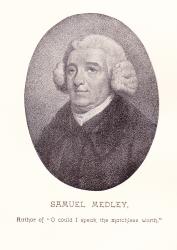
1738 - 1799 Topics: Consecration Author of "Loving Kindness" in Praise and Worship Hymns Medley, Samuel, born June 23, 1738, at Cheshunt, Herts, where his father kept a school. He received a good education; but not liking the business to which he was apprenticed, he entered the Royal Navy. Having been severely wounded in a battle with the French fleet off Port Lagos, in 1759, he was obliged to retire from active service. A sermon by Dr. Watts, read to him about this time, led to his conversion. He joined the Baptist Church in Eagle Street, London, then under the care of Dr. Gifford, and shortly afterwards opened a school, which for several years he conducted with great success. Having begun to preach, he received, in 1767, a call to become pastor of the Baptist church at Watford. Thence, in 1772, he removed to Byrom Street, Liverpool, where he gathered a large congregation, and for 27 years was remarkably popular and useful. After a long and painful illness he died July 17, 1799. Most of Medley's hymns were first printed on leaflets or in magazines (the Gospel Magazine being one). They appeared in book form as:—
(1) Hymns, &c. Bradford, 1785. This contains 42 hymns. (2) Hymns on Select Portions of Scripture by the Rev. Mr. Medley. 2nd ed. Bristol. W. Pine. 1785. This contains 34 hymns, and differs much from the Bradford edition both in the text and in the order of the hymns. (3) An enlargement of the same in 1787. (4) A small collection of new Hymns, London, 1794. This contains 23 hymns. (5) Hymns. The Public Worship and Private Devotion of True Christians Assisted in some thoughts in Verse; principally drawn from Select Passages of the Word of God. By Samuel Medley. London. Printed for J. Johnson. 1800. A few of his hymns are also found in a Collection for the use of All Denominations, published in London in 1782.
Medley's hymns have been very popular in his own denomination, particularly among the more Calvinistic churches. In Denham's Selections there are 48, and in J. Stevens's Selections, 30. Their charm consists less in their poetry than in the warmth and occasional pathos with which they give expression to Christian experience. In most of them also there is a refrain in the last line of each verse which is often effective. Those in common use include:—
1. Come, join ye saints, with heart and voice. (1800). Complete in Christ.
2. Death is no more among our foes. Easter.
3. Eternal Sovereign Lord of all. (1789). Praise for Providential Care.
4. Far, far beyond these lower skies. (1789). Jesus, the Forerunner.
5. Father of mercies, God of love, whose kind, &c. (1789.) New Year.
6. Great God, today Thy grace impart. Sermon.
7. Hear, gracious God! a sinner's cry. (1789). Lent.
8. In heaven the rapturous song began. Christmas.
9. Jesus, engrave it on my heart. (1789). Jesus, Needful to all.
10. Mortals, awake, with angels join. (1782). Christmas.
11. My soul, arise in joyful lays. (1789). Joy in God.
12. Now, in a song of grateful praise. Praise to Jesus. In the Gospel Magazine, June, 1776.
13. O could I speak the matchless worth. (1789.) Praise of Jesus.
14. O for a bright celestial ray. Lent.
15. O God, Thy mercy, vast and free. (1800). Dedication of Self to God.
16. O let us tell the matchless love. Praise to Jesus.
17. O what amazing words of grace. (1789). Foutain of Living Waters.
18. Saints die, and we should gently weep. (1800). Death and Burial. From his "Dearest of Names, Our Lord and King."
19. See a poor sinner, dearest Lord. Lent.
20. Sing the dear Saviour's glorious fame. (1789). Jesus the Breaker of bonds.
In 1800 a Memoir of Medley was published by his son, which is regarded by members of the family now living as authoritative. But in 1833 appeared another Memoir by Medley's daughter Sarah, to which are appended 52 hymns for use on Sacramental occasions. These she gives as her father's. But 8 of them are undoubtedly by Thos. Kelly, published by him in 1815, and reprinted in subsequent editions of his Hymns. The remainder are by Medley. Nearly all of these 52 hymns (both Medley's and Kelly's) have been altered in order to adapt them to Sacramental use. In Sarah Medley's volume, Kelly's hymns all follow one another, and three of them are in a metre which Medley apparently never used. What could have been Sarah Medley's motive in all this it is hard to divine. She is said to have been a clever, though unamiable woman, and was herself the author of a small volume of Poems published in 1807. In the Memoir she does not conceal her hatred of her brother. [Rev. W. R. Stevenson, M.A.]
-- John Julian, Dictionary of Hymnology (1907)
Samuel Medley
Melchior Vulpius
1570 - 1615 Person Name: Melchoir Vulpius Topics: Occasional Services Dedication / Consecration / Anniversary Composer of "CHRISTUS, DER IST MEIN LEBEN" in Psalms for All Seasons Born into a poor family named Fuchs, Melchior Vulpius (b. Wasungen, Henneberg, Germany, c. 1570; d. Weimar, Germany, 1615) had only limited educational opportunities and did not attend the university. He taught Latin in the school in Schleusingen, where he Latinized his surname, and from 1596 until his death served as a Lutheran cantor and teacher in Weimar. A distinguished composer, Vulpius wrote a St. Matthew Passion (1613), nearly two hundred motets in German and Latin, and over four hundred hymn tunes, many of which became popular in Lutheran churches, and some of which introduced the lively Italian balletto rhythms into the German hymn tunes. His music was published in Cantiones Sacrae (1602, 1604), Kirchengesangund Geistliche Lieder (1604, enlarged as Ein schon geistlich Gesanglmch, 1609), and posthumously in Cantionale Sacrum (1646).
Bert Polman
Melchior Vulpius
James G. Deck
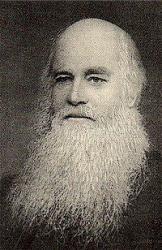
1802 - 1884 Topics: The Christian Consecration Author of "Jesus, Thy Name I Love" in The Baptist Standard Hymnal Deck, James George, eldest son of John Deck, of Bury St. Edmunds, was born in 1802 and educated for the army, and became an officer in the Indian service. Retiring from the army, and having joined the Plymouth Brethren, he undertook, in 1843, the charge of a congregation of that body, at Wellington, Somerset. In 1852 be went abroad and settled in New Zealand. His hymns were published in Hymns for the Poor of the Flock, 1837-1838; Psalms and Hymns, &c, London, Walther (containing those in the former collection), 1842; the Wellington Hymn Book, 1857; Hymns and Spiritual Songs, 1860. Of his hymns now in use outside his own denomination, the greater part appeared in the 1837-1838 book, and are found in his brother-in-law's (Dr. Walker's) Cheltenham Psalms & Hymns, 1855. His compositions are marked by directness of aim, simplicity of language, and great earnestness. The rhythm is good, and an expressive tenderness pervades many of them. Although dealing mainly with the "Second Advent," there are several on other subjects which are of more than average merit. In a collected form they were published in his Hymns and Sacred Poems, Melbourne, H. Seelenmeyer, 1876. The more important of his hymns are annotated under their respective first lines. Of the rest we have:—
i. From Hymns for the Poor of the Flock, 1838.
1. Behold yon bright and countless throng. All Saints. Repeated in Maurice's Choral Hymnbook, 1861.
2. How long, O Lord our Saviour. Second Advent desired. In the Parish Hymnbook., 1803 and 1875, this is altered to "How long, O Lord, Beloved."
3. Jesus, spotless Lamb of God. Good Friday.
4. Lord Jesus, are we [we are] one with Thee? One with Christ. In Walker's Psalms and Hymns, 1855-1880, and several American hymn-books.
5. Lord, we are Thine, our God Thou art. One with Christ. Originally in 4 st. of 8 1., it appeared, in a re-written form in 3 st. in Walker's Psalms and Hymns, 1855, as " Lord, we are Thine, in Thee we live."
6. 0 happy day when first we felt. The Day of Peace.
7. 0 Jesus Christ, the Saviour. Jesus All in All. In Walker's Psalms and Hymns, it begins: "0 Jesus Christ, our Saviour."
8. 0 Jesus, gracious Saviour." The Advocate.
9. 0 Lord, when we the path retrace. Christ our Example.
10. 0 Lord, who now art seated. Christ in glory.
11. Saviour, haste; our souls are waiting. Second Advent desired. This is given in Walker's Psalms and Hymns, in a rewritten form as "Saviour, hasten Thine appearing."
12. Soon shall our Master come. Waiting for Christ.
13. There is a place of endless joy. Heaven.
14. We're not of the world that fadeth away. Christ's Sheep.
15. When along life's thorny road. Passiontide.
ii. From Appendix, to the 1841 edition of the Hymns for the Poor of the Flock.
16. Lamb of God, our souls adore Thee. Praise to Christ. Sometimes it begins with st. ii.," Lamb of God, Thy Father's bosom."
17. Lamb of God, Thou now art seated. 2nd Part. of No. 10.
iii. From Psalms and Hymns, in Two Parts, Lond., D. Waither, 1842.
18. Again we meet in Jesus' name. Divine Worship.
19. Great Captain of Salvation. Burial. In the Irish Church Hymnal, and other collections.
20. Jesus, Thy name indeed is sweet. Hope of the Resurrection.
21. O blessed Jesus, Lamb of God. Praise to Jesus.
22. 0 Lamb of God, still keep me [us]. Christ's Presence desired. This hymn is somewhat popular in America.
23. 0 Lord, in nothing would I boast. Christ All in All.
24. Oft we, alas! forget the love. Holy Communion.
25. The veil is rent! lo, Jesus stands [our souls draw near]. The Intercessor.
26. We bless our Saviour's name. Thanksgiving for Forgiveness.
iv. From Psalms and Hymns for Public and Social Worship (Dr. Walker's Collection), 1855.
27. Father, to seek Thy face. Public Worship.
28. Jesus, [I] we rest in [on] Thee. Joy in Forgiveness.
29. 0 Lord, 'tis joy to look above. Joy in the service of Christ.
30. Thou hast stood here, Lord Jesus. Burial.
31. 'Twas Thy love, 0 God, that knew us. Praise to God.
32. When first o'erwhelm ed with sin and shame. Peace with God.
All these hymns, except No. 1, are given in Dr. Walker's Collection, 1855-1880, and most of them are also found in other collections.
-- John Julian, Dictionary of Hymnology (1907)
======================
Deck, James George, p. 285, ii. He died circa 1884. His hymn, noted on p. 286, No. 28, "Jesus [I] we rest in [on] Thee," should be dated 1842. Additional hymns in common use are:—(1) "Lord Jesus, when I think of Thee," 1856 (Jesus, All and in All); (2) "The day of glory, bearing," 1838 (Passiontide).
--John Julian, Dictionary of Hymnology, Appendix, Part II (1907)
====================
Deck, J. G., pp. 285, ii.; 1559, ii. Miss M. O. Deck, of Motueka, Nelson, New Zealand, informs us that her father, Mr. J. G. Deck, died at the village of Motueka, near Nelson, N.Z., on the 14th of August, 1884.
--John Julian, Dictionary of Hymnology, New Supplement (1907)
====================
James Deck wrote of his youth, "I hoped there were no God," yet his mother's training pursued after him. "She read to me of Jesus, Of all his grace and love." After his conversion, the study of scripture revealed the doctrinal error of his Anglican upbringing. Forsaking all, he set his heart to follow God "at any cost." Later, his son testified this determination was "a trust never disappointed."
- Psalms and Hymns and Spiritual Songs (2018)
James G. Deck
Pages




