You help make Hymnary.org possible. More than 10 million people from 200+ countries found hymns, liturgical resources and encouragement on Hymnary.org in 2025, including you. Every visit affirms the global impact of this ministry.

If Hymnary has been meaningful to you this year, would you take a moment today to help sustain it? A gift of any size—paired with a note of encouragement if you wish—directly supports the server costs, research work and curation that keep this resource freely available to the world.

Give securely online today, or mail a check to:
Hymnary.org
Calvin University
3201 Burton Street SE
Grand Rapids, MI 49546

Thank you for your partnership, and may the hope of Advent fill your heart.

Person Results

Tune Identifier:"^azmon_glaser$"
In:people

Planning worship? Check out our sister site, ZeteoSearch.org, for 20+ additional resources related to your search.
Showing 41 - 50 of 149Results Per Page: 102050

J. Hart

1712 - 1768 Person Name: Rev. Joseph Hart, 1712-1768 Author of "Eternal Spirit, Source of truth" in Songs of Praise Hart, Joseph, was born in London in 1712. His early life is involved in obscurity. His education was fairly good; and from the testimony of his brother-in-law, and successor in the ministry in Jewin Street, the Rev. John Hughes, "his civil calling was" for some time "that of a teacher of the learned languages." His early life, according to his own Experience which he prefaced to his Hymns, was a curious mixture of loose conduct, serious conviction of sin, and endeavours after amendment of life, and not until Whitsuntide, 1757, did he realize a permanent change, which was brought about mainly through his attending divine service at the Moravian Chapel, in Fetter Lane, London, and hearing a sermon on Rev. iii. 10. During the next two years many of his most earnest and impassioned hymns were written. These appeared as:— Hymns composed on Various Subjects, with the Author's Experience, London, 1759. During this year he became the Minister of the Independent Chapel, Jewin Street, London. In 1762 he added a Supplement to his Hymns; and in 1765 an Appendix. In modern editions of his Hymns these three are embodied in one volume as:— Hymns composed on Various Subjects: With the Author's Experience, The Supplement and Appendix. By the Rev. Joseph Hart, late Minister of the Gospel in Jewin Street, London. Allott & Co. [no date]. Hart died on May 24, 1768. At one time his hymns were widely used, especially by Calvinistic Nonconformists. Many of them are of merit, and are marked by great earnestness, and passionate love of the Redeemer. The best known are: “Come, Holy Spirit, come"; “Come, ye sinners, poor and wretched"; "This God is the God we adore"; and "Lord, look on all assembled here." Those which are more limited in their use include:— i. From his Hymns, &c, 1759. 1. Descend from heaven, celestial Dove. Whitsuntide. No. 6, in 6 stanzas of 6 lines. In Snepp's Songs of Grace & Glory., 1872, No. 374, st. iv., v. are omitted. It is in extensive use in America. 2. Great High Priest, we view Thee stooping. High Priesthood of Christ. No. 56, pt. ii., in 3 stanzas of 8 lines. In Snepp's Songs of Grace & Glory, 1872, No. 236; Hatfield's Church Hymn Book, N. Y., 1872, No. 435, &c. 8. How wondrous are the works of God. Redeeming Love. No. 21, in 9 stanzas of 4 lines. In the Scottish Evangelical Union Hymnal, 1878, st. i.-iv. are given as No. 11. 4. If ever it could come to pass. Final Perseverance. No. 58, in 3 stanzas of 6 lines. Repeated in Snepp's Songs of Grace & Glory, 1872, No. 729. 6. Jesus is our God and Saviour . Faith and Repentance. No. 54, in 7 stanzas of 8 lines. In Snepp's Songs of Grace & Glory, 1872, No. 146, st. iv. is omitted. In the London Hymn Book (enlarged), 1879, st. iii. and v. are given as "Nothing but Thy blood, 0 Jesus." 6. Jesus, while He dwelt below. Gethsemane. No. 75, in 23 stanzas of 6 lines. In Snepp's Songs of Grace & Glory, 1872, No. 230, sixteen stanzas are broken up into three parts: (i.) "Jesus, while He dwelt below"; (ii.) "Full of love to man's lost race"; (iii.) "There my God bore all my guilt." A cento is also given in Hatfield's Church Hymn Book, N. Y., 1872, No. 441, as "Many woes had Christ [He] endured." It is composed of st. viii., ix., xiii., xx., xxiii., slightly altered. In the Scottish Evangelical Union Hymnal, 1878, No. 34, 8 stanzas are given in two parts: pt. i. as, "Jesus, while He dwelt below"; pt. ii. "Eden from each flowery bed." 7. Lamb of God, we fall before Thee. Christ All in All. No. 17 in 4 stanzas of 8 lines. It is in various collections, and as altered in Kennedy , 1863, No. 1171, is much improved. 8. Let us all with grateful praises. Christmas. No. 14 in 7 stanzas of 8 lines. In Spurgeon's 0ur Own Hymn Book, 1866, it is reduced to 4 stanzas of 4 lines. 9. Lord, look on all assembled here. For a Public Fast. No. 96, in 8 stanzas of 4 lines. It is in several of the older hymnbooks. 10. Lord, we lie before Thy feet. Lent. No. 74, in 6 stanzas of 6 lines, and based on 2 Chron. xx. 20. In Spurgeon's 0ur Own Hymn Book, 1866, stanza i., iii., vi. are given as No. 585. 11. Mercy is welcome news indeed. God's Mercy in pardoning Sin. No. 51, in 6 stanzas of 4 lines, on St. Luke vii. 42. In Spurgeon, 1866, No. 544. 12. Much we talk of Jesu's blood. Passiontide. No. 41, in 4 st. of 8 lines, on Lam. i. 12. In Spurgeon, 1866, it is abridged to 4 stanzas of 4 lines. 13. Bow from the garden to the cross. Good Friday. No. 63, in 9 stanzas of 4 lines, and entitled, "The Crucifixion." In Spurgeon, 1866, No. 274, st. ii.-v., vi.-ix. are given as "See how the patient Jesus stands." 14. The Fountain of Christ Assist me to sing. The Fountain. No. 86, in 8 stanzas of 8 lines on Zech. xiii. 1. In Spurgeon, 1866, st. i., v., vii., viii., are given as No. 375. 15. The moon and stars shall lose their light. Advent. No. 48, in 4 stanzas of 4 lines, on St. Matt. xxiv. 35. In Spurgeon, 1866. 16. The sinner that truly believes. Saving Faith. No. 88, in 5 stanzas of 4 lines, and entitled, "Saving Faith" In Spurgeon, 1866, No. 533, st. ii. is omitted, and the opening line is altered to "The moment a sinner believes." ii. From his Supplement, 1762. 17. Behold what awful pomp. Advent. No. 52, in 8 stanzas of 4 lines. It is usually abridged as in the American Methodist Episcopal Hymns, 1849, No. 1107. 18. Christ is the Eternal Rock. The Offices of Christ. No. 27, in 6 stanzas of 8 lines. In Windle's Metrical Psalter & Hymnal, 1862, stanzas i., ii., v. are given as No. 53. 19. Christians, dismiss your fear. Easter. No. 33, in 4 stanzas of 8 lines into Dr. Alexander's Augustine Hymn Book, 1849, No. 79, in 7 stanzas of 4 lines. 20. Dismiss us with Thy blessing, Lord. Close of Service. No. 78, in 2 stanzas of 4 lines. In a few collections. 21. Gird thy loins up, Christian soldier. The Christian Armour . No. 29, in 5 stanzas of 8 lines, on Eph. vi. 11. Found in several of the older, and a few of the modern collections. 22. Glory to God on high, Our peace, &c. Holy Communion. No. 3, in 6 stanzas of 4 lines. In Hatfield's Church Hymn Book, 1872, No. 704, st. v., vi. are omitted. 23. Holy Ghost, inspire our praises. On behalf of Ministers. No. 77, in 5 stanzas of 8 lines. In the Scottish Evangelical Union Hymnal, 1878, No. 412, st. iii.-v. are given as, "Happy soul that hears and follows." 24. Jesus once for sinners slain. Holy Communion. No. 18, in 6 stanzas of 4 lines. In American use. 25. Lord, help us on Thy word to feed. Close of Service. No. 80, in 2 stanzas of 4 lines. In several modern hymnbooks. 26. O for a glance of heavenly day. Lent. No. 64, in 5 stanzas of 4 lines. In Hatfield's Church Hymn Book, 1872, and other American collections it is usually repeated in full. In Bickersteth's Christian Psalmody, 1833, it was given as, "Lord, shed a beam of heavenly day," and this is repeated in modern hymnbooks. 27. Once more before we part. Close of Service. No. 79, in 2 stanzas of 4 lines. Popular in Great Britain and America. 28. Once more we come before our God. Before a Sermon. No. 21, in 6 stanzas of 4 lines, into Hatfield, 1872, No. 111, and others. 29. Sons of God by bless'd adoption. Burial. No. 45, in 3 stanzas of 8 lines, into Snepp's Songs of Grace & Glory, 1872, No. 981, as "Sons of God by blest adoption." 30. Suffering Saviour, Lamb of God . Holy Communion. No. 14, in 8 stanzas of 4 lines. In W. F. Stevenson's Hymns for Church & Home, 1873, st. iii., vii. are omitted. 31. That doleful night before His death. Holy Communion. No. 17, in 2 stanzas of 8 lines. In the Scottish Evangelical Union Hymnal, 1878, st. i. 11. 4-8, and st. ii., are given as, "To keep Thy Feast, Lord, we are met." iii. From his Appendix, 1765. 32. Christians, in your several stations. Christian Duty. No. 7, in 5 stanzas of 6 lines. It is slightly altered in Snepp's Songs of Grace & Glory, 1872, No. 742, and dated 1759 in error. 33. Prayer was [is] appointed to convey. Prayer. No. 12 in 6 stanzas of 4 lines into Snepp's Songs of Grace & Glory, 1872, No. 542, with alterations and the omission of st. ii., v. In some American collections it begins, "Prayer is to God, the soul's sure way." --John Julian, Dictionary of Hymnology (1907) ======================= Hart, Joseph, p. 492, ii. Other hymns in common use are— 1. The blest memorials of Thy grief (1762). Holy Communion. 2. To comprehend the great Three-One (1759). Holy Trinity. 3. Vain man, thy fond pursuits forbear (1759). Death. 4. When the blest day of Pentecost (1759). Whitsuntide. --John Julian, Dictionary of Hymnology, Appendix, Part II (1907)

Jane Taylor

1783 - 1824 Author of "Who Made the Sky So Bright and Blue?" in Ambassador Hymnal Taylor, Jane, the younger of two sisters, was born at London, Sept. 23, 1783. Her gift in writing verse displayed itself at an early age. Her first piece was printed in the Minor's Pocket Book for 1804. Her publications included Display, a tale, 1815; Essays in Rhymes, 1816; and the posthumous work edited by her brother, entitled The Contributions of Q. Q., 1824, being pieces in prose and verse from the Youth's Magazine, to which she had contributed under the signature of "Q. Q." She died at Ongar, Essex, April 13, 1824. Her Memoir and Poetical Remains, were published by her father in 1825. The joint productions of the two sisters, Ann Taylor Gilbert & Jane Taylor, were:-- (1) Original Poems, 1805; (2) Hymns for the Nursery, 1806; (3) Hymns for Infant Minds, 1809; 2nd edition 1810; 52nd edition 1877. To the 35th edition, 1844, Mrs. Gilbert interspersed 23 additional hymns by herself, thereby raising the total to 93. In 1886 Josiah Gilbert revised these hymns, added thereto from the works named above, supplied the initials "A." and "J." respectively, and published the same under the original title as the Authorized Edition." (4) Original Hymns for Sunday Schools, 1812. In addition to the hymns which are noted under their respective first lines, Miss Taylor is the authors of the following (the date in brackets indicates the book in which each hymn appeared):— 1. A sinner, Lord, behold I stand (1809). A Child's Humble Confession. 2. Almighty God, Who dwellest high (1809). Praise to God. 3. Come, my fond, fluttering heart (Collyer's Collection 1812). Renunciation of the World. 4. God is so good that He will hear (1809). Encouragement to Pray. 5. God!—What a great and awful name (1809). God's Condescension. 6. How dreadful to be turned away (1812). Expulsion from Sunday School. 7. Lord, I would own thy tender care (1809). Thanks for Daily Mercies. 8. Love and kindness we may measure (1809). Against Selfishness. 9. Now condescend, Almighty King (1809). Evening Hymn for a Small Family. 10. This is a precious book indeed (1809). Holy Scripture. 11. What is there, Lord, a child can do? Repentance. 12. When daily I kneel down to pray (1809). Against wandering thoughts in Prayer. 13. When for some little insult given (1809). Against Anger, &c. 14. When to the house of God we go (1809). Public Worship. Mr. Gilbert's edition of the Hymns for Infant Minds, 1886, together with manuscript notes, are our authorities for the foregoing ascriptions of authorship. Mr. Gilbert cannot distinguish the authorship of the following hymns by one or both sisters:— 1. Good David, whose Psalms have so often been sung (1812). Concerning David. 2. If Jesus Christ was sent (1812). Repentance. 3. King Solomon of old (1812). Concerning Solomon. In literary excellence Mrs. Gilbert's hymns surpass those of her sister. They are more elevated in style, ornate in character, broader in grasp, and better adapted for adults. The best are "Great God, and wilt Thou condescend?", "Jesus, Who lived above the sky," and "Lo! at noon 'tis sudden night." Miss Taylor's hymns are marked by great simplicity and directness. The most popular and one of the best is, "There is a path that leads to God." Taken as a whole, her hymns are somewhat depressing in tone. They lack brightness and warmth. --Excerpts from John Julian, Dictionary of Hymnology (1907)

Adam M. L. Tice

b. 1979 Author of "The Church of Christ Cannot Be Bound" in Celebrating Grace Hymnal

John Ryland

1753 - 1825 Person Name: John Ryland, 1753-1825 Author of "In All My Lord's Appointed Ways" in The Cyber Hymnal Ryland, John, D.D., son of Rev. John Collett Ryland, was born at Warwick, Jan. 29, 1753. At that time his father was Baptist minister at Warwick, but in 1759 removed to Northampton. "J. Ryland, junior," as for many years he was accustomed to subscribe himself, was in 1781 ordained co-pastor with his father at Northampton. In 1794 he accepted the presidency of the Baptist College and the pastorate of the church in Broadmead, Bristol, and these offices he retained until his death on June 25, 1825. Dr. Ryland was a man of considerable literary culture, and received the degree of D.D. from Brown University, Rhode Island. He was one of the founders of the Baptist Missionary Society, and for the three years following the death of Rev. A. Fuller, in 1815, acted as its secretary. His prose works were Memoirs of Rev. B. Hall, Arnsby (2nd ed., 1852); A candid statement of the reasons which induce Baptists to differ from their Christian brethren; and many Sermons and Charges. After his death appeared 2 vols. of Discourses, selected from his manuscripts, and entitled Pastoral Memorial. To these discourses are appended many of his hymns, with their dates. Dr. Ryland's hymns were composed at different times, from his sixteenth year to the year of his death. The earliest were published when he was 16, in his Serious Essays, 1771. These 36 hymns were never republished. Several appeared in the Gospel Magazine from 1771 to 1782, and the Protestant Magazine, 1782-83; others in Rippon's Baptist Selection, 1787; 2 in the Collection for the Monthly Prayer Meeting at Bristol, 1797 ; 2 in Andrew Fuller's Memoirs, 1831; and 25 in the Pastoral Memorials, 1825. His Hymns and Verses on Sacred Subjects, to the number of 99, were reprinted from his mss. by D. Sedgwick, and were published, with a Memoir, in 1862. The hymns are dated therein from the mss. [Rev. W. R. Stevenson, M.A.] Those of Dr. Ryland's hymns now in common use include:— 1. For Zion's sake I'll not restrain. Missions. Dated 1798, and printed by D. Sedgwick from Ryland's manuscripts, 1862. 2. Had not the Lord, my soul may say [cry] . Ps. cxxiv. From his Serious Essays, 1771. It is No. 124 in Spurgeon's Our Own Hymn Book, 1866. Not in Sedgwick's reprint. 3. Holy, holy, holy Lord, self-existent Deity. Holy Trinity. Dated 1796. It was given in the tenth edition of Rippon's Baptist Selection, 1800, Pt. 2, No. 22; in the Pastoral Memorials, 1825; and Sedgwick's reprint, 1862, in 5 stanzas of 8 lines. It is in common use in Great Britain and America. 4. Look down, my soul, on hell's domain. Gratitude for escape. This is No. 881 in Spurgeon's Our Own Hymn Book. 1866, and dated 1777. We cannot trace it in any of Ryland's works or amongst his hymns. 5. Lord, teach a little child to pray. A Child's Prayer. Dated 1786. The note to this hymn by Dr. Ryland's son, in Sedgwick's reprint, 1862, p. 15, is:— "This and the following hymn ["God is very good to me “was composed at the request of Mrs. Fuller, wife of the Rev. Andrew Fuller, of Kettering, for the use of Miss Sarah Fuller, who died May 30th, 1789, aged six years and six months." It was published in Andrew Fuller's Memoirs, 1831, p. 442, andsin Sedgwick's reprint, 1862. 6. Now let the slumbering church awake. Activity in the Church desired. Dated "Feb. 20, 1798." Published in the Pastoral Memorials, 1825, and in Sedgwick's reprint, 1862. In Spurgeon's Our Own Hymn Book, 1866. 7. O Lord, I would delight in Thee. Delight in Christ. Dated "Dec. 3, 1777." Dr. Ryland added this note to the ms.:—-" I recollect deeper feelings of mind in composing this hymn, than perhaps I ever felt in making any other." It was published in Rippon's Selection 1798, No. 248; in the Pastoral Memorials, 1825; and in Sedgwick's reprint, 1862, in 7 st. of 41. It is in extensive use in its original, or an abbreviated form; or as "O Lord we would delight in Thee." In the American Methodist Episcopal Hymns, 1849; and their Hymn, 1878, st. i., ii., vi., vii. are rewritten in S. M. as "Lord, I delight in Thee." 8. Out of the depths of doubt and fear. Ps. cxxx. From the Serious Essays, 1771 (misdated in Spurgeon's Our Own Hymn Book 1775). It is not in the Pastoral Memorials, 1825, nor in Sedgwick's reprint, 1862. 9. Rejoice, the Saviour reigns. Missions. Dated "Jan. 19, 1792." In the 10th ed. of Rippon's Selection, 1800, 422 (2nd pt.) it is given in 6 st. of 6 1., as in the Ryland ms., and then after the word "Pause" two stanzas are added on, which are not in the ms. The 6 stanzas were repeated in the Pastoral Memorials, 1825; in Sedgwick's reprint, 1862; and in Spurgeon's Our Own Hymn Book, 1866 (abbreviated), and other modern hymnals. 10. Sovereign Ruler of the skies. Guidance, Peace, and Security in God. Dated "Aug. 1,1777." Included in Rippon's Selection, 1787, No. 545 ; the Pastoral Memorials, 1825 ; and Sedgwick's reprint, 1862, in 9 st. of 4 1. 11. Thou Son of God, and Son of Man. Praise to God, the Son. This is undated. It was given in the Pastoral Memorials, 1825; and Sedgwick's reprint, 1862. 12. When Abraham's servant to procure. Onward, Heavenward. Dr. Ryland's son, under the date of Nov. 4, 1861, informed D. Sedgwick that this hymn "was written with a slate pencil on a rusty iron blower by moonlight, past twelve o'clock, Dec. 30, 1773," and he gives these words as a quotation from his father's manuscript. It is almost needless to add that this account does not agree with the generally received history of the hymn, as set forth in Miller's Singers and Songs, 1869, p. 313. In the May number of the Gospel Magazine, 1775, p. 235, the hymn was given in 9 st. of 4 1., with the heading" Hinder me not-—Gen. xxiv. 56," and signed "Elachistoteros." It was repeated in Rippon's Selection, 1787, No. 447; and Sedgwick's reprint, 1862. In Rippon a note is added, "This hymn may begin with 6th verse." This direction has been followed in some modern collections, the result being the hymn commonly known as "In all my Lord's appointed ways." 13. When the Saviour dwelt below. Compassion of Christ. Dated 1806. Included in the Pastoral Memorials, 1825, and Sedgwick's reprint, 1862. Dr. Ryland's hymns are plain and simple, but they lack poetry and passion, and are not likely to be largely drawn upon, for future hymnals. --John Julian, Dictionary of Hymnology (1907)

W. G. Tarrant

1853 - 1928 Person Name: William G.Tarrant, 1853-1928 Author of "Come, Let Us Join With Faithful Souls" in Pilgrim Hymnal Tarrant, William George, B.A., b. 1853. Since 1883 Minister of the Wandsworth Unitarian Christian Church. Editor of The Inquirer, 1888-97. One of the editors of the Essex Hall Hymnal. 1890, and of the Revised ed., 1902. 1. Come, let us Join with faithful souls. The Faithful. 2. Draw nigh to God; He will draw nigh to you. The Divine Helper. 3. Long ago the lilies faded. The Constant Presence. 4. The Light along the ages. Easter. 5. With happy voices ringing. Children's Praise. --John Julian, Dictionary of Hymnology, New Supplement (1907)

William J. Irons

1812 - 1883 Person Name: Rev. William Joseph Irons (1812-1883) Author of "Constant Trust in God" in Many Voices; or, Carmina Sanctorum, Evangelistic Edition with Tunes Irons, William Josiah, D.D., son of Joseph Irons, was born at Hoddesdon, Herts, Sep. 12, 1812, and educated at Queen's College, Oxford (B.A. 1833, D.D. 1854), and took Holy Orders 1835. In 1837 he became Incumbent of St. Peter's, Walworth, and was subsequently Vicar of Barkway, Incumbent of Brompton, Rector of Wadingham; and in 1872, Rector of St. Mary-Woolnoth, formerly held by his father's friend, John Newton. He was also Bampton Lecturer in 1870, and Prebendary of St. Paul's Cathedral. He died June 18, 1883. Dr. Irons took a somewhat prominent part in the ecclesiastical controversies of his day, and published extensively thereon in the form of Sermons, Letters, Pamphlets, &c. His important work, the Bampton Lectures, 1870, was on Christianity as taught by St. Paul. His hymnwriting and translating began during his Curacy at St. Mary, Newington, 1835-1837, and was continued to his death. Many were first printed as broadsheets, and subsequently included in the Rev. R. T. Lowe's (Rector of Lea, Lincolnshire) Hymns for the Christian Seasons, Gainsburgh, 1st ed., 1854, and in his own collections. Of these separate publications the most important were his translation of the Dies Irae, and Quicumque vult, and a few special Hymns (Hayes) in 1867. His hymnological works, in addition to these, were:— (1) Metrical Psalter, 1857; (2) Appendix to the Brompton Metrical Psalter, 1861 (22 hymns); (3) Hymns for Use in Church, 1866 (100 hymns). These contained hymns by Dr. Irons, and others. The next contains his Translations and Original Hymns only. (4) Psalms and Hymns for the Church, 1st ed., 1873 (126 h.); 2nd ed., 1875 (190 h.); 3rd ed., 1883 (308 h.). The principal object of this last work was to supply special hymns on the Collects, Epistles, and Gospels, and for Advent and Lent, together with special hymns for the Festivals; and this to a great extent Dr. Irons was enabled to accomplish. His versions of individual Psalms are directly from the Hebrew, line for line. In addition to those of Dr. Irons's hymns and translations, which are annotated under their respective first lines, the following are in common use outside of his own collections, the details appended being from his MS. notes:— 1. Blest voice of love, 0 Word divine. Confirmation. Written for a Confirmation at Brompton, and published in Lowe's Hymns for the Christian Seasons, 1854, No. 184; in the Appendix to the Brompton Metrical Psalter, 1861; and the author's later collections. 2. Can earthly voices fitly sing. Public Opening of a School. Written at Brompton on the occasion of the opening of a School, and published in the 1861Appendix as above, and in the author's later collections. 3. Children of earth, for heaven we seek. Epiphany. A meditation on the Collect for the first Sunday after the Epiphany, and published in his Psalms & Hymns, 1875. 4. Eternal Spirit, God of Grace. Whitsuntide. Written in 1865, and published in his Hymns for Use in Church, 1866, and in a revised form in his Psalms & Hymns, 1873. 5. Faithful Creator, Lord Divine. Consecration to God. Published in his Psalms & Hymns, &c, 1873. 6. Father of love, our Guide and Friend. Confirmation. Written for a large Confirmation at Brompton, in 1844, and published in Lowe's Hymns for the Christian Seasons, 1854, No. 185, and in the 1861 Appendix as above, and the author's later collections. 7. Hail, holy rest, calm herald of that day. Sunday. Published in his Psalms & Hymns, &c, 1873. 8. Is not this our King and Prophet? Palm Sunday. Published in his Psalms & Hymns, &c, 1873. 9. It is not finished, Lord of grace. Preparation for Heaven. Written in 1850. It is No. 45 of his Hymns, 1866, in 6 stanzas of 5 lines. 10. Jesu, Who for us didst bear. Words from the Cross. In his Hymns, 1866, No. 42. 11. Joy of joys, He lives, He lives. Easter. Written in 1873. In the New Mitre, 1875; and the author's Hymns, 1875. 12. Lord, hear my prayer, bow down Thine ear. Lent. Published in Psalms & Hymns, 1873. 13. Lord, in Thy wrath Thou thinkest yet. Lent. In his Hymns, 1866, No. 91. 14. Lord, Thy voice hath spoken. The Beatitudes. In Hymns for use in the Church of Saint Ethelburga, Bishopsgate, 1873, and Dr. Irons's Psalms & Hymns, 1875. 15. No sorrow and no sighing. Heaven. Published in his Psalms & Hymns, 1873, in 5 stanzas of 4 lines. In Thring's Collection 1882, stanzas i.-iii. were given from the 1875 text, and a new stanza was added by Dr. Irons at Prebendary Thring's request. 16. 0 God with us, the Saviour. For use during a Retreat. Given in Psalms & Hymns, 1873. 17. 0 how long, how long. Ps. xiii. Appeared in his Psalms & Hymns, &c, 1873. 18. 0 Saviour, now at God's right hand. Jesus the High Priest. Published in the 1861 Appendix as above, and revised in the author's latter collections. In the Psalms & Hymns, 1873., stanzas i., ii., v. are from 1861, iv. from 1866; and iii. is new. 19. 0 who are they so pure and bright? Holy Innocents . Written on the death of Infants in the Epidemic of 1837, and published in Lowe's Hymns for the Christian Seasons, 1854, No. 20, and in the 1861 Appendix as above, in 3 stanzas of 8 lines. In the 1866 Hymns it was divided into 6 stanzas of 4 lines, and this arrangement was repeated in the 1873 Psalms & Hymns. 20. Sing with all the sons of men. Easter. Given in his Psalms & Hymns, 1873. 21. Thanks be to God for meet and right. Processional. Published in his Hymns, &c, 1866, and again in his Psalms & Hymns, 1873. 22. To whom but Thee, 0 God of Grace. Passiontide. Appeared in his Hymns, &c, 1866; and in his Psalms & Hymns, 1873. 23. Triumphant Lord, Thy work is done. Ascension. Published in the 1861 Appendix as above, in 3 st. of 4 1. In the 1866 Hymns the st. (iii.) “0 by Thy spotless, wondrous birth " was added; and in this enlarged form the hymn was repeated in the Psalms & Hymns, 1873. 24. We praise Thee, 0 our God--to Thee. Children's Hymn of Praise to the Holy Trinity. Written for the Schools at St. Mary's Newington, and published in the 1861 Appendix as above, and repeated in the Hymns, &c, 1866, and the Psalms & Hymns, 1873. 25. Who is this from Bethlehem coming? Purification of Blessed Virgin Mary. Appeared in the Psalms & Hymns, 1873. 26. Why art thou weary, 0 my soul? Ps. lxi. Given in his Hymns, &c, 1866, and his Psalms & Hymns, 1873, in 6 stanzas of 7 lines. In Thring's Collection, 1882, stanza iii. is omitted. Amongst modern hymnwriters, Dr. Irons ranks with the first. His hymns have not been largely used outside of his own congregation; but their high excellence, variety of subjects and metres, intense earnestness, powerful grasp of the subject, and almost faultless rhythm must commend them to the notice of hymnbook compilers. Prebendary Thring has enriched his Collection (1882) with most of those named above. They are of more than usual excellence, and others remain of equal merit. -- John Julian, Dictionary of Hymnology (1907) ====================== Irons, W. J., p. 571, ii. Of the hymns noted under his name, Nos. 13, 21, and 26, appeared in Chope's Hymnal, 1862. --John Julian, Dictionary of Hymnology, Appendix, Part II (1907)

Bernard Barton

1784 - 1849 Person Name: Bernard Barton (1784-1649) Author of "Walk in the light! so shalt thou know" in Hymns of the Ages Barton, Bernard, commonly known as the "Quaker Poet," was born in London Jan. 31, 1784, and educated at a Quaker school at Ipswich. In 1798 he was apprenticed to Mr. S. Jesup, a shopkeeper at Halstead, Essex, with whom he remained until 1806, when he removed to Woodbridge, Suffolk, and entered into business with his brother, as a coal and corn merchant. On the death of his wife at the end of the first year of their married life, he proceeded to Liverpool, where he acted as a private tutor for a short time. He returned to Woodbridge in 1810, where he secured an engagement in the local bank of the Messrs. Alexander. This appointment he held for 40 years. He died at Woodbridge, Feb. 19, 1849. During the same year his daughter published his Poems and Letters, with a Memoir. His poetical works were numerous, including:— (1) Metrical Effusions , 1812; (2) Poems by an Amateur, 1818; (3) Poems , 1820; (4) Napoleon, and other Poems, 1822; (5) Poetic Vigils, 1824; (6) Devotional Verses founded on Select Texts of Scripture, 1826; (7) A Widow's Tale, 1S27; (8) New Year's Eve, 1829; (9) The Reliquary, 1836; (10) Household Verses, 1845. A complete list of his works is given in Joseph Smith's Descriptive Catalogue of Friends' Books, Lond., J. Smith, 1867, vol. i. pp. 196-200. From these works about 20 pieces have come into common use as hymns. These are found principally in the Scottish Evangelical Union Hymnal, on the one hand, and various American Unitarian collections on the other. The best known are, “Lamp of our feet, whereby we trace," and "Walk in the light, so shalt thou know." From his Devotional Poems, &c, 1826, the following have passed into the Scottish Evangelical Union Hymnal, 1878:— 1. Fear not, Zion's sons and daughters. Gracious Promises. This is part of a poem on Isaiah xliii. 1, “Fear not, Jacob, tabulated." 2. Hath the invitation ended? Invitation. 3. See we not beyond the portal? Present vision Imperfect. This is part of the poem on 1 Cor. xiii. 12, “Dim and dark our present vision." 4. Those who live in love shall know. Peace. 5. Would'st thou share this benediction! Poor in Spirit. In addition, there are also in various collections:— 6. Around Bethesda's healing wave. Consolation. This is on pp. 182-185, in his Napoleon, and other Poems, 1822, in 10 stanzas of 6 lines. A cento therefrom is given in a few American hymnals, including Mr. Beecher's Plymouth Collection, No. 746, as, "The waters of Bethesda's pool." 7. There is a life more dear. Spiritual Life. From the Devotional Verses, 1826, p. 96, into Kennedy, 1863, No. 1177, with the omission of stanza v. 8. Say not the law divine. Spiritual Law. Also from the Devotional Verses, 1826, p. 34, into various American hymnals, generally Unitarian, as the Hymn and Tune Book, Boston, 1868, No. 342, &c, where, however, it is rewritten from an irregular metre to S.M. This had previously appeared in Hedge and Huntington's Hymns for the Church of Christ, Boston, U.S., 1853. Other hymns, given in great part in American Unitarian collections, are annotated under their respective first lines. -- John Julian, Dictionary of Hymnology (1907) ====================== Barton, Bernard, p. 116, i. Other hymns in common use:— 1. God made the country, yet in scenes. Country Life. This begins with stanza iii. of a poem "Addressed to a Friend in London" in The Reliquary, 1836, p. 83. 2. Lamp of our feet! whereby we trace. Holy Scriptures, published in The Reliquary, 1836, p. 116, in 11 stanzas of 4 lines. It is in common use in its full form, and also abbreviated as (1) "Word of the ever-living God"; and (2) "Word of the everlasting God." In extensive use. 3. There is a Friend more tender, true. Jesus, the Friend. This begins with stanza iii. of "But yet, however cheerless seem," in his Poems & Letters, 1853, p. 254. 4. Walk in the light! So shalt thou know. (Walking in the Light.) Published in his Devotional Verses, 1826, p. 242, in 6 stanzas of 4 lines. It is found in many modern collections, and is one of the most popular of his hymns. 5. We journey through a vale of tears. Heaven Anticipated. In his Poems & Letters, 1853, p. 193. Of these hymns, Nos. 3, 5, are of an earlier date than the Poems & Letters of 1853; but we have failed to find them in Barton's earlier works. --John Julian, Dictionary of Hymnology, Appendix, Part II (1907)

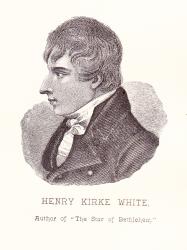
Henry Kirke White

1785 - 1806 Person Name: H. Kirke White Author of "The Lord Our God Is Clothed With Might" in The A.M.E. Zion Hymnal White, Henry Kirke, a gifted English poet who died early in life, was born in Nottingham, England, March 21, 1785. Very early he manifested a remarkable love for books and a decided talent for composition. But his parents were poor, and he was apprenticed in early boyhood to a stocking weaver, from which uncongenial servitude he escaped as soon as he could and began the study of law; but later he was converted and felt called to the ministry. The story of his conversion from deism to Christianity is briefly but beautifully told in the poem titled "The Star of Bethlehem." He entered St. John's College, Cambridge, in 1805 as a servitor; but died October 19, 1806, in the second year of his college course, when only twenty-one years of age. In 1803 he published a small volume of poems. Some of them are very fine, but no doubt he would have produced others far better if he had lived to the ordinary age of man. His rare poetic genius, his victory over skepticism and subsequent faith and piety, his hard struggle with poverty and early death invest the story of his life with more than ordinary pathos. His hymns, ten in number, appeared in Collyer's Collection, 1812. Oft in danger, oft in woe 412 The Lord our God is clothed with 99 When marshaled on the mighty 124 Hymn Writers of the Church, 1911 ============================ White, Henry Kirk, remarkable both for the early development of his genius and for the untimely termination of his brief life of splendid promise, was born at Nottingham, March 21, 1785. His father was a butcher, but his mother must have been a superior woman, since for a number of years she successfully conducted a boarding-school for girls. The writing-master in her establishment was for some time Henry's teacher, and under his instruction he made remarkable progress in Latin and other subjects. At the age of 13 he composed the lines "To an early Primrose," which were subsequently printed with his poems. At 14 he left school, and was put to the stocking-frame in order to learn prac¬tically the business of a hosier; but, disliking the employment, he was removed to an attorney's office in Nottingham, with a view to the legal profession. All his spare time was now devoted to literary pursuits, the acquisition of languages, and the composition of poetical and other contributions for the periodicals of the day. At the age of 15 he obtained from the Monthly Preceptor a silver medal for a translation from Horace, and a pair of globes for the best description of an imaginary tour from London to Edinburgh. When only 17 he was encouraged to publish his Clifton Grove and other Poems, which were certainly excellent as the compositions of a mere boy. About this time he was inclined to scepticism, but. through the perusal of Scott's Force of Truth and the arguments and appeals of a young friend, R. W. Almond (afterwards Rector of St. Peter's, Nottingham), he was led to earnest faith in Christianity. His well-known hymn "When marshall'd on the nightly plain" is understood to be a figurative description of his spiritual experience at this period. He now desired to become a Christian minister, and through the generosity of his employers he was released from his articles in 1804. With the help of the Rev. C. Simeon and other friends, he became a student of St. John's College, Cambridge. There he speedily distinguished himself, and the highest honours seemed within his grasp; but over application to study destroyed his health, and he fell ill and died Oct. 19, 1806, in the 22nd year of his age. Universal regret was expressed at his untimely end. Southey published his Remains, accompanied by a short memoir. Lord Byron composed some beautiful lines on the sad event. Josiah Conder and others wrote commemorative verses. The entire literary young manhood of England and America seemed moved with sympathy. A monumental tablet, with a medallion by Chantrey, was erected in All Saints Church, Cambridge, at the expense of a citizen of Boston, in the United States. Ten hymns are ascribed to H. K. White, which were printed by the Rev. Dr. W. B. Collyer in his Supplement to Dr. Watts's Psalms & Hymns, London, 1812. Of these four of the most popular are annotated as follows: "Awake, sweet harp of Judah, wake"; "Christians, brethren, ere we part"; "Much in sorrow, oft in woe"; “When marshalled on the nightly plain." These are all in extensive use. The rest, all in common use at the present time, are:— 1. 0 Lord, another day has flown. Evening. From this the hymn "0 let Thy grace perform its part" is taken. 2. 0 Lord, my God, in mercy turn. Penitence and Faith. 3. The Lord our God is full [clothed in] of might. Divine Sovereignty. 4. The Lord our God is Lord of all. Divine Sovereignty. 5. Through sorrow's night and danger's path. The Resurrection. Sometimes given as "When sorrow's path and danger's road." 6. What is this passing scene? Human Frailty. This hymn consists of selected stanzas from his “Ode on Disappointment." [Rev. W. R. Stevenson, M.A.] -- John Julian, Dictionary of Hymnology (1907)

Carolyn Winfrey Gillette

b. 1961 Author of "Our Lord, You Stood in Pilate's Hall" in Songs of Grace Carolyn Winfrey Gillette has been a pastor in rural, small town, suburban, and city churches; she has also served as a hospice chaplain, a hospital chaplain, and a school bus aide helping children with special needs. She and her husband Bruce are pastors of the First Presbyterian Union Church in Owego, NY. Carolyn is a gifted hymn writer who has written over 400 hymns. These hymns have been sung by congregations throughout the United States and around the world — from the Washington National Cathedral to St. Giles' Cathedral in Edinburgh, Scotland to St. George's Cathedral in Cape Town, South Africa to small town churches and small household congregations; they have also been sung at national church and international ecumenical meetings. She has written four books: "I Sing to My Savior: New Hymns from the Stories in Luke's Gospel", "God's World is Changing: New Hymns for Advent and Christmas", "Gifts of Love: New Hymns for Today's Worship" (Geneva Press) and "Songs of Grace: New Hymns for God and Neighbo"r (Upper Room Books). Her hymns have been published in over 20 books. Two of her hymns have been published by the Choristers Guild as anthems. Carolyn was commissioned to write the lead article for the special issue on "Singing Our Lives" for Baylor University's "Christian Reflectio"n journal. Her hymns have also been in "Call to Worship" journal, "The Chorister" (cover story), "Reformed Worship," "The Presbyterian Outlook" and posted on thousands of web sites. All of her hymns can be found on her website with indices to scriptural references, topics, tunes, and the three-year cycle of the Revised Common Lectionary: http://www.carolynshymns.com The World Council of Churches, National Council of Churches, Church World Service and Churches Uniting in Christ have asked her to write hymns. Habitat for Humanity International used a hymn by Carolyn for their 30th anniversary celebration. Family Promise (Interfaith Hospitality Network) did a music video of her hymn for their ministry with homeless families. The Humane Society of the United States did a music video contest of her hymn for their Blessing of the Animals service. The Presbyterian Church (USA) 216th General Assembly presented her with the "Ecumenical and Interreligious Service Recognition." Sojourners did a short video about her hymn writing. A Canadian scholar wrote her biography for the "Cambridge Dictionary for Hymnology." Feature stories about Carolyn's hymns addressing concerns facing the Church, nation and world, were done by The New Yorker, The Christian Century, America, National Public Radio, national PBS-TV, and newspapers (Philadelphia Inquirer, Washington Post, New Jersey Courier Post, Delaware News Journal, and others). Carolyn is a graduate of Lebanon Valley College and Princeton Theological Seminary. She finds joy in parish ministry, hymn writing, and most of all in her family as a wife, mother (and foster mother), grandmother, sister, and human parent to a rescue dog, "Annie." Carolyn sees her hymn writing as a partnership and is very grateful for prayers for her hymn writing, suggestions for hymns, gifts for hymn use and commissions, and invitations to speak at conferences, workshops, and church gatherings (in person and online). She hopes her hymns nurture people in their discipleship and support churches in their worship and service in the world. Sing to the Lord a new song! Copied from "About the Author" in "I Sing to My Savior: New Hymns from the Stories in Luke's Gospel." Email from Bruce Gillette

Brian A. Wren

b. 1936 Person Name: Brian Wren, b. 1936 Author of "Come, Let Us Praise What God Has Done" in One Lord, One Faith, One Baptism Brian Wren (b. Romford, Essex, England, 1936) is a major British figure in the revival of contemporary hymn writing. He studied French literature at New College and theology at Mansfield College in Oxford, England. Ordained in 1965, he was pastor of the Congregational Church (now United Reformed) in Hockley and Hawkwell, Essex, from 1965 to 1970. He worked for the British Council of Churches and several other organizations involved in fighting poverty and promoting peace and justice. This work resulted in his writing of Education for Justice (1977) and Patriotism and Peace (1983). With a ministry throughout the English-speaking world, Wren now resides in the United States where he is active as a freelance lecturer, preacher, and full-time hymn writer. His hymn texts are published in Faith Looking Forward (1983), Praising a Mystery (1986), Bring Many Names (1989), New Beginnings (1993), and Faith Renewed: 33 Hymns Reissued and Revised (1995), as well as in many modern hymnals. He has also produced What Language Shall I Borrow? (1989), a discussion guide to inclusive language in Christian worship. Bert Polman

Pages


Export as CSV
It looks like you are using an ad-blocker. Ad revenue helps keep us running. Please consider white-listing Hymnary.org or getting Hymnary Pro to eliminate ads entirely and help support Hymnary.org.